Showing posts with label new model. Show all posts

Buick GL8

The Buick GL8 is a minivan sold by General Motors' Buick division in China. Introduced in 2000, the GL8 is similar to the Pontiac Montana. Unlike other GM minivans, a roof rack was never offered. It was redesigned for 2005; however, it has a more aerodynamic and futuristic look than its American and Canadian counterparts, the Buick Terraza, the Chevrolet Uplander, the Pontiac Montana, and the Saturn Relay.A revamped edition was released in late 2010/early 2011, featuring 2.4L and V6 3.0L engines. [1] It is based on an old minivan platform from the U.S., but it would likely require costly upgrade to meet current U.S. safety and requirements. Sales amounted to 52,127 units in 2010, and it was relatively stable over past few years. The previous generation is still available as GL8 First Land.

Models

The regular wheelbase GL8 is known as the GL8 2.5 while the extended wheelbase variant is called the GL8 Firstland. There are four trim levels available, called the LT, CT1, CT2, and GT (which is only available on the Firstland). In October 2001, the first bunch of Buick GL10s (10 passenger versions of the 1st-generation GL8) were exported to the Philippines.
Engines:


Prototype

In 2001, the Buick GL8 XEA1 or Phoenix was developed as a collaboration between General Motors and Shanghai Automotive Industry Corporation (SAIC). The Buick GL8 XAE1 is a hybrid vehicle that uses a 35 kW fuel cell and compressed hydrogen gas to deliver its power. The General Motors Phoenix was officially unveiled at the Pan Asia Automotive Technology Center in China in the year 2001.

Ferrari California

The Ferrari California is a grand touring sports car that was launched by Ferrari at the 2008 Paris Motor Show. It is a two door "2+2" hard top convertible. The California is powered by front-mid mounted gasoline direct injection 4.3 L (260 cu in) V8, sending a claimed 460 PS (340 kW; 450 hp).[2] The car revives the "California" name used for the late-1950s Ferrari 250 GT.
According to industry rumors, the California originally started as a concept for a new Maserati, but the resulting expense to produce the car led the Fiat Group to badge it as a Ferrari in order to justify the high cost of purchase; the company denies this, however.[3] The California represents a new, fourth model range for the company.

Production

The California will be built in a new production line adjacent to the existing factory at Maranello.[3] The existing production line produces 27 cars per day, or 6,000 per annum. Ferrari plans to produce 5,000 Californias in the first two years of production, thereby increasing Ferrari production by 50% with introduction of this nameplate.[3] The California, according to many motoring magazines, is sold out until 2011, with 60% of buyers being new to the Ferrari marque.[5]

Design

The California represents a number of firsts for Ferrari:
Bosch produced the direct injection system. The engine displaces 4,297 cubic centimeters, delivering 338 kilowatts (460 horsepower) at 7,750 revs per minute, with a the maximum torque is 485 Newton meters at 5,000 revs per minute. The resulting 107 horsepower per litre of engine displacement is one of the highest for a naturally aspirated engine, as other manufacturers have used supercharging or turbocharging to reach similar power levels. [6]

Performance


The California has a top speed of 310 km/h (193 mph) and it can accelerate from zero to 100 km/h (62 mph) under 4 seconds.[2] Although 180 kilograms (397 lb) heavier and 30 PS (22 kW; 30 hp) less powerful than the mid-engined F430, the California reaches 60 mph (97 km/h) in the same time as the F430 due to the dual-clutch transmission.

Aerodynamics

Ferrari spent over 1,000 hours in the wind tunnel with a one-third-scale model of the California perfecting its aerodynamics. With the top up, the California has a drag coefficient of 0.32, making it the most aerodynamic Ferrari ever made.[7]


Infiniti FX 2012 first pictures

The Infiniti FX is a mid-size luxury crossover SUV produced by the Nissan-owned Infiniti luxury vehicle brand since the 2003 model year. The FX replaced the QX4 as Infiniti's mid-size luxury-type SUV, although the QX4 was smaller than the FX. It was released at the same time as its competitors, the Porsche Cayenne and Volvo XC90. It shares the same FM platform as the rear-wheel drive Nissan 370Z, whereas the similarly sized Nissan Murano is based on the same D platform as the front-wheel drive Nissan Altima. The FX and QX56, whose platform is shared with the Nissan Armada, are not sold in Japan.
The FX has been described as having the profile of a "giant scarab" or a "Bionic cheetah". Its designers sought what they called a "cool fusion" – the blending of a substantial SUV lower body with the sleek, elegant upper body more reminiscent of a classic sports car or sports GT.[1] In addition, they sought to combine sports-car performance with SUV functionality.[2][3] The FX is now in its second generation, since the 2009 model year FX35 and FX50.

Second generation (S51, 2009–)

The redesigned 2009 Infiniti FX was officially unveiled at the Geneva Motor Show on March 4, 2008, and went on sale in June 2008. The V6 model is still called the FX35 with the VQ35HR V6, however the V8 model has been renamed FX50 in recognition of its 5-liter engine with the newly-developed VK50VE.[7]
The exterior retains some of the first generation's "Bionic Cheetah" look and "giant scarab" profile, while incorporating new styling cues. Some of the most distinct features of the new FX are the longer, sharklike sculpted headlights, a large trapezoidal grille filled with horizontal dark-chrome waves, and completely functional side air vents. The overall size and dimensions of the new model, both external and internal, remain similar to the previous model.
The interior was completely redesigned to bring the FX up to the level of luxury found inside of other Infiniti models like the G37 and EX35.[8] Features include stitched leather seats, stained maple wood or piano black finishes, and matte-finish surfaces.
The FX comes with a new double-wishbone front suspension design, similar to that found on the G37 and EX35, replaces the previous generation FX’s front strut-type suspension. The suspension’s upper and lower A-arms help provide superior control of a wheel’s motion, especially when the suspension compresses and extends, providing more travel than the previous strut design. The net result is a better ride and improved handling. The current FX is now 1.6 times more torsionally rigid and 3.4 times more resistant to bending than the previous model.


FX37 (Europe)

A Europe-specific FX37 was unveiled at the 2008 Paris Motor Show, and went on sale in Europe in October, 2008 with the VQ37VHR. According to Jim Wright, Vice President Infiniti Europe, “FX37 is a significant model for Europe and we expect it to account for as much as 80 per cent of FX sales. By combining excellent handling and punchy performance with genuine luxury and SUV practicality, FX37 will appeal to customers who appreciate quality and individuality." Europeans get the 320-hp FX37 as their entry level model instead of the FX35, which will be available in FX37 GT and FX37S versions. The FX37 GT comes standard with 20-inch alloy wheels, electric and heated/ventilated front seats, adaptive xenons, parking camera sensors, all-wheel-drive and a 7-speed automatic with paddle shifting. The FX37S gets 21 inch alloy wheels, Continuous Damping Control and sports seats.
Pricing for the 2009 Infiniti FX37 in Europe starts at €55,950 ($79,437 USD).[9]

FX30 turbo diesel (Europe)

Infiniti has launched a new 3.0-liter V6 (V9X Engine) diesel engine that will power the EX, FX and M models. The V6 engine delivers a total of 240 hp (179 kW), 406 lb·ft (550 N·m) at 2,500 rpm. The engine is mated to a seven-speed automatic transmission. It was launched in the 2010 Geneva Motor Show.
Phase two of Infiniti’s quiet assault on the European luxury car market is underway with the arrival of a newly developed 3.0-litre V6 diesel. The engine, the first in the brand’s 20 year history, has been specifically designed to deliver high levels of refined performance in line with Infiniti philosophy. It will initially be available in both the acclaimed EX and FX crossovers and later in the Infiniti M luxury performance sedan.Although a V8 diesel engine was investigated, the V6 format was identified early on as the ideal layout for the unit, providing the optimum balance between overall performance, refinement and volume potential across the three Alliance brands. Target performance was 238 PS (175 kW), 500 N·m (370 lb·ft) of torque and early compliance with forthcoming Euro 5 emission legislation.
Power output is bang on target at 175 kW (238 PS) while the class-leading torque output of 550 Nm (for rear and four-wheel drive applications) is better than the target. Better still, peak torque is achieved from as low as 1,750 rpm and is available all the way to 2,500 rpm, while as much as 500 N·m (370 lb·ft) is available from a mere 1,500 rpm. Idle speed is an exceptionally low 650 rpm with none of the NVH usually associated with a diesel.

Equipment

Standard comfort features include dual-zone automatic climate control, a premium 11-speaker, 300 watt Bose stereo with in-dash 6 CD changer and 2GB hard drive, steering wheel mounted audio controls, premium leather seating surfaces, heated front bucket seats, heated power mirrors, 10-way power driver seat w/ lumbar adjustment, 8-way power passenger seat, individual driver memory system (drivers seat, side mirrors, and steering wheel positions), RearView back-up camera, UV reflective glass, and Infiniti's Intelligent Key system. The Intelligent Key design from the first generation FX now incorporates a Push Button Ignition system. With this system, the driver does not have to remove keys to drive the vehicle; a simple electronic fob carried on the driver allows the driver to lock/unlock and start the vehicle keyless.
Other standard features include Scratch Shield paint (first introduced on the Infiniti EX), black lacquer interior trim, high-intensity discharge (HID) headlamps, LED brake lamps, 12-point sequential welcome lighting, electronic liftgate closure assist, automatic dimming rear-view mirror with compass, glass moonroof, rear privacy glass, integrated rear spoiler, and dual chrome exhaust tips.
Standard safety features include dual front air bags, side impact air bags, and rear curtain airbags with rollover sensor, as well as Zone Body construction with front and rear crumple zones.
Options include Infiniti's Hard Drive Navigation with touch screen and 3D building images, All-Around View Monitor (first introduced on the Infiniti EX) which displays a virtual bird's-eye view of the vehicle and surroundings to aide in parking, and Intelligent Cruise Control, which provides the benefits of standard cruise control with the ability to add speed and distance intervals, as well as automatically slowing the vehicle in slowing traffic to help provide a safe distance. When traffic flow ahead speeds up, Intelligent Cruise Control then reaccelerates to the preset speed and distance settings. Optional industry-first Distance Control Assist intuitively helps the driver release the throttle and apply the brakes as needed in slowing traffic. Another option, Forward Collision Warning uses the Intelligent Cruise system's laser range finder to alert the driver of a potential collision, and if the driver does not respond, Brake Assist automatically engages the brakes to help reduce collision speed and impact. The Premium Package adds heated and cooled front seats, a power adjustable steering wheel, iPod integration system, folding outdoor mirrors, and aluminum paddle shifters to adjust the gears when using the manual shift mode.

Transmission and drivetrain

All 2009 FX models came standard with Infiniti's new 7-speed automatic transmission, which was also introduced on the 2009 G37 coupe. A much welcomed improvement over the previous 5-speed box, the 7-speed transmission delivers power more smoothly.
The FX35 (U.S.) is available in both rear-wheel drive or all-wheel drive configuration, while the FX35 (Canada), FX37 (Europe) and FX50 (all) come standard with all-wheel drive. The FX uses Nissan's ATTESA E-TS all-wheel drive system.
All FX50 models ordered with the Sport package (FX50S) come equipped with Active Steering package. This package features a planetary gearset on the steering shaft (similar to BMW), that varies the steering ratio between 12.0:1 and 18.5:1. The package also includes a rear-wheel steering system that induces up to one degree of steer to the rear wheels, to provide increased handling response for the vehicle.

Mercedes-Benz SLS AMG

The Mercedes-Benz SLS AMG is a luxury grand tourer automobile developed by Mercedes-AMG to replace the Mercedes-Benz SLR McLaren.[1] The car is the first Mercedes automobile designed in-house by AMG and is described by Mercedes-Benz as a spiritual successor to the Mercedes-Benz 300SL Gullwing.[2]
The vehicle was unveiled at the 2009 IAA. Sales began in mid-2010 in Europe with MSRP of €177,310 (including taxes)[3] and will begin in the United States in mid-2011 for less than $200,000.[4] The SLS AMG is featured as the cover car for the PlayStation 3 racing game Gran Turismo 5, and is the safety car for the 2010 and 2011 Formula One seasons.
The SLS AMG is designed to be a modern 300SL Gullwing revival by Gorden Wagener. The car has a long bonnet, the passenger compartment is close to the rear axle and the rear of the car is short. The SLS AMG will also adapt the feature of wing doors that will swing open upwards on gas struts, not in a mix of upwards and forward like the SLR. The doors must be closed manually as AMG engineers decided against auto-closing systems because the systems would have added 90 pounds (41 kg) to the car.[4] In case of a roll-over, the doors can be fully detached to allow the occupants to leave the vehicle.

Transmission

Standard transmission is AMG SPEEDSHIFT DCT 7-speed dual-clutch semi-automatic transmission through a lightweight carbon fiber driveshaft in a transaxle arrangement.[2] Selectable driving modes include "C" (Controlled Efficiency), "S" (Sport), "S+" (Sport plus) or "M" (Manual).[14] A true manual transmission is not available.


Brakes

Standard brakes are 390 mm (15.35 in) (front) and 360 mm (14.17 in) (rear) cast iron disc brakes with 6-piston aluminium (front) and 4-piston (rear) calipers. Optional on the SLS AMG are carbon-ceramic disc brakes. 402 mm (15.83 in) discs with 6-piston aluminium calipers (front) and 360 mm (14.17 in) discs with 4-piston calipers (rear). These brakes provide increased stopping power with a 40% weight reduction compared to the standard brake system.[2]

Environment

The fuel consumption of the SLS AMG is around 13 L/100 km (22 mpg-imp; 18 mpg-US) combined driving according to (NEDC, provisional figure).[2]

Performance

The SLS AMG is capable of accelerating from 0 to 100 km/h (62 mph) in 3.8 seconds, and can reach an electronically limited top speed of 197 mph (317 km/h) (figures are provisional).[15] In a Car and Driver test, the SLS recorded a quarter mile time of 11.7 seconds @ 125 mph (201 km/h).[16]

Safety

In the July 2010 issue of Car and Driver magazine, safety specifications were revealed pertaining to the safety of the SLS AMG's gullwing doors. Ten to fifteen milliseconds after a detected rollover, explosive bolts situated at the top of the door frame fire and bell cranks separate the doors from the car for easy exit during a serious accident. An anti-locking system and a 3-stage ESP® are standard.

Exterior

The exterior aluminum body is supplied by Magna Steyr.[17] This and the CL65 AMG 40th Anniversary Edition are the only roadgoing Mercedes-Benz with the AMG Alubeam Silver paint available, at an extra cost of €11,900 in Germany. Other colors include both metallic as matte colors, such as Designo Magno Kashmir, the matte paint known from the SL63 AMG IWC edition.
The SLS AMG has a rearwing which will pop up at high speeds for stability and handling, and when braking.

 Versions

The SLS AMG will be made in at least four different versions. The first to launch is the coupe with gullwing doors. In 2009 a Desert Gold version debuted at the Dubai International Auto Show, in mid-2010 a FIA-GT3 racing version. For 2011-2013 Mercedes will also be releasing a roadster (with conventional doors and a soft top), an electric powered E-Cell version (most likely to be a coupe), and there will be a Black Series version, which will see its weight being reduced by as much as 300 kg (661 lb).

SLS AMG GT3

A GT3-spec racing version of the SLS AMG was unveiled at the 2010 New York Auto Show. It is set to compete in national GT3 championships before being allowed race in the FIA GT3 Championship in 2011.[6] At VLN Nürburgring, the SLS AMG GT3 was admitted into the SP9 class with "Balance of Performance" set to 1350 kg and 556 PS,[7] and won its first race in October.[8]

SLS AMG "Blackbird"

The SLS AMG "Blackbird" was a unique, special edition SLS AMG created by Mercedes-Benz's Australian subsidiary specifically for the 2010 Australian International Motor Show. The one-off vehicle was eventually sold to a private customer from Singapore.[9]

SLS AMG E-Cell

The SLS AMG E-Cell is planned for model year 2013 and will use all-electric powertrain components. It will include four electric motors (one on each wheel) with combined ratings of 392 kW (525 bhp) and 880 N·m (650 lb·ft), liquid-cooled 400V lithium-ion battery rated 48 kWh and a capacity of 40 Ah. The battery will be supplied by Deutsche Accumotive GmbH & Co. KG, a joint venture between Daimler AG and Evonik Industries AG.[10][11] Mercedes-Benz anticipates selling the vehicle beginning in late 2012.[12]

SLS AMG Roadster

The SLS AMG Roadster was unveiled by Mercedes-Benz via press release on May 5, 2011. It retains the same specifications, dimensions and drivetrain as the Coupe but is a more traditional convertible with a power folding fabric top and conventional doors.[13]

Specifications

Data

  • Wheelbase: 105.5 in (2680 mm)
  • Length 182.6 in (4638 mm)
  • Width 76.3 in (1939 mm)
  • Height 49.7 in (1262 mm)
  • Rims: 9.50 × 19 in (front), 11 × 20 in (rear), forged aluminium
  • Tyres: 265/35 R 19 (front), 295/30 R 20 (rear)
  • Kerb Weight: 3562.48 lb (1620 kg)
  • Power-to-weight ratio: 348 bhp/tonne
  • Weight-to-power ratio: 2.78 kg (6.1 lb)/ 1 PS (0.74 kW)

Aston Martin One-77

The Aston Martin One-77 is a two-door coupé built by Aston Martin.
It first appeared at the 2008 Paris Motor Show, although the car remained mostly covered by a "Savile Row tailored skirt" throughout the show,[1] before being fully revealed at the 2009 Geneva Motor Show.
It will have a limited run of 77 units with delivery starting in October 2010.[1][2][3] The car is featured in the video game Forza Motorsport 3 available as a drivable from AutoWeek Car Pack DLC. and Need for Speed: Hot Pursuit as a drivable vehicle in both factory form and in police livery. It featured in the 2011 video game Test Drive Unlimited 2 where it is drivable by players and is one of the quickest and most exclusive cars on the game. It also served as the cover art of the 2011 game Asphalt 3D

Car details

Prior to the One-77's Paris Motor Show debut, various details about the car had been leaked,[4] but official specifications were not fully revealed until the 2009 Geneva Motor Show.
The One-77 will feature a full carbon fibre monocoque chassis, a handcrafted aluminium body, and a naturally aspirated 7.3 litre V12 engine with 750 hp (560 kW). Aston Martin claims that this will be the most powerful naturally aspirated production engine in the world when the car is delivered.[5]
The car will also use a strengthened version of the DB9's 6-speed automated manual transmission and height-adjustable pushrod suspension coupled with dynamic stability control.[6] It will feature Pirelli P Zero Corsa tyres (255/35 ZR20 front, 335/30 ZR20 rear) and Carbon Ceramic Matrix brakes.
The top speed was estimated to be 200 mph (320 km/h) but actual tests in December 2009 showed a figure of 220.007 mph (354.067 km/h),[7] with a 0–60 mph time of approximately 3.5 seconds.
The engineering and build source of the carbon chassis and suspension system is contracted to Multimatic of Canada.
The projected weight is 1,500 kg (3,307 lb).
Due to the lack of details from Aston Martin, many automotive publications have speculated on the final pricing of the car. While estimates vary, all expect the price to easily run in the millions.
According to the website 925.nl, the One-77 will cost approximately £1,050,000.[4] However, the Australian newspaper The Courier-Mail expects it to be priced at around AU$2.6 million.[9], $800,000 of which is tax and import duty.
According to British magazine Top Gear, the car's price will be £1,200,000,[10] while the American magazine Robb Report expects it to be priced at US$1,700,000. In India, the car is expected to be priced at Rs 20 crores or approximately $4.4 million.[11]
On 13 May 2011, it was reported that a New Zealand businessman, Neil Graham, the co-founder of Mainfreight, paid NZ$2.8 million. It is the only One-77 in Australasia.[12]


Accolades

The Aston Martin One-77 has been awarded with several internationally renowned design awards including the Concorso d’Eleganza Design Award for Concept Cars and Prototypes[13], the GOOD DESIGN award by The Chicago Athenauem: Museum of Architecture and Design in North America[14] and the "Best Design" award by the UK motoring magazine Auto Express.[15] and many others.

Ferrari 458 Italia

The Ferrari 458 Italia is a mid-engined sports car produced by the Italian sports car manufacturer Ferrari. The 458 Italia replaces the Ferrari F430.[2] The 458 Italia was officially unveiled at the 2009 Frankfurt Motor Show on 15 September 2009.

Specifications

In Ferrari's first official announcement of the car, the 458 Italia was described as the successor to the F430 but arising from an entirely new design, incorporating technologies developed from the company's experience in Formula 1.

Engine

The 458 Italia is powered by a 4.5 L (270 cu in) V8 engine derived from a shared Ferrari/Maserati design, producing 562 hp (419 kW; 570 PS) at 9,000 rpm (redline) and 398 lb·ft (540 N·m) at 6,000 rpm[5] with 80% torque available at 3,250 rpm.[4] Due to the aerodynamics pushing more air into the engine at high speeds, the engine develops 570 hp (425 kW) at top speed.[citation needed] The engine features direct fuel injection, which is a first for Ferrari mid-rear engine setups in its road cars.

Transmission

The standard transmission is a Getrag dual-clutch 7-speed transmission, similar to the Ferrari California.[4] There is no traditional manual option, making this the fourth road-car after the Enzo, Challenge Stradale and 430 Scuderia not to be offered with Ferrari's classic gated manual. It is the first mainstream model to not be offered with a manual transmission.
The car's suspension features double wishbones at the front and a multi-link set-up at the rear, coupled with E-Diff and F1-Trac traction control systems, designed to improve the car's cornering and longitudinal acceleration by 32% when compared with its predecessors.[4]
The brakes include a prefill function whereby the pistons in the calipers move the pads into contact with the discs on lift off to minimise delay in the brakes being applied.[2] This combined with the ABS has reduced 100–0 km/h (62-0 mph) braking distance to 32.5 metres (107 ft).[6]
The adaptive magnetorheological dampers were co-developed with Delphi.


Performance

Ferrari's official 0-100 km/h (62 mph) acceleration is under 3.4 seconds,[7] while top speed is over 325 km/h (202 mph), with a fuel consumption in combined cycle (ECE+EUDC) 13.3 L/100 km (21.2 mpg-imp; 17.7 mpg-US) while producing 307g/km of CO2.[8] Note* Road & Track recently recorded a 0-60 mph time in 3.0 seconds flat.
The body was designed by Pininfarina, as with all recent Ferrari models. The car’s exterior styling and features were designed for aerodynamic efficiency, producing a downforce of 140 kg at 124 miles per hour (200 km/h).[4] In particular, the front grille features deformable winglets that lower at high speeds, in order to offer reduced drag.[9] The car's interior was designed using input from former Ferrari Formula 1 driver Michael Schumacher, including a new steering wheel design which incorporates many features and controls as opposed to their being on the dashboard, similar to racing car designs.[4]
According to British car magazine Autocar, the 458 Italia's design has drawn inspiration from the Enzo Ferrari and its Millechili concept car.[10] It has been designed to be Ferrari's sportiest V8-engined car, to distinguish itself from the recently launched Ferrari California.[10]
The 458 was also reviewed on 15th season of Top Gear, where it received acclaim for its styling and performance. In a drag race against a Ferrari F430, it won by a considerable margin. The car also lapped the Top Gear test track in 1:19.1, just 0.1 seconds slower than the Enzo Ferrari.

458 Challenge

The 458 Challenge was presented at the Ferrari Annual Dealer Meeting on 14 July 2010. Ferrari say their newest Challenge racer can lap the Fiorano test track in 1:16.5, which is two seconds faster than its F430 Challenge predecessor and only .2 seconds slower than the Ferrari FXX.[11][12]

Recall: wheel-arch adhesive fires

On the 24th August 2010, BBC News reported that ten 458s had either crashed or caught fire in just three months.[13] Ferrari responded later that it was aware of the fire-related cases, and was in the process of investigating them.[13][14]
On September 1, 2010 Ferrari officially recalled all 1,248 of the 458s sold to date. A spokesman commented that the problem had been traced to adhesive used in the wheel-arch assemblies and that, in certain circumstances, the glue could begin to overheat, smoke and even catch fire. In extreme cases the melting adhesive could lead to the heat shield deforming, and hence moving closer to the exhaust, causing the wheel-arch lining to catch fire. Owners who had reported fires, that were later confirmed by independent engineers to be due to this problem, will now receive a new car. All other cars will be modified replacing the adhesive with mechanical fasteners.[15][16]

Convertible and lightweight versions

Speculation started only a few months after the 458 Italia coupe had been showed to the public in Frankfurt, about a Spider version. Firstly, rumours went around that it would have a folding soft top but Ferrari confirmed in early 2011 that the "458 Italia Spider" would be the second convertible in Ferrari's history to use a folding-metal roof. It would however drop the transparent engine cover.
The lightweight version has not even been mentioned to be in development but it has been rumoured that the lightweight version would be called the "458 Italia Tifosi", being named after the fans of Ferrari. The 458 Italia Tifosi would use the same 4.5-litre V8 as the standard Italia but power would be increased from 562hp (570 PS) to 612hp (620 PS).

458 Italia GTC

Ferrari unveiled their new GTE racer for the 2011 races sanctioned by the ACO. The 458 GTC drops the "flex splitter" found in the road cars and replaced with a more conventional inlet, with the air exit out through louvers in the bonnet. Under new restrictor regulations, the 4.5L engine produces 464 hp (346 kW; 470 PS), which is less than the road car and the 458 Challenge. The double-clutch gearbox had to be replaced but paddle-shifting is retained since rules in 2011 allow them. 6 Ferrari 458 Italia GTCs are on the entry list in 2011 Le Mans 24 Hours, backed by 4 older F430 GTCs.
Content provided by Wikipedia.org

New Mercedes B Class first interior pictures.

Mercedes decided to release the first official pictures of the interior of the new B Class.If you look at this pictures and you believe that you're watching the pictures the most beautiful car in the world learn that Mercedes very wisely used specialists in perceptive psychology to find out how to stimulate the minds of the viewers of this interior to feel satisfied and happy.Daimler promisses to continue play with our mind for a long time to come.


BMW i8-The supercar of the future


         BMW proves that being "green" doesn't necessarily means to abandon the brands values and tradition.I mean this is what they're saying that they'll prove but I personally think all "green" thing is bullshit.BMW says that it i8 is very similar to the production i8 model that will be launched the near future.I say this is bullshit also.Basically with the i3 and i8, BMW is launching a new brand that will be based on this green,eco shit.The i8 concept is actually a preview of the series version that is based on the BMW Vision EfficientDynamic.Its a plug in hybrid that borrows the propulsion system from the i3 only this time the power is transmitted to the front.This means that being a hybrid is all a stupid lie that is ecofriendly! You know why? Because all this hybrid and electric fashion is crap.

     The manufacture process of electric batteries for a hybrid or an electric car is creating a bigger carbon foot print and therefore hurting more the environment that is more "eco friendly" to own a Hummer ! On this car the combined engines make 348 HP and 550 NM of torque.The only good thing about this car is that its the first hybrid that seem sporty.It gets from0 to 60 in 4,6 seconds and has a top speed of 155 Mph.The fuel economy is fuckin' amazing:87 Mpg.Honestly even 40 Mpg wouldn't be bad considering the performance of this car.Designwise the i8 is a victim of aerodynamics,which is good.The design is great for a German car its almost like an Italian.So this is my controversial opinion on this concept car.

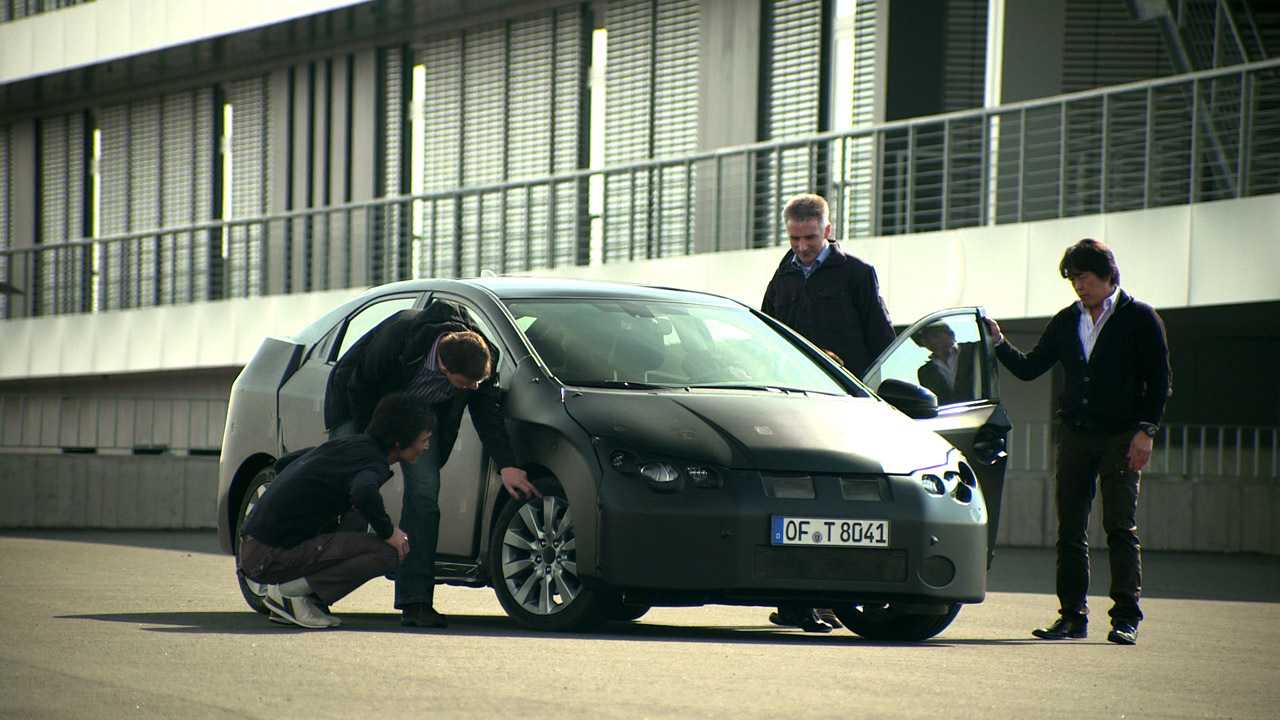
New Honda Civic preview

     The new Honda Civic generation will have its world premiere la the 2011 Frankfurt motorshow.Until then the car is hidden under camouflage but in the following video its engineers offer us some details.

Porsche 911

The Porsche 911 (pronounced as Nine Eleven, German: Neunelfer) is a luxury 2-door sports coupe made by Porsche AG of Stuttgart, Germany. It has a distinctive design, rear engined and with independent rear suspension, an evolution of the swing axle on the Porsche 356. The engine was also air-cooled until the introduction of the Type 996 in 1998. Since its introduction in autumn 1963,[1] it has undergone continuous development, though the basic concept has remained little changed.[2]
Throughout its lifetime, the 911 has been modified by private teams and by the factory itself for racing, rallying and other forms of automotive competition. It is among the most successful competition cars ever. In the mid 1970s, normally aspirated 911 Carrera RSRs won major world championship sports car races such as Targa Florio, Daytona, Sebring and Nürburgring, even against prototypes. The 911-derived 935 turbo also won the coveted 24 Hours of Le Mans in 1979.
In the 1999 international poll for the award of Car of the Century, the 911 came fifth.[3] It is one of two in the top five that had remained continuously in production (the original Beetle remained in production until 2003),[4] and was until 1998 the most successful surviving application of the air- (now water-) cooled opposed rear engine layout pioneered by its original ancestor, the Volkswagen Beetle. It is one of the oldest sports coupe nameplates still in production.

Porsche 911 classic (1963–1989)

The 911 can trace its roots back to sketches drawn by Ferdinand "Butzi" Porsche in 1959.[5] The Porsche 911 classic was developed as a much more powerful, larger, more comfortable replacement for the Porsche 356, the company's first model. The new car made its public debut at the 1963[1] Frankfurt Motor Show (German: Internationale Automobil-Ausstellung).[6] The car presented at the auto show had a non-operational mockup of the 901 engine, receiving a working one in February 1964.[5]
It originally was designated as the "Porsche 901" (901 being its internal project number). 82 cars were built as 901s.[5] However, Peugeot protested on the grounds that in France it had exclusive rights to car names formed by three numbers with a zero in the middle. So, instead of selling the new model with another name in France, Porsche changed the name to 911. Internally, the cars part numbers carried on the prefix 901 for years.[5] Production began in September 1964,[6] the first 911s reached the US in February 1965 with a price tag of US$6,500.
The earliest edition of the 911 had a 130 PS (96 kW; 128 hp)[1] flat-6 engine, in the "boxer" configuration like the 356, air-cooled and rear-mounted, displaced 1991 cc compared with the 356's four-cylinder, 1600 cc unit. The car had four seats although the rear seats were very small, thus the car is usually called a 2+2 rather than a four-seater (the 356 was also a 2+2). It was mated to a four or five-speed manual "Type 901" transmission. The styling was largely by Ferdinand "Butzi" Porsche, son of Ferdinand "Ferry" Porsche. Erwin Komenda, the leader of the Porsche car body construction department, was also involved in the design.
The 356 came to the end of its production life in 1965, but there was still a market for a 4-cylinder car, particularly in the USA. The Porsche 912, introduced the same year, served as a direct replacement, offering the 356's 4-cylinder, 1600 cc, 90 hp (67 kW) engine inside the 911 bodywork.
In 1966 Porsche introduced the more powerful 911S, the engine's power raised to 160 PS (118 kW; 158 hp). Alloy wheels from Fuchs, in a distinctive 5-leaf design, were offered for the first time. In motorsport at the same time, installed in the mid-engined Porsche 904 and Porsche 906, the engine was developed to 210 PS (154 kW).

In 1967 the Targa (meaning "shield" in Italian[7]) version was introduced as a "stop gap" model. The Targa had a stainless steel-clad roll bar, as Porsche had, at one point, thought that the U.S. National Highway Traffic Safety Administration (NHTSA) would outlaw fully open convertibles in the US, an important market for the 911. The name "Targa" came from the Targa Florio sports car road race in Sicily, Italy in which Porsche had notable success, with seven victories since 1956, and four more to come until 1973. This last win in the subsequently discontinued event is especially notable as it was scored with a 911 Carrera RS against prototypes entered by Italian factories of Ferrari and Alfa Romeo. The road going Targa was equipped with a removable roof panel and a removable plastic rear window (although a fixed glass version was offered alongside from 1968).
The 110 PS (81 kW; 108 hp) 911T was also launched in 1967 and effectively replaced the 912. The staple 130 PS (96 kW; 128 hp) model was renamed the 911L. The 911R had a very limited production (20 in all), as this was a lightweight racing version with thin aluminium doors, a magnesium crankcase, twin-spark cylinder heads, and a power output of 210 PS (154 kW).
In 1969 the B series was introduced: the wheelbase for all 911 and 912 models was increased from 2211 to 2268 mm (87 to 89¼ in), an effective remedy to the cars nervous handling at the limit. The overall length of the car did not change: rather, the rear wheels were relocated aft. Fuel injection arrived for the 911S and for a new middle model, 911E. A semi-automatic Sportomatic[8] model, composed of a torque converter, an automatic clutch, and the four speed transmission, was added to the product lineup. It was canceled after the 1980 model year[9] partly because of the elimination of a forward gear to make it a three-speed.[9]
The 2.2 L 911E was called "The secret weapon from Zuffenhausen"[citation needed]. Despite the lower power output of the 911E (155 PS (114 kW; 153 hp)) compared to the 911S (180 PS (132 kW; 178 hp)) the 911E was quicker in acceleration up to 160 km/h (100 mph).

The 1972–1973 model years consisted of the same models, but with a new, larger 2341 cc (142 in³) engine. This is universally known as the "2.4 L" engine, despite its displacement being closer to 2.3 litres. The 911E and 911S used mechanical fuel injection (MFI) in all markets. For 1972 the 911T was carbureted, except in the U.S. and some Asian markets where emission regulations forced Porsche to equip the 911T with mechanical fuel injection. In January, 1973, US 911Ts were switched to the new K-Jetronic CIS (Continuous Fuel Injection) system from Bosch.
With the power and torque increases, the 2.4 L cars also got a newer, stronger transmission, identified by its Porsche type number 915. Derived from the transmission in the Porsche 908 race car, the 915 did away with the 901/911 transmission's "dog-leg" style first gear arrangement, opting for a traditional H pattern with first gear up to the left, second gear underneath first, etc.
911S models also gained a discreet spoiler under the front bumper to improve high-speed stability. With the cars weighing only 1050 kg (2315 lb), these are often regarded as the best classic mainstream 911s. For racing at this time, the 911 ST was produced in limited numbers (the production run for the ST only lasted from 1970 to 1971). The cars were available with engines of either 2466 cc or 2492 cc, producing 270 PS (199 kW; 266 hp) at 8000 rpm. Weight was down to 960 kg (2166 lb). The cars had success at the Daytona 6 Hours, the Sebring 12 Hours, the 1000 km Nürburgring and the Targa Florio.


Porsche 911 Carrera RS, 1973
These models, valued by collectors, are considered by many to be the greatest classic 911s of all-time. RS stands for Rennsport in German, meaning race sport in English. The Carrera name was reintroduced from the 356 Carrera which had itself been named after Porsche's class victories in the Carrera Panamericana races in Mexico in the 1950s. The RS was built so that Porsche could enter racing formulae that demanded that a certain minimum number of production cars were made. Compared with a standard 911S, the Carrera 2.7 RS had a larger engine (2687 cc) developing 210 PS (150 kW; 210 hp) with MFI, revised and stiffened suspension, a "ducktail" rear spoiler, larger brakes, wider rear wheels and rear fenders. In RS Touring form it weighed 1075 kg (2370 lb), in Sport Lightweight form it was about 100 kg (220 lb) lighter, the saving coming from the thin-gauge steel used for parts of the bodyshell and also the use of thinner glass. In total, 1580 were made, comfortably exceeding the 500 that had to be made to qualify for the vital FIA Group 4 class. 49 Carrera RS cars were built with 2808 cc engines producing 300 PS (221 kW).
In 1974, Porsche created the Carrera RS 3.0 with K-Jetronic Bosch fuel injection producing 230 PS (169 kW). It was almost twice as expensive as the 2.7 RS but offered a fair amount of racing capability for that price. The chassis was largely similar to that of the 1973 Carrera RSR and the brake system was from the Porsche 917. The use of thin metal plate panels and a spartan interior enabled the shipping weight to be reduced to around 900 kg (1984 lb).

1976 Porsche 911 2.7

The Carrera RSR 3.0 was sold to racing teams, and scored outright wins in several major sports car races of the mid 1970s. Also, a prototype Carrera RSR Turbo (with 2.1 L engine due to a 1.4x equivalency formula) came second at the 24 Hours of Le Mans in 1975 and won several major races, a significant event in that its engine would form the basis of many future Porsche attempts in sportscar racing. Save for the earlier Porsche 917, it can be regarded as Porsche's start of its commitment to turbocharging also in road cars.

2.7- series (1974-1977)

Model year 1974 saw three significant changes. First, the engine size was increased to 2687 cc giving an increase in torque. Second, was the introduction of impact bumpers to conform with low speed protection requirements of US law, these bumpers being so successfully integrated into the design that they remained unchanged for 15 years. Thirdly, the use of K-Jetronic CIS Bosch fuel injection in two of the three models in the line up— the 911 and 911S models, retaining the narrow rear arches of the old 2.4, now had a detuned version of the RS engine producing 150 PS (110 kW; 150 hp) and 175 PS (129 kW; 173 hp), respectively. The Carrera 2.7 retained the same 210 bhp MFI engine, suspension, brakes etc. as the 1973 Carrera RS. It weighed in at 1075 kg, the same as the RS Touring. The US market Carrera only had the 165 bhp CIS engine owing to emission regulations. The 930 Turbo was introduced in 1975 (see below). The Carrera 3.0 was introduced in 1976 with what was essentially the Turbo's 2994 cc engine minus the turbocharger, and with K-Jetronic CIS although now developing 200 PS (150 kW; 200 hp).
Also produced in the 1976 model year for the U.S. market, was the 912E, a 4-cylinder version of the 911 like the 912 that had last been produced in 1969. It used the I-series chassis and the Volkswagen 2.0 engine from the Porsche 914. In all, 2099 units were produced. In 1976 the front-engine Porsche 924 took this car's place for the 1977 model year and beyond.

Porsche 928


Although Porsche was continuing with the development of the 911, executives were troubled by its declining sales numbers and in 1971 approved work on the Porsche 928. With a front-mounted V8 engine that was considerably more powerful than the contemporary 911s, the larger 928 was not only designed to eclipse its performance, it was designed to be a more comfortable car, a sporty grand tourer rather than a real sports car. The 928 sold reasonably well, and managed to survive from its introduction in 1977 until 1995. Throughout its 17 years, despite its capabilities on the road, it never managed to outsell the 911. Not intended for racing, it achieved little success in the hands of privateers.

911SC (1978–1983)

In 1978, Porsche introduced the new version of the 911, called the 911SC. It featured a 3.0 liter engine with Bosch K-Jetronic fuel injection and a 5-speed 915 transmission. Porsche broke away from using magnesium crankcases like in the late 2.0, 2.2, 2.4, and 2.7 liter engines. This was the start of what are considered by collectors to be the most reliable 911s. In 1981, a Cabriolet concept car was introduced at the Frankfurt Motor Show. Not only was the car a true convertible, but it also featured four-wheel drive, although this was dropped in the production version. The first 911 Cabriolet debuted in late 1982, as a 1983 model. This was Porsche’s first cabriolet since the 356 of the mid-1960s. It proved very popular with 4,214 sold in its introductory year, despite its premium price relative to the open-top targa.[10] Cabriolet versions of the 911 have been offered ever since.
It was during this time, that Porsche AG decided the long-term fate of the 911. In 1979 Porsche had made plans to replace the 911 with their new 928. Sales of the 911 remained so strong however, that Porsche revised its strategy and decided to inject new life into the 911 editions. 911 SC sales totaled 58,914 cars.[10]
Peter W. Schutz (CEO Porsche AG 1981-1987) wrote:The decision to keep the 911 in the product line occurred one afternoon in the office of Dr. Helmuth Bott de:Helmuth Bott, the Porsche operating board member responsible for all engineering and development. I noticed a chart on the wall of Professor Bott’s office. It depicted the ongoing development schedules for the three primary Porsche product lines: 944, 928 and 911. Two of them stretched far into the future, but the 911 program stopped at the end of 1981. I remember rising from my chair, walking over to the chart, taking a black marker pen, and extending the 911 program bar clean off the chart. I am sure I heard a silent cheer from Professor Bott, and I knew I had done the right thing. The Porsche 911, the company icon, had been saved, and I believe the company was saved with it.

911 3.2 Carrera series (1984–1989)

With the 911’s future ensured, 1984 saw the launch of a replacement for the successful SC series. It was the model year 1984 911 3.2 Carrera, reviving the Carrera name for the first time since 1975. The 911 3.2 Carrera was the last iteration in the original 911 series, with all subsequent models featuring new body styling with new brake, electronic and suspension technologies.
A new higher displacement motor, a 3.2 liter horizontally opposed flat 6 cylinder, was utilized. At the time Porsche claimed it was 80% new.[12] The new swept volume of 3164 cc was achieved using the 95 mm (3.7 in) bore (from the previous SC model) combined with the 1978 Turbo 3.3 crankshaft's 74.4 mm (2.9 in) stroke. In addition, higher domed pistons increased the compression ratio from 9.8 to 10.3:1 (although only 9.5:1 for the US market). New inlet manifold and exhaust systems were fitted. The 915 transmission was carried over from the SC series for the first three model years. In 1987, the Carrera got a new five-speed gearbox sourced from Getrag, model number G50 with proven Borg-Warner synchronizers. This slightly heavier version also featured a hydraulically operated clutch.
With the new engine, power was increased to 207 bhp (154 kW; 210 PS) (@ 5900 rpm) for North American-delivered cars and to 231 bhp (172 kW; 234 PS) (@ 5900 rpm) for most other markets. This version of the 911 accelerated 0–60 mph (100 km/h) in 5.4 seconds and had a top speed of 150 mph (242 km/h) as measured by Autocar. Factory times were more modest: 0-60 mph time of 6.3 seconds for the US version and 6.1 seconds for cars outside the American market.
The brake discs were increased in size to aid in more effective heat dissipation and improved oil-fed chain tensioners were fitted to the engine. To improve oil cooling, a finned cooler replaced the serpentine lines in the front passenger fender well. This was further improved in 1987, with the addition of a thermostatically controlled fan.
Driving refinement and motor reliability were improved with an upgrade of the fuel and ignition control components to a L-Jetronic with Bosch Motronics 2 DME (Digital Motor Electronics system). An improvement in fuel-efficiency was due to the DME providing a petrol cut-off on the overrun. Changes in the fuel map & chip programming from October 1986, further improved the power to 217 bhp (162 kW; 220 PS) (@ 5900 rpm) for North American delivered cars as well as for other markets requesting low emissions, like Germany. Custom-mapped chips remain a popular upgrade. The fuel relay that is mounted externally on the DME is known to be a weak point of the system.
Three basic models were available throughout the Carrera years – coupe, targa and cabriolet. When launched in 1984 in the United States, the prices of the 911 Carrera lineup were $31,950 for the coupe, $33,450 for the targa and $36,450 for the cabriolet.[13] Almost indistinguishable from the SC, external clues are the front fog lights, which were integrated into the front valance in the Carrera. Very modest cosmetic changes were made throughout the lifespan of the Carrera, with a redesigned dash featuring larger air conditioning vents appearing in 1986.
In 1984, Porsche also introduced the M491 option. Officially called the Supersport in the UK, it was commonly known as the "Turbo-look". It was a style that resembled the Porsche 930 Turbo with wide wheel arches and the distinctive "tea tray” tail. It featured the stiffer turbo suspension and the superior turbo braking system as well as the wider turbo wheels. Sales of the Supersport were particularly strong for its first two years in the United States because the desirable 930 was not available.
For the European market in Italy a very exclusive version was introduced by the Porsche agent, ten Carrera model ST (Senza Turbo) were produced to commemorate the myth of the 10th anniversary of the Carrera RS model, revised engine developing 255 bhp (190 kW; 259 PS) they were all "Grand Prix white" with red or blue "Carrera ST" decal on each side of the car and blue or red wheels, the logo carrera ST (and 3.2 on the boot gril) on their famous duck tail, and a special engraved plate on the dash board, the serial N° were 490-499.
The 911 Carrera Club Sport (CS) (option M637), 340 of which were produced worldwide from August 1987 to September 1989, is a reduced weight version of the standard Carrera that, with engine and suspension modifications, was purpose built for club racing. The CS had a blueprinted engine with hollow intake valves and a higher rev limit, deletion of: all power options, sunroof (except one example), air conditioning (except two examples), radio, rear seat, undercoating, sound insulation, rear wiper, door pocket lids, fog lamps, front hood locking mechanism, engine and luggage compartment lights, lockable wheel nuts and even the rear lid "Carrera" logo, all in order to save an estimated 70 kg (155 lb) in weight. With the exception of CSs delivered to the UK, all are identifiable by the "CS Club Sport" decal on the left front fender and came in a variety of colors, some special ordered. Some U.S. CS's did not have the decal installed by the dealer; however, all CS's have a "SP" stamp on the crankcase and cylinder head. The UK CS's were all "Grand Prix White" with a red "Carrera CS" decal on each side of the car and red wheels. Although the CS was well received by the club racers, because it cost more than the stock 911 but had fewer "creature comforts", it was not well received by the public in general. Consequently, according to Porsche Club of America and Porsche Club Great Britain CS Registers, only 21 are documented as delivered to the U.S. in 1988 with 7 in 1989, one to Canada in 1988 and 53 to the United Kingdom from 1987 to 1989.

The 911 Speedster (option M503), a low-roof version of the Cabriolet which was evocative of the Porsche 356 Speedster of the 1950s, was produced in limited numbers (2,104) starting in January 1989 until July 1989 as both a narrow body car and a Turbo-look. The narrow version was produced only 171 times. The Speedster started as a design under Helmuth Bott in 1983 but was not manufactured until six years later. It was a two-seat convertible that featured a low swept windshield.[14]
Total production of the 911 3.2 Carrera series was 76,473 cars (35,670 coupé, 19,987 cabrio, 18,468 targa).

964 Series (1990–1994)n late 1989, the 911 underwent a major evolution with the introduction of the Type 964.

Based with many innovative technologies from the 959 model, this would be a very important car for Porsche, since the world economy was undergoing recession and the company could not rely on its image alone. It was launched as the Carrera 4, the "4" indicating four-wheel-drive, a decision that surprised many but demonstrated the company's commitment to engineering by reminding buyers that race and rally engineering (of the 959) does affect road cars. Drag coefficient was down to 0.32. A rear spoiler deployed at high speed, preserving the purity of line when the vehicle was at rest. The chassis was redesigned overall. Coil springs, ABS brakes and power steering made their debut. The engine was increased in size to 3600 cc and developed 250 PS (184 kW). The car was more refined, but thought by some journalists to have lost some purity of the 911's concept. The rear-wheel-drive version, the Carrera 2, arrived a year later.
The 964 incarnation of the 911 Turbo returned in 1990 after an absence from the price lists. Using a refined 3.3 L engine of the previous Turbo, but two years later a turbo engine based on the 3.6 L engine of the other models was introduced.
In 1990, Porsche introduced the ahead-of-its-time Tiptronic automatic transmission in the 964 Carrera 2, featuring adaptive electronic management and full manual control. The 964 was one of the first cars in the world offered with dual airbags standard (from 1991), the first being the Porsche 944 Turbo (from 1987).
In 1992, Porsche re-introduced a limited-edition RS model, inspired by the 1973 Carrera RS and emissions-legal in Europe only. Appeals from American customers resulted in Porsche developing the RS America of which 701 were built. However, while European RS was a homologation special, RS America was an option delete variant of the regular model. The RS 3.8 of 1993 had Turbo-style bodywork, a larger fixed whale tail in place of the movable rear spoiler, and a 300 PS (221 kW) 3746 cc engine.
Since the RS/RS America was intended as a no-frills, higher performance version of the 964, there were only four factory options available: a limited-slip differential, AM/FM cassette stereo, air conditioning, and a sunroof. The interior was more basic than a standard 911 as well; for example the interior door panels lacked the armrests and door pockets and had a simple pull strap for the opening mechanism. Although the RS America was about $10,000 cheaper than a fully equipped C2 at the time of their production, these models now command a premium price on the used market over a standard 964 (RS Europe was about $20,000 more expensive than a C2).

993 Series (1995–1998)

The 911 was again revised in 1993 under the internal name Type 993. This car was significant as it was the final incarnation of the air-cooled 911, introduced in 1964.
The exterior featured an all new front and rear end. The revised bodywork was smoother, having a noticeably more aerodynamic front end somewhat reminiscent of the 959. Styling was by Englishman Tony Hatter under the supervision of design chief Harm Lagaay.

Along with the revised bodywork, mechanically the 993 also featured an all-new multilink rear suspension that improved the car's ride and handling. This rear suspension was largely derived from the stillborn Porsche 989's rear multilink design, and served to rectify the problems with earlier models' tendency to oversteer if the throttle or brakes were applied mid-corner. These modifications also reduced previous 911's lift-off oversteer problems to a much more moderate degree.
The new suspension, along with chassis refinements, enabled the car to keep up dynamically with the competition. Engine capacity remained at 3.6 L, but power rose to 272 PS (200 kW) thanks to better engine management and exhaust design, and beginning with model year 1996 to 286 PS (210 kW). The 993 was the first Porsche to debut variable-length intake runners with the "Varioram" system on 1996 models. This addressed the inherent compromise between high-RPM power production and low-RPM torque production, and was one of the first of its kind to be employed on production vehicles. A new four-wheel-drive made a return as an option in the form of the Carrera 4, the rear wheel drive versions simply being called Carrera. A lightweight RS version saw capacity rise to 3.8 L, with power reaching 300 PS (221 kW). The RS version had rear-wheel drive only.
Non-turbo models appeared that used the Turbo's wide bodyshell and some other components (the Carrera 4S and later the Carrera S).
The rare Targa open-topped model also made a return, this time with a large glass roof that slid under the rear window. The expensive air-cooled 993 Targa had a limited release between 1996–1998.

993 Turbo (1995–1997)

A Turbo version of the 993 was launched in 1995 and became the first standard production Porsche with twin turbochargers and the first 911 Turbo to be equipped with permanent all-wheel-drive (the homologated GT2 retained RWD). The similarity in specification and in performance levels inspired several comparison road tests with the Porsche 959.[16] The 3.6 L twin turbo M64/60 engine produced 408 PS (300 kW).
In 1997, Porsche introduced a limited run of 182 copies of the 993 911 Turbo S with even higher performance. The additions include a boost of 24 PS (17.7 kW) over the regular Turbo's 400 PS (294 kW). There are some modifications to the body as well, which includes a scoop on the side right behind the doors for engine cooling and vents on the whale tail rear spoiler.
993 Turbo models, because of raw power, reliability and their nature as the final air-cooled 911 Turbo cars still command a massive premium.

996 Series (1998–2005)

After 34 years in production the famous air-cooled 911 was replaced by an all-new water-cooled model. Known as the Type 996, this car was a major leap for Porsche, although many of the traits that defined the 911 during past decades still remained. With the new model there was finally a newly designed bodyshell (all previous 911s being based on the original 1963 shell). As with the 993 before it the 996 was also a significant model, but mainly for the way it was conceived and designed, and the effect it had on Porsche during the 1990s.
Pundits criticized the 996's styling a great deal, largely because it shared its headlamps— indeed much of its front end, mechanically— with the less expensive Boxster. The 996 had been on the drawing board first and was a more advanced car in some respects, but the cost-cutting seemed inappropriate for an expensive car. Otherwise, the Pinky Lai-penned shape followed the original Butzi Porsche design very closely; the Carrera model had a 0.30 Coefficient of drag. The interior was further criticized for its plainness and its lack of relationship to prior 911 interiors, although this came largely from owners of older 911s.
The Type 996 spawned over a dozen variations, including all wheel drive Carrera 4 and Carrera 4S (which had a 'Turbo look') models, the club racing-oriented GT3, and the forced-induction 996 Turbo and GT2. The Turbo, four-wheel-drive and twin-turbo, often made appearances in magazines' lists of the best cars on sale.


996 GT3 RS
The Carrera and Carrera 4 underwent revisions for model year 2002, receiving the front headlight/indicator lights which were first seen on the Turbo version two years earlier. This allowed the 911 to be more distinguishable from the Boxster. A mildly revised front fascia was also introduced, though the basic architecture remained.
A limited number (1963) of 2004 40th Anniversary Editions include a more powerful 345-horsepower engine, a standard Porsche Stability Management system (PSM), enhanced acceleration due to a mechanical rear axle differential lock, more aggressive suspension tuning. Painted GT Silver metallic, the 40th Anniversary edition of the 2004 Porsche 911 Carrera has front air cooling openings like the Porsche 911 Turbo, body-color air intake grilles, unique sill trim and an aluminum 911 logo on the engine cover, polished 18-inch wheels, and high-gloss chromed tailpipes. Other equipment on this limited production model includes a power sunroof and bi-Xenon headlights with dynamic beam angle control and lens cleaners. Inside the 40th Anniversary 911 Carrera, dark gray leather sport seats include two-stage heating, special silver metallic and aluminum interior trim and a numbered plaque on the center console. Ref: 'Autobytel.com, 2004 Porsche 911 Carrera New Car Buyer's Guide'.
Engine wise, displacement was 3.4 L and power 300 PS (221 kW)featuring dry sump technology and variable valve timing, increased in 2002 to 3.6 L and 320 PS (235 kW).
The roof system on the convertible transformed the car from a coupe to a roadster in 19 seconds. The car is equipped with a rear spoiler that raises at speeds over 120 km/h (75 mph). It can also be raised manually by means of an electric switch.

[edit] US-spec water-cooled 911 Carrera

Starting from the water-cooled engines models, US-spec 911 Carreras don't come with rear limited-slip differential, except the 40th Anniversary 911, GT2, GT3 and Carrera GT. US-spec 911 turbo comes with limited-slip center differential, like the rest of the world.

[edit] 996 GT3 (1999–2004)

Porsche unveiled a road-going GT3 version of the 996 series which was derived from the racing GT3. Simply called GT3, the car featured lightweight materials inside and out, including thinner windows, the GT3 was a lighter and more focused 911 with the emphasis on handling and performance. The suspension was lower and more aggressive than other 996s, leading to excellent handling and razor-sharp steering though the ride was very firm. Of more significance was the engine used in the GT3. Instead of using a version of the water-cooled units found in other 996s, the naturally aspirated engine was derived from the Porsche 911 GT1 '98 sports-prototype racing car and featured lightweight materials which enabled the engine to rev highly.
Its engine was a non-turbo 3600 cc F6 rather than either engine from the pre-facelift and revised Carrera. It produced 360 bhp (268 kW; 365 PS) at first, later increased to 381 bhp (284 kW; 386 PS) at the whole 996 series' revision.
The GT3 did not feature rear seats.
In 2000, Porsche launched the Turbo version of the Type 996. Like the GT3, the new Turbo engine derived from the 911 GT1 engine and, like its predecessor, featured twin-turbos and now developed 420 PS[17] (309 kW). Also like its predecessor the new Turbo was only available with all wheel drive. A US$17,000 factory option, the X50 package, was available that boosted the engine output to 450 PS (331 kW) with 620 N·m (457 ft·lbff) of torque across a wide section of the power band. With the X50 package in place the car could make 0–100 km/h (0–62 mph) in 3.8 seconds. This package is named as Turbo S in Europe. Later on toward the end of the 996 life cycle, a 996 Turbo S coupe also returned to the US along with a new debut of the Turbo S Cabriolet boasting even more power— 450 PS (331 kW) and 620 N·m (457 ft·lbff)— than the regular Turbo. The Turbo can reach a top speed of 189 mph (304 km/h).[17]
Styling-wise, the car was more individual than previous Turbos. Along with the traditional wider rear wings, the 996 Turbo had different front lights and bumpers when compared to the Carrera and Carrera 4. The rear bumper had air vents that were reminiscent of those on the Porsche 959 and there were large vents on the front bumper, which have been copied on the Carrera 4S and Cayenne Turbo.

997 Series (2005–present)

In 2005, the 911 was heavily revised and the 996's replacement, the 997, was unveiled. The 997 keeps the basic profile of the 996, bringing the drag coefficient down to 0.28, but draws on the 993 for detailing. In addition, the new headlights revert to the original bug-eye design, drifting from the teardrop scheme of the 996. Its interior is also similarly revised, with strong links to the earlier 911 interiors while at the same time looking fresh and modern. The 997 shares less than a third of its parts with the outgoing 996, but is still technically very similar to it.
Initially, two versions of the 997 were introduced— the rear wheel drive Carrera and Carrera S. While the base 997 Carrera produced 325 PS (239 kW) from its 3.6 L Flat 6, a more powerful 3.8 L 355 PS (261 kW) Flat 6 powers the Carrera S. Besides a more powerful engine, the Carrera S also comes standard with 19 inch (48 cm) "Lobster Fork" style wheels, more powerful and larger brakes (with red calipers), a more sporty suspension, complete with PASM (Porsche Active Suspension Management) which allows for electronic adjustability of suspension settings, Xenon Headlamps, and Sport Steering wheel.
In late 2005, Porsche announced the all wheel drive versions to the 997 lineup. Carrera 4 models (both Carrera 4 and Carrera 4S) were announced as 2006 models. Both Carrera 4 models are wider than their rear wheel drive counterparts by 1.26 inches (32 mm) to cover wider rear tires. 0–60 mph (97 km/h) for a base Carrera 4 with the 325 PS (239 kW; 321 hp) engine was reported at 4.5 seconds according to Edmunds.com. The 0–100 km/h (62 mph) acceleration for the Carrera S with the 355 PS (261 kW; 350 hp) was noted to be as fast as 4.2 seconds in a recent Motor Trend comparison, and Road & Track has timed it at 3.8 seconds. The 997 lineup includes both 2 and 4 wheel drive variants, named Carrera 2 and Carrera 4 respectively. The Targas (4 and 4S), released in November 2006, are 4-wheel drive versions that divide the difference between the coupes and the cabriolets with their dual, sliding glass tops.
There were rumours that the 997 911 was to undergo an update for the 2008 model year, however these changes were held off until the 2009 model year. The official changes, originally found in leaked product guides,[18] indicate the new 997 will receive a larger air intake in the front bumper, new headlights, new rear lights, new direct fuel injection engines built from the ground up, and the introduction of a dual-clutch gearbox called PDK.[19] Porsche USA revealed that the 2009 models due out in April would be equipped with Bluetooth support in the communications system.

997 Turbo

The Turbo version of the 997 series featured the same 3.6 L twin-turbocharged engine as the 996 Turbo, but this time it developed 480 PS (353 kW; 473 bhp) and 620 N·m (457 lb·ft) of torque. This was in part due to the 997's VTG (variable turbine geometry), which essentially combines the low-rev boost and quick responses of a small turbocharger with the high-rev power of a larger turbocharger. As well as producing more power and flexibility, the new turbocharger improved fuel consumption over the 996 Turbo. With these performance upgrades, it accelerates to 100 km/h (62 mph) in 3.7 seconds (with the manual transmission) and reaches a top speed of 310 km/h (193 mph). However, these are official figures and Porsche is notable for being conservative about their power and performance ratings. Motor Trend Magazine has clocked the 997 Turbo's 0–60 mph time in 3.2 seconds with the Tiptronic transmission. Jeremy Clarkson on his "Thriller" dvd, showed that on a de-restricted stretch of autobahn with just the right downwards gradient, the car maxed out 200 mph (320 km/h). The optional Sports Chrono overboost package increases torque to 680 N·m (500 lb·ft) for short periods (maximum 10 seconds) but over a narrower rev range.


997 GT3
The 997 Turbo features a new all wheel drive system, similar to the one found on the Porsche Cayenne. Featuring PTM (Porsche Traction Management) the new system incorporates a clutch-based system which varies the amount of torque to the wheels to avoid tyre slippage. This, according to Porsche, aids traction and the handling by redirecting the torque to control oversteer or understeer, thus resulting in far more neutral handling, as well as greatly improved performance in all weather conditions (as opposed to older AWD system which gave the Turbo stability under hard acceleration). However, in the facelifted 911 Turbo, launched in August 2009, [1] the PTM system has now been tweaked to give more a more rearward power bias. The new 911 Turbo also has paddle shifters for the PDK double-clutch gearbox for the first time [2]. The new 911 turbo uses a completely different engine. The previous water cooled turbos (996 and 997) measured 3600cc and were based on the so called Mezger motor that powered numerous race cars. The new engine measures 3800cc and was first developed for the new carrera that was launched in 2008. The variable-vane twin turbochargers have also been extensively reworked to increase responsiveness, and the intercooler and fuel system have been uprated. It develops 493 bhp which is 20 bhp more than the previous model.[3]. The steering wheel also houses a display showing when Sport, Sport Plus and launch control have been selected through the optional Sport Chrono package. [4]
Styling wise, as with the 996 Turbo the car featured more distinctive styling cues over the Carreras, one of the more distinctive elements the front LED driving/parking/indicator lights mounted on a horizontal bar across the air intakes. The traditional rear wing is a variation of the 996 bi-plane unit.
A new 911 Turbo S has been announced by Porsche for production in 2010. This is, in essence, a fully optioned Porsche 911 Turbo. It has a PDK gearbox, sport exhausts, and other such options as standard. It also comes with re engineered turbos to give an extra 30 horsepower. A 2010 911 Turbo was tested 0-60 in 2.7 seconds with the PDK transmission by Car and Driver magazine. Road & Track tested the 911 Turbo S and achieved a 0-60 time of 2.6 seconds.
See article on the new Porsche 911 http://carslover2k11.blogspot.com/2011/07/porsche-911-2012.html

Awards

In 2004, Sports Car International named the 911 number three on the list of Top Sports Cars of the 1960s, the Carrera RS number seven on the list of Top Sports Cars of the 1970s, and the 911 Carrera number seven on the list of Top Sports Cars of the 1980s. In addition, the 911 was voted Number 2 on Automobile Magazine's list of the "100 Coolest Cars". The 997 was nominated for the World Car of the Year award for 2005.


This are spy photos of the newest generation.See official info at:http://carslover2k11.blogspot.com/2011/07/porsche-911-2012.html


 Courtesy to Wikipedia as always.


Related Posts Plugin for WordPress, Blogger...