Showing posts with label God bless AMERICA. Show all posts

Lincoln MKZ


The Lincoln MKZ, initially named the Lincoln Zephyr, is a mid-size, entry-level luxury car from the Lincoln division of the Ford Motor Company. Lincoln revived the Zephyr name in the fall of 2005 as a platform-mate for the Ford Fusion and Mercury Milan; the vehicles were based on the CD3 platform, which was derived from the Mazda 6. The Zephyr's sole powertrain was a 3.0 L DOHC Duratec V6 mated to an Aisin 6-speed automatic transmission; identical to the V6 powertrain that was optional in the Fusion and Milan. Visually, the Zephyr could be easily distinguished from its Ford and Mercury siblings thanks to unique fascias and other stylistic elements, but as much as 35% of its body panels were shared with the other cars. However, the interior is entirely unique to the Lincoln, and this, along with different equipment packaging, helped differentiate the brands. Reflecting its entry-level luxury position, the 2006 Zephyr started at a base MSRP of $29,995 USD, ranging up to $35,575 USD when fully optioned.[2]
Though slightly smaller and natively front-wheel drive, the Zephyr was marketed as a replacement for Lincoln's previous entry level mid-size, the rear-wheel drive, V8-equipped Lincoln LS. To facilitate a smooth transition, the Zephyr and LS were sold parallel to each other during the 2006 model year, the first model year of the Zephyr and the last for the LS. Ironically the Zephyr's first model year was also its last, in name. For 2007 the car was renamed MKZ, and took over the LS' market with sales beginning in September 2006. Lincoln's decision to resurrect the Zephyr name refers to the very early days of Lincoln before World War II. At that time, the only Lincoln manufactured was the Lincoln K-series which was a full-size sedan, and Lincoln, under the direction of Edsel Ford, Henry Ford's only son, hoped to indroduce a smaller product to compete with the LaSalle, a smaller sibling offered at Cadillac dealerships. The Zephyr moniker was discontinued after a year, switching to MKZ to align with Lincoln's alphanumeric naming strategy. Previously during the early 1980s, the Zephyr name reappeared on a compact sedan called the Mercury Zephyr, a twin of the Ford Fairmont, however the Mercury Zephyr was replaced after a short period of time with the Mercury Topaz, itself a twin of the Ford Tempo.
Highlighting the MKZ for 2007, other than the new name, was a mild exterior refresh, optional all-wheel drive, and a larger displacement engine with more power. The MKZ name followed a new nomenclature used at Lincoln for new vehicles beginning in the 2007 model year (existing models such as the Navigator and Town Car have been unaffected thus far). Ford initially intended the "MK" to represent an abbreviation of its traditional "Mark" naming series, but has since abandoned that in favor of simply reading the letters.[3] The Lincoln MKZ (and the Zephyr before it) is built at Ford's Hermosillo, Sonora, Mexico, plant.
The MKZ was the first in this series of new "MK"-named Lincolns, and has since been followed by the MKX, MKT and MKS. For 2010 the MKZ was revised with new exterior and interior styling along with other new features. A version hybrid was launched in the U.S. market in September 2010, becoming EPA's most fuel efficient luxury sedan in the U.S. until the release of the 2011 Lexus CT 200h.[4][5] The MKZ Hybrid is also the first (as and of July 2011, the only) hybrid in the market priced the same as its conventional gasoline-engine version (although the hybrid model's engine has two fewer cylinders than the gasoline-engine model).

MKZ (2010–present)
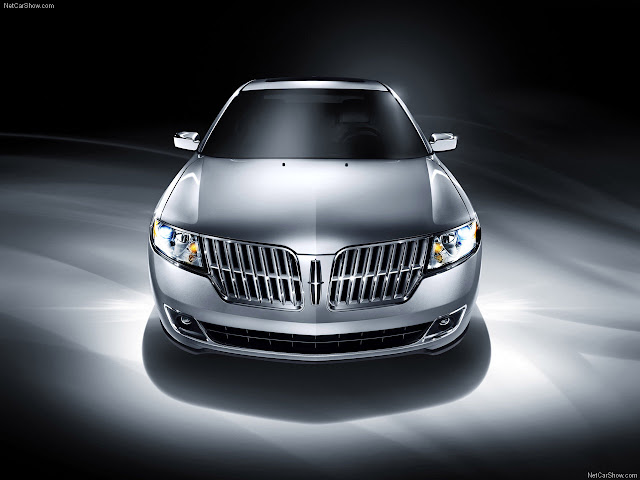
The 2010 MKZ was unveiled at the 2008 Los Angeles International Auto Show, revealing an extensive update with a revised interior and exterior in addition to new features. The MKZ's exterior was updated with an emphasis on the front and rear fascias. In the front, the MKZ's headlights are new while its fascia and split-wing grille closely resembles that of the Lincoln MKS, which was in turn inspired by the styling of the Lincoln MKR concept. In the rear, the taillights have been revised to be longer and thinner, similar to the original Zephyr concept. The MKZ's standard and optional 17-inch wheels have been restyled again and are supplemented with a new 18-inch wheel option. Inside, the MKZ's interior is all-new stylistically but continues to extensively use real wood accents and metal surfaces. Higher quality Bridge of Weir leather seating surfaces are standard. Other features new for 2010 include a reverse camera system, Sirius Travel Link, a DVD-based satellite navigation system updated to accept voice commands, rain-sensing windshield wipers, a cabin air filter, and adaptive HID headlights. Mechanically, the MKZ features new suspension tuning to further improve ride quality and handling and a new SelectShift 6-speed automatic transmission that improves acceleration. The 2010 MKZ was released during the Spring of 2009.The 2011 MKZ Hybrid was unveiled at the 2010 New York International Auto Show[17] and sales began in September 2010.[18] It is the first Lincoln hybrid electric vehicle and the first Lincoln model with a 4-cylinder engine and delivers an EPA city rating of 41 mpg-US (5.7 L/100 km; 49 mpg-imp) and a highway rating of 36 mpg-US (6.5 L/100 km; 43 mpg-imp), which made it the most fuel efficient luxury sedan in the U.S. until the release of the 2011 Lexus CT 200h in March 2011.[4] The Lincoln MKZ Hybrid carries over the hybrid powertrain from the Ford Fusion and Mercury Milan hybrids, including the 2.5 L Duratec I4 with electric motor producing a total of 191 hp (142 kW).[17][19] The Lincoln MKZ Hybrid has an E.V. mode that allows the car to travel short distances on electricity alone, at speeds up to 47 mph (76 km/h).[6] The MKZ Hybrid offers an improvement of Ford's Smart Gauge with EcoGuide, first introduced in the 2010 Fusion Hybrid.The MKZ Smart Gauge version offers a new "Flower" design compared to the "Leaf" design of the Fusion. In essence, the car rewards you with flower blossoms for economic driving/driving habits.
The Lincoln MKZ Hybrid is marketed by Ford as a competitor to the Lexus HS 250h, and as of July 2011 it is the only hybrid in the market with the same price as its conventional gasoline-engine version of the car.[6][20] Ford reported that until June 2011, about 20% of 2011 MKZ sales have been hybrids, and the market share is even higher in markets where hybrids in general sell well, such as the Los Angeles region, where sales of the hybrid model represent 44%, and the San Francisco area, with a market share of 66%.[6] The MKZ Hyrid base price is US$35,520, and with popular options including a sunroof, navigation system, blind spot monitors, a THX surround-sound stereo and a backup camera the price rises to US$41,370.[6]
A complete redesign of the Ford Fusion line-up is schedule for model years 2013.[21] Both the Lincoln MKZ and the Fusion Hybrid are expected to use a new compact lithium-ion batterypack and an updated powertrain that is expected to deliver a higher fuel economy of up to 47 to 48 mpgUS (4.9 to 5.0 L/100 km; 56 to 58 mpgimp) highway. The next generation Lincoln MKZ Hybrid is expected to be launched by mid-2012.[22][23]
The MKZ Hybrid was one of the five finalists for the 2011 Green Car of the Year awarded by the Green Car Journal in November 2010, which was won by the Chevrolet Volt.[24] In its 2011 Hybrid Scorecard, the Union of Concerned Scientists (UCS) ranked the MKZ Hybrid, together with the Lexus CT200h, as the top luxury hybrid models in the scorecard’s environmental improvement category, an achievement the UCS attributed to their relatively small gasoline engines.[25] Nevertheless, the Lincoln MKZ Hybrid ranked higher than the Lexus on all factors: consumer value, hybrid technology, fuel efficiency and pollution reduction. Also, the UCS praised the MKZ Hybrid, together with the Hyundai Sonata Hybrid, because both hybrids are available with few or no forced features that inflate the cost without adding to fuel savings or reducing emissions.[6] The UCS's Hybrid Scorecard ratings for the MKZ Hybrid are higher than the non-luxury Toyota Prius for environmental performance, and hybrid vale; both are rated the same for forced features; and the Prius scores higher in fuel economy.

Ford Explorer

The Ford Explorer is a full-size crossover SUV sold in North America and built by the Ford Motor Company since 1990, as a replacement for the smaller but related Ford Bronco II. It is manufactured in Chicago, Illinois (it was also assembled in Hazelwood, Missouri until the plant closed on March 10, 2006). The Ford Explorer was instrumental in turning the SUV from a special-interest vehicle into one of the most popular vehicle types on the road. It is marked as a mid-sized crossover SUV and is slotted between the larger Ford Expedition and the smaller Ford Escape.
The Explorer has also been involved in controversy, after a spate of fatal rollover accidents involving Explorers fitted with Firestone tires. Both two-door Explorer Sport and four-door models of Explorer have been sold. Part-time four-wheel drive is an available option, and since 1995 this has been a 'shift on the fly' system with full protection against being engaged at high speed. A specially modified Special Service Vehicle version is also available from Ford Fleet for law enforcement agencies, fire departments, and EMS agencies. Explorer was also the name of a trim package offered on the Ford F-Series trucks from 1968 to 1986. The 2011 Ford Explorer was named North American Truck of the Year.

Fifth generation (2011–)

The fifth generation 2011 Explorer takes cues from the Explorer America concept's construction, and includes a monocoque (unibody) structure based on the D4 platform, a modified version of the D3 platform.[12][13] The new Explorer features blacked-out A, B, and D-pillars to produce a floating roof effect similar to Land Rover’s floating roof design used on its sport utility vehicles. Ford already uses this floating roof design on the Ford Flex. The Explorer's C-pillar remains body colored. It also gets sculpted body work with stepped style headlamps similar to the Flex, Edge, Escape, Expedition and F-150. In addition, the Explorer receives new stepped style tail lamps. The grille will receive the corporate three-bar design with upper and lower perforated mesh work, similar to that of the sixth-generation Taurus.
The Explorer's chief design engineer is Jim Holland, who was also a chief design engineer for Land Rover. Holland is responsible for the design of the current generation Land Rover Range Rover (L322). Holland also worked on the outgoing Ford Expedition (U324) during its initial development.[14]
The fifth generation 2011 Explorer, developed under the U502 program code name,[15] made its debut online on July 26, 2010. Ford had set up a Ford Explorer Facebook page ahead of its debut.[16] Assembly of the fifth-generation Explorer moved to Ford's Chicago Assembly plant, where it is built alongside the Ford Taurus and Lincoln MKS. The Louisville plant, where the previous generation was built, was converted to produce cars based on Ford's global C platform (potentially including the Ford Focus, Ford C-Max, and Ford Kuga).[17] Like the Escape, the Explorer will continue to be marketed as an "SUV" rather than a "crossover SUV". It went on sale in early 2011; pre-launch sales had by the end of November 2010 totaled around 15,000.[18]

Features

Available features include intelligent access with push button start, remote engine start, power liftgate, power adjustable pedals with memory, premium leather trimmed seating, heated and cooled front seats, dual headrest DVD entertainment system, adaptive cruise control, active park assist, SIRIUS Travel Link, MyFord Touch, Ford SYNC by Microsoft, Sony audio system with HD radio and Apple iTunes tagging, in-dash advanced navigation system, SoundScreen laminated acoustic and solar tinted windshield with rain-sensing wipers, 20-inch polished V-spoke aluminium wheels, high intensity discharge (HID) headlamps and LED tail lamps.


Capability

The Explorer is available in either front-wheel-drive or full-time four-wheel-drive. Only one engine was initially available: a standard 3.5 Liter TiVCT twin independent variable camshaft timing V6 (290 hp, 255 lb·ft (346 N·m) of torque) mated to a 6-speed 6F automatic with a 6-speed 6F SelectShift automatic as a option.
A second optional engine will become available in 2011: a 2.0 liter EcoBoost turbocharged, direct injected I-4 (237 hp, 250 lb·ft (340 N·m) of torque) mated to a 6-speed 6F automatic. The I-4 engine will not be available with the optional 6-speed 6F SelectShift automatic and will only be available in front-wheel-drive form.[19][20]
The Explorer is available with full-time Intelligent four-wheel drive using open front & rear differentials with 3.39:1 gearing and an electronic center coupling by Haldex. The electronic center coupling controls the front-to-rear torque distribution (torque split) between the front & rear drive wheels and acts as a center differential to allow for full-time operation. The power take off (PTO) unit has a heavy-duty dedicated cooling system to allow the front drive based, four-wheel drive system to supply continuous non-stop torque delivery to all four wheels indefinitely without overheating.[21] "4WD" badging is also included on the rear liftgate.[22][23] Explorer’s overall off road crawl ratio is 15.19:1 with high range gearing only.
Off road electronics include Hill Descent Control (HDC), Hill Ascent Assist (HAA), 4-wheel electronic traction control and Terrain Management.
4-wheel electronic traction control (ABS braking) is employed to force the open front & rear differentials to behave like limited-slip differentials, transferring torque from side-to-side.[21] In the right conditions, the Explorer can keep moving even if only one front wheel has traction.
Terrain Management will include four selectable modes. Each mode can be selected via a rotary control dial on the center console, aft of the transmission shifter.

Hummer H3

The Hummer H3 was a crossover SUV/Sport Utility Truck from General Motors' Hummer division introduced in 2005 based on the GMT355 underpinning the Chevrolet Colorado and GMC Canyon compact pickup trucks. Produced at GM's Shreveport, Louisiana factory and the Port Elizabeth plant in South Africa the H3 was the smallest among the Hummer models, and the first to be built by GM. It was available either as a traditional midsize SUV or as a midsize pickup known as the H3T.

Powertrains

The H3 was launched with a 3.5 liter straight-5 cylinder L52 engine that produced 220 hp (160 kW) and 225 ft·lbf (305 N·m) of torque and was mated to a standard five-speed manual transmission or an optional Hydra-Matic 4L60-E four-speed automatic transmission. In 2007 this engine was replaced by 3.7 liter LLR that produced 242 hp (180 kW) and 242 ft·lbf (328 N·m) of torque, figures that were revised in 2009 to 239 hp (178 kW) and 241 ft·lbf (327 N·m). Under revised EPA testing standards when equipped with either transmission this straight-5 engine achieved 14 mpg-US (17 l/100 km) in the city and 18 mpg-US (13 l/100 km) on the highway with a combined average of 15 mpg-US (16 l/100 km). Available solely with the automatic transmission, a 5.3 liter LH8 V8 engine producing 300 hp (220 kW) and 320 ft·lbf (430 N·m) of torque was added in 2008 for the Alpha model and delivered slightly lower fuel economy, estimated at 13 mpg-US (18 l/100 km) in the city, 16 mpg-US (15 l/100 km) on the highway, with a combined average of 14 mpg-US (17 l/100 km).[3]

Safety

Electronic stability control, anti-lock four-wheel disc brakes, brake-controlled traction control, LATCH child-seat anchors, and tire-pressure monitoring were standard features on the H3. Side-curtain airbags were optional until 2008 when they were made standard across. The H3 was rated Acceptable, the second highest rating, by the Insurance Institute for Highway Safety in both frontal offset and side-impact crashes (with side airbags) and Poor, the lowest rating, for rear-crash protection/head restraints.[4]
The U.S. National Highway Traffic Safety Administration (NHTSA) gave the 2008 H3 the following scores:
Frontal Driver: 5/5 stars
Frontal Passenger: 4/5 stars
Side Driver: 5/5 stars
Side Rear Passenger: 5/5 stars
AWD Rollover : 3/5 stars

Capabilities

The H3 featured a two-speed, electronically controlled full-time four-wheel drive system that made it suitable for both on-road and off-road driving. Electronic locking front and rear differentials were optional. The Hummer H2, the H3 can ford 24 inches (610 mm) of water (tested in depths up to 31 in/790 mm) at a speed of 5 miles per hour (8.0 km/h) and 16 inches (410 mm) of water at a speed of 20 miles per hour (32 km/h). Standard ground clearance is measured at 9.7 inches (250 mm) while the approach, departure, and breakover angles are measured at 37.4°, 34.7°, and 22.1° respectively, allowing the H3 to scale a 16-inch (410 mm) vertical wall and negotiate grades of 60% and side slopes of 40%. Front and rear recovery hooks were standard, with an optional trailer hitch and wiring harness.
Maximum towing capacities were 3,000 pounds (1,400 kg) for the straight-5 with manual transmission, 4,500 pounds (2,000 kg) for the straight-5 with automatic transmission, and 6,000 pounds (2,700 kg) for the V8 with automatic transmission. Cargo volume with the second-row seats in the upright position was 25.0 cubic feet (0.71 m3) that could be expanded to a maximum of 62.8 cubic feet (1.78 m3) when the seats are folded down. V8 models featured the lightest maximum payload capacity of just over 1,100 pounds (500 kg) while straight-5, manual transmission models allowed the greatest payload at 1,300 pounds (590 kg).

Ford Taurus SHO

The Ford Taurus SHO (Super High Output[1]) is a full-size performance sedan based on the Ford Taurus that was originally produced by the Ford Motor Company from 1989 until 1999. It returned in 2009 for the 2010 model year.[2]
The SHO (spoken as "ess ayche o") was built by the same team that produced the Ford Mustang SVO. It was originally created as a limited production model for 1989 through 1993. However, the car proved to be very popular and quickly sold its planned 15,519 units in its first model year,[3] leading Ford to order more engines and begin series production.[4] The SHO would go on to be produced for ten years in three generations, totaling 106,465 vehicles as of late 1999.[3]
Production ended after the 1999 model year due to a decline in popularity, in which Ford decided to not produce a SHO version of the fourth generation Taurus; in 1999, just over 3,000 SHOs were sold, which was only a sixth of the SHO's sales numbers from ten years prior.[3] Today, the SHO enjoys a cult following among performance car enthusiasts, due to its relation to the Taurus, which classifies it as a "Sleeper".

Fourth generation (2010–present)

A month after the introduction of the sixth generation Taurus, Ford unveiled the much-awaited return of the SHO at the 2009 Chicago Auto Show.[13]
After skipping two Ford Taurus generations, the resurrected sport sedan has all-wheel drive and is largely derived from the Ford D3 platform. It features a 3.5 liter direct-injected twin-turbo EcoBoost V6 producing 365 hp (272 kW) at 5500 rpm and 350 lb·ft (475 N·m) of torque at 1500-5250 rpm,[14] mated to Ford's 6F55 [15] six-speed SelectShift semi-automatic transmission with a paddle- or console-activated Manual mode.
The new SHO comes with Ford's new SR1 suspension setup with MacPherson front struts and a multi-link design in the rear. This includes SHO-specific shock absorbers, springs, stabilizer bars and strut mount bushings. An optional Performance Package offers better brake pads, recalibrated steering, a "Sport Mode" for the stability control and shorter 3.16 to 1 final drive ratio.
Visually, the differences from the regular Taurus are subtle. It is encompassed by a dark grey grille finish that matches the larger wheels, a decklid spoiler, dual chrome exhaust tips, new parking lamp bezels, an EcoBoost rear logo, and an SHO C-Pillar logo.[2][16]


Awards

The 2010 Taurus SHO was named Car of the Year by Esquire magazine.

Dodge Charger SRT8

The new product onslaught continues for the Dodge brand with the announcement at the 2011 Chicago Auto Show that the Dodge Charger SRT8 will return for the 2012 model year.
"We're continuing the fast-paced rebuilding of Dodge as our performance brand, and the expansion of our SRT product lineup in 2012 is an important part of our rejuvenation," said Ralph Gilles, President and CEO, Dodge Brand — Chrysler Group LLCs. "The new 2012 Dodge Charger SRT8 builds on the iconic four-door fastback coupe design of the all-new Charger and adds a much larger power band across the rpm range, along with intelligent performance attributes and safety and creature comforts for customers who are passionate about performance driving."
The 2012 Dodge Charger SRT8 will be built at the Brampton Assembly plant in Brampton, Ontario, Canada and will be in dealer showrooms in late 2011.
"AWE-INSPIRING" POWERTRAIN
Under the hood, the new 6.4-liter HEMI® V-8 delivers more horsepower and torque than the 6.1-liter HEMI V-8 it replaces. It also will offer improved fuel economy.
Estimated power ratings for the 2012 Dodge Charger SRT8 are 465 horsepower and 465 lb.-ft. of torque, including an estimated additional 80 lb.-ft. of torque at 2,900 rpm. Specific horsepower, torque and fuel economy numbers will be announced closer to the vehicle introduction.
Building upon the standard Fuel Saver technology (four-cylinder mode) found in the new 6.4 HEMI V-8, a new for 2012 adaptive valve exhaust system allows the technology to engage over a wider rpm range, which delivers improved fuel efficiency or the use of all eight cylinders when the power is needed.
An active intake manifold and high-lift camshaft with cam phasing provides maximum low-end torque for impressive standing starts while optimizing high-end power.
For the first time in any Chrysler Group LLC SRT product, standard paddle-shift technology joins the standard AutoStick on the floor shifter. Both are mated to the proven W5A580 five-speed automatic transmission, allowing a choice of spirited shifting on the road and the racetrack.
Both shifting methods give the driver the ability to shift while the transmission controller calibration prevents situations that might over rev the engine. Fully adaptive electronic control of all shifting makes the powertrain more responsive while minimizing harshness.
OUTSTANDING RIDE AND HANDLING
New for 2012, the Dodge Charger SRT8 features an adaptive damping suspension that uses a wide range of on-road and driver inputs, such as vehicle speed, steering angle, steering speed, brake torque, throttle position and lateral acceleration, to automatically tune the suspension for specific conditions. Drivers also can manually choose between "Auto" and "Sport" settings that quickly change the shock damping and harshness characteristics from the ease of everyday commuting to harsher, more challenging driving situations.
The performance SRT-tuned, fully hydraulic steering system also is improved with a new, heavy-duty pump and revised gearing to give drivers more direct feel and on-center response.
New, split five-spoke, 20-inch lightweight forged and polished aluminum wheels with black painted pockets provide great looks, and the available three- or four-season tires make the 2012 Dodge Charger SRT8 easy to handle and fun to drive.
OUTSTANDING BRAKING
World-class stopping power for the 2012 Dodge Charger SRT8 comes through four-piston Brembo calipers and vented/slotted rotors measuring 14.2 inches up front and 13.8 inches in the rear.
The Dodge Charger SRT8's Ready Alert Braking system anticipates situations when the driver may initiate an emergency brake stop and engages the electronic stability control pump to set brake pads against rotors in order to decrease the time required for full brake application.
AGGRESSIVE AND FUNCTIONAL EXTERIOR
Exclusive new front and rear fascias, along with a new rear spoiler, distinguish the 2012 Dodge Charger SRT8 with a high performance look.
The front grille, grille surround and Dodge crosshair feature high-gloss black finishes and the SRT badge. A newly sculpted hood features a 6.4 L (liter) badge and black air exhauster for added engine cooling.
In the rear, the Charger's new signature "racetrack" taillamp design with 164 illuminating LEDs receives new 4-inch round dual exhaust tips and an SRT8 decklid badge to boldly show the Street and Racing Technology DNA.
Unique fside-sill cladding is painted to match the body color.
A newly designed underbody belly pan features integrated brake ducting to improve cooling and brake fade performance at all four corners.
RACE-INSPIRED AND FUNCTIONAL INTERIOR
Building upon the all-new design from 2011, the interior environment of the 2012 Dodge Charger SRT8 combines more world-class accommodations with race-inspired technology and appointments.
An all-new, leather-wrapped, SRT-exclusive steering wheel features a unique rim section with a flattened bottom surface that showcases the SRT logo. The standard paddle shifters flank both sides of the new steering wheel behind the new contoured palm rests.
For the high-performance look, carbon-weave, fiber aluminum interior trim pieces are integrated into the new instrument panel and shifter bezel.
The front seats have unique, aggressive bolstering and perforated suede insert fabric to help "grip" the driver and passengers, keeping them in place during spirited driving. Heated and ventilated front seats are standard. Reactive headrests also are standard. The SRT logo is embroidered in the seat backs. Rear seats also are heated for passenger comfort.
Modified door trim panels feature unique bolster material and accent stitching on arm rests to match the seats.
New for 2012, the Dodge Charger SRT8 features a 900-watt, 19-speaker premium SRT performance audio surround-sound system from Harmon Kardon. The intuitive user interface for the system is controlled through the state-of-the-art Uconnect® Touch on the largest standard touchscreen display (8.4-inch) in the segment. Benchmarked against the best E-segment sedans from Europe, Asia and North America, the easy-to-use system also features Uconnect Voice to deliver world-class functionality to keep all passengers easily connected, comfortable and secure.
Exclusive Performance Pages are new for 2012 and included within the touchscreen display. The instrument panel display can be customized to view driver preferences and expanded to include instant feedback on steering input measurements, horsepower, torque, expanded engine information, along with 0-60 mph time, 60-0 braking, g-forces and one-eighth mile and quarter-mile times. The color graphic Electronic Vehicle Information Center also includes the Performance Pages timers and added engine information.
SAFETY AND SECURITY
For everyday commuting, the 2012 Dodge Charger SRT8 incorporates features like Keyless Enter-N-Go, adaptive-cruise control with Forward Collision Warning and Blind-spot Monitoring with Rear Cross Path Detection, to keep drivers and passengers secure.
Standard front-row reactive head restraints, standard full-length side-curtain air bags, driver's knee bag and standard front seat-mounted side-thorax air bags offer enhanced occupant protection to passengers in the event of a collision.
Standard three-mode electronic stability control with segment-exclusive Ready Alert Braking and Rain Brake Support safety features, offer improved overall vehicle handling and performance both on the road and the track.


Source:www.Netcarshow,com
Related Posts Plugin for WordPress, Blogger...