Showing posts with label supercar. Show all posts

Porsche 968


The 968 is a sports car sold by Porsche AG from 1992 to 1995. It took over the entry-level position in Porsche's lineup from the 944, with which it shared about 20% of its parts. The 968 became the final model in an evolving line, starting almost 20 years earlier with the introduction of the Porsche 924 and ending with the Turbo S, Turbo RS, and Turbo RS Lemans, which are three separate versions of the 968.

Information

Porsche's 944 model debuted for the 1982 model year, was updated as "944S" in 1987 and as "944S2" in 1989. Shortly after the start of production of the S2 variant, Porsche engineers began working on another set of significant upgrades for the model, as executives were planning a final "S3" variant of the 944. During the development phase, 80% of the 944's mechanical components were either significantly modified or completely replaced by the engineers, leaving so little of the outgoing S2 behind that Porsche management chose to introduce the variant as a new model, entitling it 968. In addition to the numerous mechanical upgrades, the new model also received significantly evolved styling both inside and out, with a more modern, streamlined look and more standard luxury than on the 944. Production was moved from the Audi plant in Neckarsulm (where the 924 and 944 had been manufactured under contract to Porsche), to Porsche's own factory in Zuffenhausen.
The 968 was powered by an updated version of the 944's straight-4 engine, now displacing 3.0 L with 104mm bore, 88mm stroke and producing 240 PS (236 hp/177 kW). Changes to the 968's powertrain also included the addition of Porsche's then-new VarioCam variable valve timing system, newly-optimized induction and exhaust systems, a dual-mass flywheel, and updated engine management electronics among other more minor revisions. The 968's engine was the second-largest 4-cylinder ever offered in a production car up to that time. A new 6-speed manual transmission replaced the 944's old 5-speed, and Porsche's dual-mode Tiptronic automatic became an available option. Both the VarioCam timing system and Tiptronic transmission were very recent developments for Porsche. The Tiptronic transmission had debuted for the first time ever only 3 years prior to the debut of the 968, on the 1989 Type 964 911. The VarioCam timing system was first introduced on the 968 and would later become a feature of the Type 993 air cooled six cylinder engine.
The 968's styling was an evolution on that of the outgoing 944, itself styled evolutionarily from the earlier 924, but elements were borrowed from the more expensive 928 model in an attempt to create a "family resemblance" between models, and the swooping headlamp design, inspired by those of the 959, previewed similar units found later on the Type 993 911. Along with the new styling, the 968 featured numerous small equipment and detail upgrades, including a Fuba roof-mounted antenna, updated single lens tail lamps, "Cup" style 16" alloy wheels, a wider selection of interior and exterior colors, and a slightly updated "B" pillar and rear quarter window to accommodate adhesive installation to replace the older rubber gasket installation. Because some parts are interchangeable between the 968, 944 and 924, some enthusiasts purchase those parts from Porsche parts warehouses as "upgrades" for their older models.
Like the 944, the 968 was sold as both a coupe and a convertible. Much of the 968's chassis was carried over from the 944S2, which in itself shared many components with the 944 Turbo (internally numbered 951). Borrowed components include the Brembo-sourced 4-piston brake calipers on all four wheels, aluminum semi-trailing arms and aluminum front A-arms, used in a Macpherson strut arrangement. The steel unibody structure was also very similar to that of the previous models. Porsche maintained that 80% of the car was new.

968 Clubsport

From 1993 through 1995, Porsche offered a lighter-weight "Club Sport" version of the 968 designed for enthusiasts seeking increased track performance. Much of the 968's luxury-oriented equipment was removed or taken off the options list; less sound deadening material was used, electrical windows were replaced with crank-driven units, upgraded stereo systems, A/C and sunroof were still optional as on the standard Coupe and Convertible models. In addition, Porsche installed manually adjustable lightweight Recaro racing seats rather than the standard power-operated leather buckets (also manufactured by Recaro), a revised suspension system optimized and lowered by 20mm for possible track use, 17" wheels (also slightly wider to accommodate wider tyres) rather than the 16" as found on the Coupe and wider tires, 225 front and 255 rears rather than 205 and 245 respectively. The 4 spoke airbag steering wheel was replaced with a thicker rimmed 3 spoke steering wheel with no airbag, heated washer jets were replaced with non heated, vanity covers in the engine bay were deleted, as was the rear wiper. The Club Sport has no rear seats unlike the 2+2 Coupe. Club Sports were only available in white, black, Speed yellow, Guards red, Riviera blue or Maritime blue. Seat backs were colour coded to the body. Club Sport decals were standard in either black, red or white but there was a 'delete' option. All Club Sports had black interiors with the 944 S2 door cards. Due to the reduction in the number of electrical items the wiring loom was reduced in complexity which saved weight and also the battery was replaced with a smaller one, again reducing weight. With the no frills approach meaning less weight, as well as the optimising of the suspension, Porsche could focus media attention on the Club Sport variants fast road and track abilities. This helped to slightly bolster the flagging sales figures in the mid 1990s. The Club Sport variant achieved a 'Performance Car Of The Year' award in 1993 from Performance Car magazine in the UK. Club Sport models were only officially available in the UK, Europe, Japan & Australia, although "grey market" cars found their way elsewhere.
A UK-only version called "968 Sport", was offered in 1994 and 1995, and was essentially a Club Sport model (and was produced on the same production line with similar chassis numbers) with electric windows, electric release boot, central locking, cloth comfort seats (different to both the standard and the Club Sport). With the added electrics the larger wiring loom was used. The Sport Variant also got back the 2 rear seats, again in the cloth material specific to the Sport. At £29,975, the 968 Sport was priced £5,500 lower than the standard 968, but had most of the latter's desirable "luxuries" and consequently outsold it by a large margin (306 of the 968 Sport models compared to 40 standard 968 coupés).[1]

968 Turbo S

Porsche briefly produced a turbocharged 968 sold as "Turbo S", a fairly odd naming choice for Porsche which usually reserves the added "S" moniker for models that have been tuned for more power over a "lesser" counterpart, such as with the 911 Turbo which has infrequently been available in both "Turbo" and higher-performance "Turbo S" guise. Only 16 were produced in total and only for sale in mainland Europe. Tests conducted in 1993 produced a 0 to 60 miles-per-hour time of 4.7 seconds and a top speed of approximately 180 miles-per-hour, performance comparable to the much newer Type 996 911.

968 Turbo RS

A further stripped out version of the Turbo S which was built for Porsche's customer race teams between 1992 and 1994, this variant was available in two states of tune; a 337 bhp version which was built to the German ADAC GT specification and used the K27 turbocharger from the Turbo S, and an international spec version which used a KKK L41 turbocharger producing 350 bhp and was reduced to 1212 kg in weight (the ADAC GT version had to have ballast added to bring the car up to the 1350 kg minimum weight limit allowed by ADAC regulations). Only 4 were produced.

Historical significance

The 968 was Porsche's last new front-engined vehicle (of any type) before the introduction of the Cayenne SUV. Its discontinuation in 1995 coincided with that of the 928, Porsche's only other front-engined car at the time.
As of 2009, Porsche has not yet built another front-engined sports car, although a 4-door sports-touring sedan, called Panamera began production in 2009, and a successor to the 928, based on that sedan's architecture, is predicted to follow.
The 968 was also the last Porsche sold with a four-cylinder engine.

Collectability

While lacking the wider ranging appeal of the 911, the 968 has nonetheless carved out its own niche in the hearts of enthusiasts.[2] This is likely due to the 968's unique combination of speed and practicality.[3] Noteworthy drawbacks to purchasing a 968 as a collector's car include its visual resemblance to the earlier 944 model, its status as a late model car, and the fact that the 968 is still depreciating.[4]


Production[5]
Model year Production Notes
Total Non US/Canada US/Canada
1992 5353 3913 1440
1993 3783 2701 1082
1994 2484 965 1519
1995 1156 532 624
Total 12776 8111 4665  Of these, 4389 were cabriolets, of which 2248 to US

Nissan GT-R

The Nissan GT-R is a supercar produced by Nissan released in Japan on December 6, 2007, the United States on July 4, 2008, and the rest of the world in March 2009.

History

Between 1969 and 1974, and again between 1989 and 2002, Nissan produced a high performance version of its Skyline range called the Nissan Skyline GT-R. This car proved to be iconic for Nissan[6][7] and achieved much fame and success on road and track. The Nissan GT-R, although no longer carrying the "Skyline" badge, has heritage in the Nissan Skyline GT-R. Like the Skyline GT-Rs R32 through R34, the Nissan GT-R is all-wheel drive with a twin-turbo 6 cylinder engine; however, the evolutionary, incremental changes between Skyline models R32 through R34 have been done away with. The four-wheel-steering HICAS system has been removed, and the former straight-6 RB26DETT engine has been replaced with a new V6 VR38DETT.[8] Because of the GT-R's heritage, the chassis code for the all-new version has been called CBA-R35,[9] or 'R35' for short (where CBA is the prefix for emission standard), carrying on the naming trend from previous Skyline GT-R generations. The GT-R has also retained its Skyline predecessor's nickname Godzilla.

Concepts

Production model

The production version of the GT-R debuted at the 2007 Tokyo Motor Show, launching in the Japanese market on December 6, 2007. The U.S. official launch was 7 months later on July 7, 2008. Universal Nissan in Los Angeles provided a customer with the delivery of a new GT-R, fresh from the production line at 12:01 a.m., on July 7, 2008. The Canadian launch was also in July 2008. Europe became the third consumer market, where it launched in March 2009. The large disparity in initial marketing between these regional releases is due to Nissan having to build GT-R performance centers where the car is serviced. Also the engine and rear-mounted dual-clutch gearbox are built by hand, thus limiting production to around 1000 cars a month.[

        The revised GT-R (2012 model year for the US) features an engine with revised mapping, changes to valve timing, larger inlets and a revised exhaust system which boosts rated power to 530 bhp[14] and 612Nm of torque from 3200 to 6000rpm. Changes also include a new more rigid front strut bar made from carbon composite, larger front brake rotors, new lighter and stiffer wheels, and revised Dunlop tires. Cosmetic changes include a new front bumper with integrated LEDs which adds cooling to the radiator and front brakes while reducing drag, a new rear diffuser which improves downforce, additional rear cooling ducts, and improved interior quality. The revised GT-R went on sale in Japan from mid November 2010 and February 2011 in North America, Europe and other regions.[15]
Nissan’s VP of global product planning Andy Palmer has confirmed that the current GT-R (R35) will be replaced by 2013.[16]
GT-R Prototype at the 2005 Tokyo Motor Show
Two concept vehicles were displayed at motor shows prior to the unveiling of the production model. The first concept was shown at the Tokyo Motor Show in 2001 to preview what a 21st century GT-R would look like.[11] At the 2005 Tokyo Motor Show, Nissan unveiled a redesigned concept, the GT-R Proto, stating that the production GT-R would be 80-90% based on this concept.

Specifications


2007-2011

The VR38DETT engine
The Nissan GT-R is powered by the VR38DETT engine, a 3,799 cc (3.8 L; 231.8 cu in) DOHC V6 with plasma transferred wire arc sprayed bores.[17] Two parallel Ishikawajima-Harima Heavy Industries (IHI) turbochargers provide forced induction.[18] Production vehicles produce a manufacturer-claimed engine output of 485 PS (357 kW; 478 hp) at 6400 rpm and 434 lb·ft (588 N·m) at 3200-5200 rpm.[19] The engine also meets California Air Resources Board Ultra Low Emission Vehicle (ULEV) standards.[20] A curb weight of 1,730 kg (3,800 lb) or 1,736 kg (3,830 lb) with side curtain airbags is achieved using a jig welded steel chassis with aluminum used for the hood, trunk, and doors.[21] A rear mounted six-speed BorgWarner designed dual clutch semi-automatic transmission built by Aichi Machine Industry[22] is used in conjunction with the ATTESA E-TS system to provide power to all four wheels and along with Nissan's Vehicle Dynamics Control (VDC-R) to aid in stability. Three shift modes [23] can also be selected for various conditions.[24]
  • Displacement: V6 3,799 cc (3.8 L; 231.8 cu in)
  • Horsepower: 485 PS (357 kW; 478 hp) at 6400 rpm
  • Torque: 434 lb·ft (588 N·m)
  • Redline: 7000 rpm
  • Drivetrain: Premium Midship AWD
  • Curb weight: estimated 3,820 lb (1,730 kg)*
  • Top Speed: 193 mph (311 km/h)*
  • Drag coefficient: 0.27*
  • MSRP: US$80,790 to $84,060[25]**
* manufacturer claimed
** 2011 model year for North America
[edit] 2012-present (facelifted)
  • Horsepower: 530 PS (390 kW; 520 hp) at 6400 rpm
  • Torque: 612 N·m (451 ft·lbf) at 3200-6200 rpm, (632 N·m (466 ft·lbf) with high-gear 'boost' on SpecV only)
  • Drag coefficient: 0.26* (~10% improvement in downforce)*
  • MSRP: US$89,950 (Premium) or $95,100 (Black Edition)Nissan claims the GT-R can reach a top speed of 311 km/h (193 mph),[27] Motor Trend recorded a top speed of 195.0 mph (313.8 km/h).[28] It has been tested to achieve 0-60 mph (97 km/h) times as low as 3.2 seconds with "launch control"[29] and 3.8 seconds without[30] (improved to 3.5 seconds in models produced since March 2009[31]). Nissan's chief vehicle engineer Kazutoshi Mizuno has indicated that he has never used the term "launch control", which refers to the act of turning off vehicle dynamic control (VDC) and launching the car at around 4500 rpm.[32] However, Nissan's director of product planning John Wiener clearly stated in an interview with Jay Leno that "we (Nissan) actually offer a 'launch mode'".[33] The GT-R user's manual states that turning off the VDC is only meant for escaping low-traction situations such as mud or snow. Nissan has re-programmed the 2010 model year GT-R to reduce the engine speed at launch to around 3,000 to 3,500 rpm with VDC enabled, which is meant to improve acceleration times. The new programming was also installed on old 2009 vehicles still in Nissan's inventory, and is available for existing 2009 vehicles.[34] The new facelifted GT-R however now has a launch mode, which Nissan calls "R-Mode Start", and is activated by setting the Transmission and VDC to "R" mode (the Suspension settings can be left in normal mode), holding the brakes, then the throttle, and finally releasing the brakes. The engine speed is now held at 4,000 rpm in this mode, and it no longer voids the warranty. However, the system allows a maximum of 4 consecutive hard launches before locking itself out, after which it can be unlocked by driving normally for 1.5 miles. Tests by Edmund's Inside Line have shown the 2012 GT-R to achieve 0-60 mph in 2.9 seconds with R-Mode Start activated and did the 1/4 mile in 11.2 seconds going 122.7 MPH.[35]With a manufacturer claimed lap time of 7:26.7 on the base model's Dunlop tires[38] and previously 7:29 min on standard Japanese market tires, the GT-R is currently one of the fastest production cars to lap the Nürburgring circuit,[39][40] although Porsche accused Nissan of falsifying those claims in September 2008.[41][42] Porsche claims to have conducted their own test of the GT-R using no modifications and stock tires and achieved a best time of 7:54. Nissan officially disputed Porsche's claim in October 2008.[43][44] The German magazine sport auto achieved a time of 7:50 on the Nürburgring with a car supplied to them by Nissan during an initial short test in 2007,[45] while testing by Drivers Republic of a GT-R and GT2 in stock form resulted in times of 7:55 for the GT-R and 7:49 for the GT2 respectively.[46] Both tests were conducted in partially damp conditions and by automotive journalists rather than professional track drivers. In 2009, in a full "super test" sport auto achieved a time of 7:38 minutes on the Nürburgring with a standard GT-R driven by Horst von Saurma,[47] identical to a later "super test" Corvette ZR1 time.[48] In a first test with the facelifted GTR model, 'sport auto' recorded a lap time of 7:34 on the Nürburgring with a standard GT-R driven by Horst von Saurma.[49]
    Autocar released a video comparison of the GT-R with the Porsche 911 GT3 and BMW M3. Driven by test driver Chris Harris the GT-R was the fastest of the three.[50][51][52] Autocar released another comparison test at the Isle of Man on a 4.5 km closed public road with the Audi R8, Lotus Elise, and Lamborghini Gallardo LP560-4. The GT-R's time of 1:56:69 was behind the Gallardo's 1:55:99 time, however because the GT-R was Japanese-spec its top speed was limited to 112 mph, the reviewer noted the GT-R was stuck on the limiter for ~10–11 seconds and without the limiter would have "blitzed the Lamborghini".[53] In CAR Magazine's test with the 911 Turbo, BMW M3, and Audi R8 at Rockingham the GT-R was the fastest.[54] Evo tested the GT-R alongside the 911 GT3 at the Bedford Autodrome circuit, the GT-R ran a 1:21.7 lap time compared to GT3's 1:22.6 time.[55] In a Fifth Gear test with the 911 Turbo, Bruno Senna was able to achieve faster lap times in the GT-R.[56] Car and Driver compared the GT-R on Reno-Fernley Raceway with the 911 Turbo and BMW M3, the GT-R's lap time of 1:26.7 made it the fastest on the track.[57] Road & Track was able to achieve quick lap times with the car on Buttonwillow Raceway, clocking in at 1:56.9 just over 5 seconds faster than the Chevrolet Corvette C6 Z06 and 911 Turbo.[58][59] In an Edmunds.com 6-way test which included the Audi R8 on both the Streets of Willow and an improvised mountain road, the GT-R was quickest.[60] Auto Bild compared the GT-R with the 911 Turbo and V10 Audi R8 at Contidrome, the GT-R's time of 1:30.95 placed it ahead of both the Porsche (1:31.75) and the Audi (1:32.11).In another Autocar comparison with the PDK 911 Turbo (997.2) and V10 Audi R8 on the Castle Combe Circuit the GT-R's laptime of 1:14.6, was faster than the 911's time of 1:14.9 and the R8's 1:15.5 lap time.[62] In December, Auto, Motor und Sport published a comparison between the GT-R, PDK 911 Turbo (997.2) and the Audi R8 V10. Around the 'small' Hockenheimring circuit, the GT-R achieved a time of 1:12.0 against the 911's 1:11.5 and the Audi's 1:12.3.[63] The sport auto magazine had tested the GT-R on the 'small' Hockenheimring circuit and had recorded a lap time of 1:10.7 during the full "supertest".[64] In July 2009, CAR Magazine published a comparison of the revised 911 GT3 (997.2) and the GT-R at the Nurburgring. A time of 7:49 was achieved for the GT3 and 7:51 for the GT-R.[65] It should be noted that these times are not directly comparable to previous Nurburgring tests, as they included a section of track near the pits normally excluded from timing. At Spring Mountain Motorsports Ranch Road and Track managed a 1:20.9 lap time compared to the ZR1's time of 1:20.1 and the 911 Turbo's (997.2) time of 1:21.3.[66] In another Motor Trend comparison at the Streets of Willow, driver Randy Pobst's laptime of 1:20.25 in the facelifted GT-R was slightly faster than the competing Corvette Z06 equipped with optional carbon ceramic brake rotors.[67]
    On Willow Springs International Motorsports Park, Edmunds.com was able to achieve lap times of 1:25.09 compared to the Corvette ZR1's time of 1:23.87.[68] On the Las Vegas Motor Speedway infield road course, Motor Trend were able to achieve lap times with the GT-R that were almost as fast as the Ferrari 599 GTB Fiorano and 911 GT2 and 3 seconds slower than a Corvette ZR1.[69] The pre-2011 GT-R currently holds a lap time of 1:19.7 around the Top Gear Test Track, with the Facelifted GT-R holding a time of 1:17.8, equalling the Pagani Zonda F and being the fastest Japanese car to lap the track.[70] On Top Gear Australia's test track the GT-R posted a lap time of 1:07.06, putting it in second place 0.14 seconds behind the 997 GT2. Top Gear laps are conducted from a standing start and under varying conditions.

    Non-competitive appearances

    The GT-R was used as the official safety car for both the 2008 Japanese Super GT, and the 2009 Australian V8 Supercars series[95] before a dispute over alcohol advertising led to the arrangement being discontinued after four rounds.[96]

    Aftermarket tuning

    Despite early concerns about the difficulty of modifying the Nissan GT-R, many aftermarket tuning parts are now available. The previously reported "untuneable" ECU has since been hacked by several tuning houses.
    COBB Tuning was the first company to access the GT-R's encrypted ECU. They are still the leading tuning company for the GT-R, with their AccessPORT anyone can reprogram both the engine and transmission control units with off the shelf or custom maps.MINE'S also has limited control of the ECU, and others (MCR,[97] HKS, and Top Secret) have bypassed the unit. They have been seen testing modified GT-Rs with the former two having conducted tests at the Tsukuba Circuit.[98][99]
    In a review by Motor Trend editor Scott Kanemura, it was revealed that the GPS system fitted to the GT-R would remove the 180-kilometer per hour (112 mph) speed limiter when the car arrives at a race track, but only on tracks approved by Nissan. Aftermarket ECUs have been developed to bypass the speed limiter, in addition to stand-alone speed-limiter defeaters. The GPS check will not be implemented in American models.[100]
    In August 2008, Nissan's official motorsport and tuning arm Nismo announced the "Club Sport" tuning package for the GT-R . The package, which is also fitted to the SpecV,[101] includes Bilstein Damptronic compatible dampers, 20" forged aluminum wheels from Rays Engineering, Bridgestone run-flat tires, Recaro carbon fiber-shelled bucket seats, a titanium exhaust, and a revised rear diffuser with an added cooling duct.[102] The package is supported by a warranty and saves over 20 kg.

Koenigsegg Agera

The Koenigsegg Agera is a supercar to be produced by Koenigsegg in 2011. It is a successor to the Koenigsegg CCX/CCXR. Estimated list price is $1.6M USD. There is a biofuel powered version of the Agera, known as the Agera R.

Performance

The Agera will be built with a 4.7 litres [1] variable vane twin-turbo V8, which will be good for 910 bhp (679 kW; 923 PS), which is 104 bhp (78 kW; 105 PS) more than the 806 bhp (601 kW; 817 PS) 394 km/h (245 mph) CCX.
A faster version of the Agera has also been made. It's called the Agera R and has the same engine but runs on biofuel. Then it will produce around 1,115 bhp (831 kW; 1,130 PS).
It has a theoretical top speed of 440 km/h (270 mph).[citation needed] It does 0–100 km/h (62 mph) in 2.9 seconds and 0–200 km/h (120 mph) in 7.5 seconds respectively.[citation needed] It weighs 1,435 kg (3,164 lb).


It has an optional top box for storage or one can get full carbon body.

Mercedes-Benz SLS AMG

The Mercedes-Benz SLS AMG is a luxury grand tourer automobile developed by Mercedes-AMG to replace the Mercedes-Benz SLR McLaren.[1] The car is the first Mercedes automobile designed in-house by AMG and is described by Mercedes-Benz as a spiritual successor to the Mercedes-Benz 300SL Gullwing.[2]
The vehicle was unveiled at the 2009 IAA. Sales began in mid-2010 in Europe with MSRP of €177,310 (including taxes)[3] and will begin in the United States in mid-2011 for less than $200,000.[4] The SLS AMG is featured as the cover car for the PlayStation 3 racing game Gran Turismo 5, and is the safety car for the 2010 and 2011 Formula One seasons.
The SLS AMG is designed to be a modern 300SL Gullwing revival by Gorden Wagener. The car has a long bonnet, the passenger compartment is close to the rear axle and the rear of the car is short. The SLS AMG will also adapt the feature of wing doors that will swing open upwards on gas struts, not in a mix of upwards and forward like the SLR. The doors must be closed manually as AMG engineers decided against auto-closing systems because the systems would have added 90 pounds (41 kg) to the car.[4] In case of a roll-over, the doors can be fully detached to allow the occupants to leave the vehicle.

Transmission

Standard transmission is AMG SPEEDSHIFT DCT 7-speed dual-clutch semi-automatic transmission through a lightweight carbon fiber driveshaft in a transaxle arrangement.[2] Selectable driving modes include "C" (Controlled Efficiency), "S" (Sport), "S+" (Sport plus) or "M" (Manual).[14] A true manual transmission is not available.


Brakes

Standard brakes are 390 mm (15.35 in) (front) and 360 mm (14.17 in) (rear) cast iron disc brakes with 6-piston aluminium (front) and 4-piston (rear) calipers. Optional on the SLS AMG are carbon-ceramic disc brakes. 402 mm (15.83 in) discs with 6-piston aluminium calipers (front) and 360 mm (14.17 in) discs with 4-piston calipers (rear). These brakes provide increased stopping power with a 40% weight reduction compared to the standard brake system.[2]

Environment

The fuel consumption of the SLS AMG is around 13 L/100 km (22 mpg-imp; 18 mpg-US) combined driving according to (NEDC, provisional figure).[2]

Performance

The SLS AMG is capable of accelerating from 0 to 100 km/h (62 mph) in 3.8 seconds, and can reach an electronically limited top speed of 197 mph (317 km/h) (figures are provisional).[15] In a Car and Driver test, the SLS recorded a quarter mile time of 11.7 seconds @ 125 mph (201 km/h).[16]

Safety

In the July 2010 issue of Car and Driver magazine, safety specifications were revealed pertaining to the safety of the SLS AMG's gullwing doors. Ten to fifteen milliseconds after a detected rollover, explosive bolts situated at the top of the door frame fire and bell cranks separate the doors from the car for easy exit during a serious accident. An anti-locking system and a 3-stage ESP® are standard.

Exterior

The exterior aluminum body is supplied by Magna Steyr.[17] This and the CL65 AMG 40th Anniversary Edition are the only roadgoing Mercedes-Benz with the AMG Alubeam Silver paint available, at an extra cost of €11,900 in Germany. Other colors include both metallic as matte colors, such as Designo Magno Kashmir, the matte paint known from the SL63 AMG IWC edition.
The SLS AMG has a rearwing which will pop up at high speeds for stability and handling, and when braking.

 Versions

The SLS AMG will be made in at least four different versions. The first to launch is the coupe with gullwing doors. In 2009 a Desert Gold version debuted at the Dubai International Auto Show, in mid-2010 a FIA-GT3 racing version. For 2011-2013 Mercedes will also be releasing a roadster (with conventional doors and a soft top), an electric powered E-Cell version (most likely to be a coupe), and there will be a Black Series version, which will see its weight being reduced by as much as 300 kg (661 lb).

SLS AMG GT3

A GT3-spec racing version of the SLS AMG was unveiled at the 2010 New York Auto Show. It is set to compete in national GT3 championships before being allowed race in the FIA GT3 Championship in 2011.[6] At VLN Nürburgring, the SLS AMG GT3 was admitted into the SP9 class with "Balance of Performance" set to 1350 kg and 556 PS,[7] and won its first race in October.[8]

SLS AMG "Blackbird"

The SLS AMG "Blackbird" was a unique, special edition SLS AMG created by Mercedes-Benz's Australian subsidiary specifically for the 2010 Australian International Motor Show. The one-off vehicle was eventually sold to a private customer from Singapore.[9]

SLS AMG E-Cell

The SLS AMG E-Cell is planned for model year 2013 and will use all-electric powertrain components. It will include four electric motors (one on each wheel) with combined ratings of 392 kW (525 bhp) and 880 N·m (650 lb·ft), liquid-cooled 400V lithium-ion battery rated 48 kWh and a capacity of 40 Ah. The battery will be supplied by Deutsche Accumotive GmbH & Co. KG, a joint venture between Daimler AG and Evonik Industries AG.[10][11] Mercedes-Benz anticipates selling the vehicle beginning in late 2012.[12]

SLS AMG Roadster

The SLS AMG Roadster was unveiled by Mercedes-Benz via press release on May 5, 2011. It retains the same specifications, dimensions and drivetrain as the Coupe but is a more traditional convertible with a power folding fabric top and conventional doors.[13]

Specifications

Data

  • Wheelbase: 105.5 in (2680 mm)
  • Length 182.6 in (4638 mm)
  • Width 76.3 in (1939 mm)
  • Height 49.7 in (1262 mm)
  • Rims: 9.50 × 19 in (front), 11 × 20 in (rear), forged aluminium
  • Tyres: 265/35 R 19 (front), 295/30 R 20 (rear)
  • Kerb Weight: 3562.48 lb (1620 kg)
  • Power-to-weight ratio: 348 bhp/tonne
  • Weight-to-power ratio: 2.78 kg (6.1 lb)/ 1 PS (0.74 kW)

DDR Miami GT-McLaren F1 clone !

There was a time when the McLaren F1 was considered the ultimate supercar.So there's the reason why the manufacturer DDR decided to build an affordable supercar based on the McLaren F1.In the early 90's the fabulous F1 was launched.A supercar that had a V12 BMW engine and three seats.In 1998 it became the fastest production car in the world reaching

La începutul anilor '90 apărea fabulosul McLaren F1, un supercar cu motor V12 BMW şi care oferea trei locuri. În 1998 a devenit cea mai rapidă maşină de serie, atingând 242 Mph.Only 106 were ever sold with prices starting at 1 million dollars.This was enough for the McLaren to become a true object of worship for auto enthusiast's.Like in the case of the enthusiast's from DDR Motorsport that have decided to offer to those interested the affordable supercar, a sports car that strikingly resembles the McLaren F1.If the looks resemble the F1 very well there are some important differences.
First of all the price is shockingly low.If you're thinking 100 grand you're wrong its 20.000 dollars.YES you read correctly its 20.000 DOLLARS.20 G's for a supercar.How is this possible.Thing is that this is just a car kit.The package contains just the tubular chassis,the fiber glass unpainted body,the suspension pack,the steering,braking and cooling systems and some cockpit elements.This car has 2 seats.
The engine and the transmission remains up to the customer to provide, the specialists from DDR suggesting donors like Toyota MR2,Honda NSX or Chevrolet Corvette.

In conclusion the F1 collectors shouldn't worry that their cars will lose their value because of this little clone.

Spada Codatronca Monza


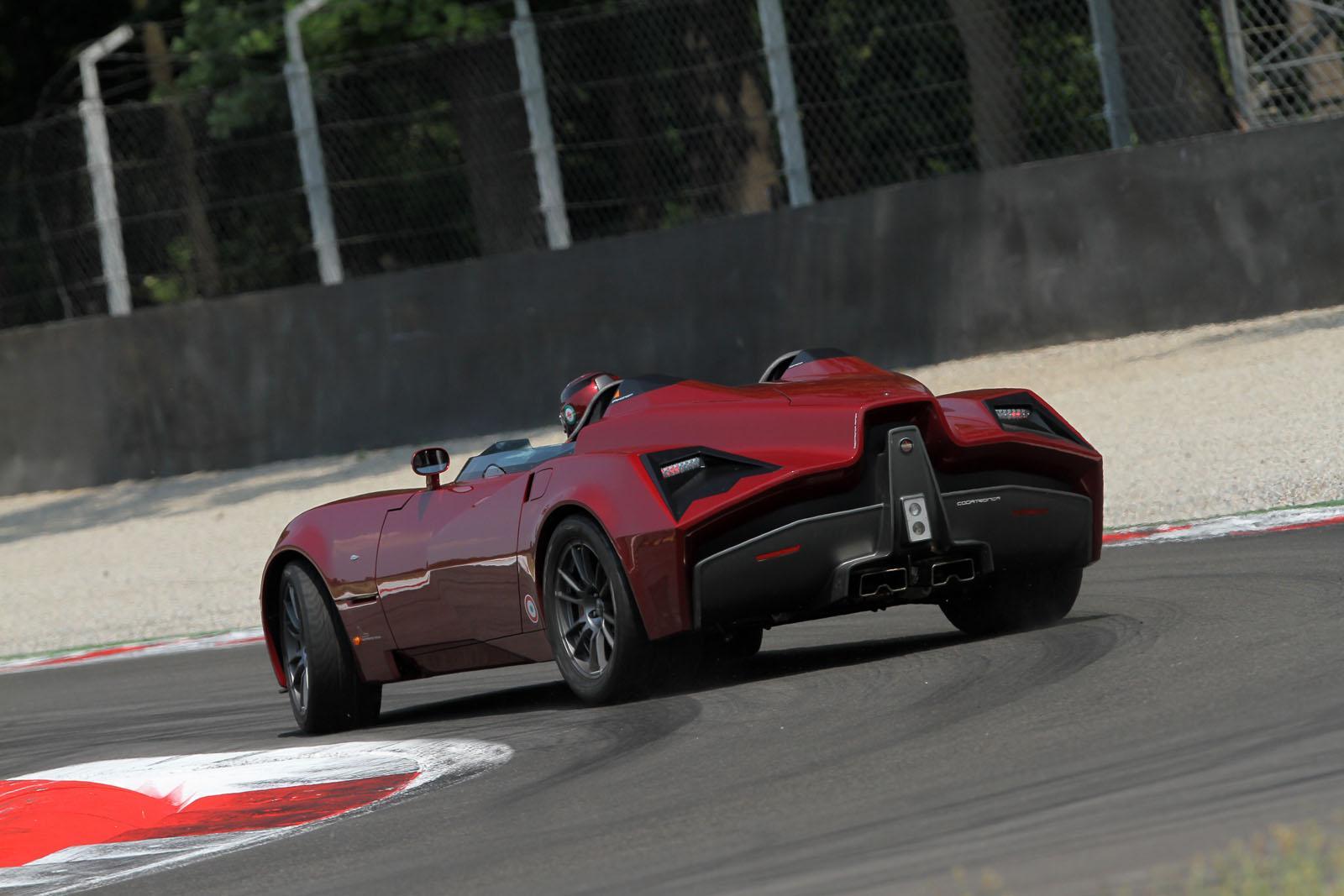
Spada Vetture Sport revealed us new details about the Codatronca Monza, an exclusive car that made its debut at Top Marques Monaco.The brand new Spada Codatronca Monza is based on the coupe Codatronca TS,which we know that it has a very attractive design inspired by the design of the roadster cars of the 60's.The model is equipped with very modern technology despite the retro design.Some examples would be the tubular design,the ultra light body frame,Brembo brakes and the OZ Racing wheels that have on Pirelli PZero Corsa racing tires.The power of this new Italian supercar comes from a huge 7.0L V8 that makes 710 HP and 950 Nm. of torque.The power is transmitted to the wheels by a 6 gear manual transmission.Thanks to all these mechanical orgy this vehicle can reach 60 in just 3 seconds( in the first gear)and has a top speed of 210 Mph.


Ferrari tries stopping the production of Lancia Stratos !!!

Lancia Stratos was going to be produced in a limited number but Ferrari stopped production and the comeback was delayed.Ferrari refused to give its approval for the new Lancia to be build with Ferrari parts even after the boss of Ferrari did a test drive with Lancia Stratos and had only praised it but the disaster has happened and the legends comeback is delayed.The 40 clients have been notified that the manufacturer is forced to orient itself to other suppliers for parts.

Icona Fuselage Concept Super Sports Car Photo Gallery


Design studio Icona Shanghai was founded in early 2010, European designers, which drew a huge market in China and Asia. The company is fully based in Shanghai, but the "ears" it grow from Turin: it built a career virtually all of its key personnel, and engineering support to ensure the Italians Tecnocad Progetti and Cecomp.
Related Posts Plugin for WordPress, Blogger...