Showing posts with label sports car. Show all posts

Porsche 968


The 968 is a sports car sold by Porsche AG from 1992 to 1995. It took over the entry-level position in Porsche's lineup from the 944, with which it shared about 20% of its parts. The 968 became the final model in an evolving line, starting almost 20 years earlier with the introduction of the Porsche 924 and ending with the Turbo S, Turbo RS, and Turbo RS Lemans, which are three separate versions of the 968.

Information

Porsche's 944 model debuted for the 1982 model year, was updated as "944S" in 1987 and as "944S2" in 1989. Shortly after the start of production of the S2 variant, Porsche engineers began working on another set of significant upgrades for the model, as executives were planning a final "S3" variant of the 944. During the development phase, 80% of the 944's mechanical components were either significantly modified or completely replaced by the engineers, leaving so little of the outgoing S2 behind that Porsche management chose to introduce the variant as a new model, entitling it 968. In addition to the numerous mechanical upgrades, the new model also received significantly evolved styling both inside and out, with a more modern, streamlined look and more standard luxury than on the 944. Production was moved from the Audi plant in Neckarsulm (where the 924 and 944 had been manufactured under contract to Porsche), to Porsche's own factory in Zuffenhausen.
The 968 was powered by an updated version of the 944's straight-4 engine, now displacing 3.0 L with 104mm bore, 88mm stroke and producing 240 PS (236 hp/177 kW). Changes to the 968's powertrain also included the addition of Porsche's then-new VarioCam variable valve timing system, newly-optimized induction and exhaust systems, a dual-mass flywheel, and updated engine management electronics among other more minor revisions. The 968's engine was the second-largest 4-cylinder ever offered in a production car up to that time. A new 6-speed manual transmission replaced the 944's old 5-speed, and Porsche's dual-mode Tiptronic automatic became an available option. Both the VarioCam timing system and Tiptronic transmission were very recent developments for Porsche. The Tiptronic transmission had debuted for the first time ever only 3 years prior to the debut of the 968, on the 1989 Type 964 911. The VarioCam timing system was first introduced on the 968 and would later become a feature of the Type 993 air cooled six cylinder engine.
The 968's styling was an evolution on that of the outgoing 944, itself styled evolutionarily from the earlier 924, but elements were borrowed from the more expensive 928 model in an attempt to create a "family resemblance" between models, and the swooping headlamp design, inspired by those of the 959, previewed similar units found later on the Type 993 911. Along with the new styling, the 968 featured numerous small equipment and detail upgrades, including a Fuba roof-mounted antenna, updated single lens tail lamps, "Cup" style 16" alloy wheels, a wider selection of interior and exterior colors, and a slightly updated "B" pillar and rear quarter window to accommodate adhesive installation to replace the older rubber gasket installation. Because some parts are interchangeable between the 968, 944 and 924, some enthusiasts purchase those parts from Porsche parts warehouses as "upgrades" for their older models.
Like the 944, the 968 was sold as both a coupe and a convertible. Much of the 968's chassis was carried over from the 944S2, which in itself shared many components with the 944 Turbo (internally numbered 951). Borrowed components include the Brembo-sourced 4-piston brake calipers on all four wheels, aluminum semi-trailing arms and aluminum front A-arms, used in a Macpherson strut arrangement. The steel unibody structure was also very similar to that of the previous models. Porsche maintained that 80% of the car was new.

968 Clubsport

From 1993 through 1995, Porsche offered a lighter-weight "Club Sport" version of the 968 designed for enthusiasts seeking increased track performance. Much of the 968's luxury-oriented equipment was removed or taken off the options list; less sound deadening material was used, electrical windows were replaced with crank-driven units, upgraded stereo systems, A/C and sunroof were still optional as on the standard Coupe and Convertible models. In addition, Porsche installed manually adjustable lightweight Recaro racing seats rather than the standard power-operated leather buckets (also manufactured by Recaro), a revised suspension system optimized and lowered by 20mm for possible track use, 17" wheels (also slightly wider to accommodate wider tyres) rather than the 16" as found on the Coupe and wider tires, 225 front and 255 rears rather than 205 and 245 respectively. The 4 spoke airbag steering wheel was replaced with a thicker rimmed 3 spoke steering wheel with no airbag, heated washer jets were replaced with non heated, vanity covers in the engine bay were deleted, as was the rear wiper. The Club Sport has no rear seats unlike the 2+2 Coupe. Club Sports were only available in white, black, Speed yellow, Guards red, Riviera blue or Maritime blue. Seat backs were colour coded to the body. Club Sport decals were standard in either black, red or white but there was a 'delete' option. All Club Sports had black interiors with the 944 S2 door cards. Due to the reduction in the number of electrical items the wiring loom was reduced in complexity which saved weight and also the battery was replaced with a smaller one, again reducing weight. With the no frills approach meaning less weight, as well as the optimising of the suspension, Porsche could focus media attention on the Club Sport variants fast road and track abilities. This helped to slightly bolster the flagging sales figures in the mid 1990s. The Club Sport variant achieved a 'Performance Car Of The Year' award in 1993 from Performance Car magazine in the UK. Club Sport models were only officially available in the UK, Europe, Japan & Australia, although "grey market" cars found their way elsewhere.
A UK-only version called "968 Sport", was offered in 1994 and 1995, and was essentially a Club Sport model (and was produced on the same production line with similar chassis numbers) with electric windows, electric release boot, central locking, cloth comfort seats (different to both the standard and the Club Sport). With the added electrics the larger wiring loom was used. The Sport Variant also got back the 2 rear seats, again in the cloth material specific to the Sport. At £29,975, the 968 Sport was priced £5,500 lower than the standard 968, but had most of the latter's desirable "luxuries" and consequently outsold it by a large margin (306 of the 968 Sport models compared to 40 standard 968 coupés).[1]

968 Turbo S

Porsche briefly produced a turbocharged 968 sold as "Turbo S", a fairly odd naming choice for Porsche which usually reserves the added "S" moniker for models that have been tuned for more power over a "lesser" counterpart, such as with the 911 Turbo which has infrequently been available in both "Turbo" and higher-performance "Turbo S" guise. Only 16 were produced in total and only for sale in mainland Europe. Tests conducted in 1993 produced a 0 to 60 miles-per-hour time of 4.7 seconds and a top speed of approximately 180 miles-per-hour, performance comparable to the much newer Type 996 911.

968 Turbo RS

A further stripped out version of the Turbo S which was built for Porsche's customer race teams between 1992 and 1994, this variant was available in two states of tune; a 337 bhp version which was built to the German ADAC GT specification and used the K27 turbocharger from the Turbo S, and an international spec version which used a KKK L41 turbocharger producing 350 bhp and was reduced to 1212 kg in weight (the ADAC GT version had to have ballast added to bring the car up to the 1350 kg minimum weight limit allowed by ADAC regulations). Only 4 were produced.

Historical significance

The 968 was Porsche's last new front-engined vehicle (of any type) before the introduction of the Cayenne SUV. Its discontinuation in 1995 coincided with that of the 928, Porsche's only other front-engined car at the time.
As of 2009, Porsche has not yet built another front-engined sports car, although a 4-door sports-touring sedan, called Panamera began production in 2009, and a successor to the 928, based on that sedan's architecture, is predicted to follow.
The 968 was also the last Porsche sold with a four-cylinder engine.

Collectability

While lacking the wider ranging appeal of the 911, the 968 has nonetheless carved out its own niche in the hearts of enthusiasts.[2] This is likely due to the 968's unique combination of speed and practicality.[3] Noteworthy drawbacks to purchasing a 968 as a collector's car include its visual resemblance to the earlier 944 model, its status as a late model car, and the fact that the 968 is still depreciating.[4]


Production[5]
Model year Production Notes
Total Non US/Canada US/Canada
1992 5353 3913 1440
1993 3783 2701 1082
1994 2484 965 1519
1995 1156 532 624
Total 12776 8111 4665  Of these, 4389 were cabriolets, of which 2248 to US

Ford Sierra RS Cosworth

The Ford Sierra RS Cosworth was a high-performance version of the Ford Sierra. It was the result of a Ford Motorsport project with the purpose of producing an outright winner for Group A racing in Europe.
The project was defined by Stuart Turner in the spring of 1983. He had then recently been appointed head of Ford Motorsport in Europe, and he realized right away that Ford was no longer competitive in this area.
Turner got in touch with Walter Hayes, at the time Vice President of Public Relations at Ford, to get support for the project. Hayes had earlier been the driving force behind the development of the Ford GT40 that won Le Mans in 1966, and the Cosworth DFV engine that brought Ford 154 victories and 12 World Championships in Formula One during the Sixties and Seventies. Hayes found the project very appealing and promised his full support.
Turner then invited Ken Kohrs, Vice President of Development, to visit Ford’s longtime partner, the automotive company Cosworth, where they were presented a project developed on Cosworth’s own initiative, the YAA engine. This was twin cam, 16-valve engine based on Ford’s own T88 engine block, better known as the Pinto. This prototype proved an almost ideal basis for the engine Turner needed to power his Group A winner.
Therefore, an official request for a turbocharged version (designated Cosworth YBB) capable of 180 HP on the street and 300 HP in race trim, was placed. Cosworth answered positively, but they put up two conditions: the engine would produce not less than 150 kW (204 HP) in the street version, and Ford had to accept no less than 15,000 engines. Turner’s project would only need about 5,000 engines, but Ford nevertheless accepted the conditions. The extra 10,000 engines would later become one of the reasons Ford also chose to develop a four door, second generation Sierra RS Cosworth.
To find a suitable gear box proved more challenging. The Borg-Warner T5, also used in the Ford Mustang, was chosen, but the higher revving nature of the Sierra caused some problems. Eventually Borg-Warner had to set up a dedicated production line for the gear boxes to be used in the Sierra RS Cosworth.
Many of the suspension differences between the standard Sierra and the Cosworth attributed their development to what was learned from racing the turbocharged Jack Roush IMSA Merkur XR4Ti in America and Andy Rouse's successful campaign of the 1985 British Saloon Car Championship. Much of Ford's external documentation for customer race preparation indicated "developed for the XR4Ti" when describing parts that were Sierra Cosworth specific. Roush's suspension and aerodynamics engineering for the IMSA cars was excellent feedback for Ford. Some production parts from the XR4Ti made their way into the Cosworth such as the speedometer with integral boost gauge and the motorsport 909 chassis stiffening plates.
In April 1983, Turner’s team decided on the Sierra as a basis for their project. The Sierra filled the requirements for rear wheel drive and decent aerodynamic drag. A racing version could also help to improve the unfortunate, and somewhat undeserved, reputation that Sierra had earned since the introduction in 1982.
Lothar Pinske, responsible for the car’s bodywork, demanded carte blanche when it came to appearance in order to make the car stable at high speed. Experience had shown that the Sierra hatchback body generated significant aerodynamic lift even at relatively moderate speed.
After extensive wind tunnel testing and test runs at the Nardò circuit in Italy, a prototype was presented to the project management. This was based on an XR4i body with provisional body modifications in fibreglass and aluminium. The car’s appearance raised little enthusiasm. The large rear wing caused particular reluctance. Pinske insisted however that the modifications were necessary to make the project successful. The rear wing was essential to retain ground contact at 300 km/h, the opening between the headlights was needed to feed air to the intercooler and the wheel arch extensions had to be there to house wheels 10” wide on the racing version. Eventually, the Ford designers agreed to try and make a production version based on the prototype.
In 1984 Walter Hayes paid visits to many European Ford dealers in order to survey the sales potential for the Sierra RS Cosworth. A requirement for participation in Group A was that 5,000 cars were built and sold. The feedback was depressing. The dealers estimated they could sell approximately 1,500 cars.
Hayes didn’t give up however, and continued his passionate internal marketing of the project. As prototypes started to emerge, dealers were invited to test drive sessions, and this increased the enthusiasm for the new car. In addition, Ford took some radical measures to reduce the price on the car. As an example, the car was only offered in three exterior colours (black, white and moonstone blue) and one interior colour (grey). There were also just two equipment options: with or without central locking and electric window lifts.

Production

The Ford Sierra RS Cosworth was first presented to the public at the Geneva Motor Show in March 1985, with plans to release it for sale in September and closing production of the 5,000 cars in the summer of 1986.
In practice, it was launched in July 1986 and 5545 were manufactured in total of which 500 were sent to Tickford for conversion to the Sierra 3 door RS500 Cosworth. The vehicle was manufactured in both RHD (Right Hand Drive) for the UK market, and LHD (Left Hand Drive) for Europe. The following number of vehicles were registered in the UK:


1985 10
1986 1064
1987 579
Total Mike Moreton was head of the team that planned to develop an evolution edition aimed at making the car unbeatable on the race tracks. In March 1987, Aston Martin in Tickford was signed for the job of converting the 500 cars.
The Cosworth RS500 was announced in July 1987 and was homologated in August 1987.
The main difference to the Sierra 3 door Cosworth was the uprated Cosworth competition engine. Its new features were [2]:
  • The engine had a thicker walled cylinder block to cope with the rigours of the track.

  • A larger Garrett T31/T04 turbocharger.

  • A larger air-air intercooler.

  • A second set of 4 fuel injectors and a second fuel rail (unused in the roadgoing version).

  • The fuel pump was uprated.

  • A reworked induction system to allow higher power outputs to be realised.

  • The oil and cooling system were both also uprated.

  • The rear semi-trailing arm beam had extended but unused mounting points.

The RS500 also had minor external cosmetic differences to its parent the Sierra 3 door Cosworth:
  • The rear tail gate had a lower spoiler in addition to the upper whale tail, which had an added lip.

  • Discrete RS500 badges on the rear tail gate and front wings.

  • A redesigned front bumper and spoiler to aid cooling and air flow, including the removal of the fog lamps and their replacement with intake grilles to supplement brake cooling

Exactly 500 RS500s were produced, all of them RHD for sale in the UK only - the biggest market for this kind of Ford car. It was originally intended that all 500 would be black, but in practice 56 white and 52 Moonstone Blue cars were produced .[1]

 Motorsport achievements


The car also fulfilled Ford's expectations on the race track. The 1987 World Touring Car Championship came like a gift to Ford. Competent BMW drivers, some trouble with gear boxes, amongst other things, and only 340 HP in the first Sierra RS Cosworth prevented Ford from dominating the first half of the season.
In August 1987 the Sierra RS500 Cosworth was homologated. Fords took pole position in all the remaining six events, and was first over the finishing line in five of them. Disqualification from the 1987 James Hardie 1000 for wheel arch panel irregularities though was a bitter pill for the Fords, depriving Steve Soper and Pierre Dieudonné of the World Championship and handing it to BMW driver Roberto Ravaglia. The Eggenberger Motorsport team did however claim the entrants prize.[3]
The Sierra Cosworth was also pressed into service as a rally car, and saw some success. After the abolition of the Group B formula in the World Rally Championship at the end of 1986, manufacturers had to turn to Group A cars and Ford, like most others, found itself without a fully suitable car. The Cosworth was very powerful but, with only rear-wheel-drive, lost out to the four-wheel-drive Lancias and Mazdas on loose-surface events, whilst the four-wheel-drive XR4x4 had an excellent chassis but an elderly engine producing only around 200bhp, at least 100 less than the Lancia. For the 1987 season the team ran both, using the XR4x4 on loose surfaces and the Cosworth on tarmac, but the XR4x4's power disadvantage was too great and from 1988 the team concentrated on the Cosworth alone, and continued to use it until the arrival of the Sierra RS Cosworth 4x4 in 1990.
The rear-drive car never won a loose-surface World Rally Championship event, but in the hands of drivers such as Stig Blomqvist, Carlos Sainz and Ari Vatanen it frequently finished in the top five, except when conditions were particularly slippery. On tarmac it was a much more serious competitor, and a young Didier Auriol won the 1988 Corsica Rally outright, the only time that season that Lancia were beaten in a straight fight. However, as Lancia developed the Delta further and new cars such as the Toyota Celica GT4 appeared, the Cosworth became steadily less competitive.
Thanks to strong support and readily available parts from Ford Motorsport, the Cosworth was a popular car with private teams. Moreover, below World Championship level four-wheel-drive opposition was limited at the time, and the Cosworth was as fast as any of its two-wheel-drive rivals. It lacked the fine handling of the BMW M3, for example, but on the other hand it was much more powerful. It was also very reliable. Consequently it became a very popular car at national championship level, and during the late 1980s Sierra drivers won many national series. Jimmy McRae took the British Rally Championship in a Sierra in 1987 and 1988, whilst Carlos Sainz won the Spanish Championship in the same years, to name but two. The Cosworth was popular with spectators because it was visually dramatic, with its flame-spitting exhaust and tail-sliding, rear-drive handling; and it was popular with amateur drivers because it was competitive, robust and relatively cheap. To this day it is a fairly common sight on lower-level events.


2wd Sierra Sapphire RS Cosworth

The second generation 4 door Sierra Sapphire Cosworth was assembled in Genk, Belgium, with the UK-built Ford-Cosworth YBB engine. Cylinder heads on this car were early spec 2wd heads and also the "later" 2wd head which had some improvements which made their way to the 4X4 head. Suspension was essentially the same with some minor changes in geometry to suit a less aggressive driving style and favour ride over handling. Spindles, wheel offset and other changes were responsible for this effect. Approximately 13,140 examples were produced during 1988-1989 and were the most numerous and lightest of all Sierra Cosworth models. Specifically the LHD models which saved weight with a lesser trim level such as roll up rear windows, no air conditioning etc.
In the UK, the RHD 1988-1989 Sierra Sapphire RS Cosworth is badged as such with a small "Sapphire" badge on the rear door window trims. All 1988-1989 LHD models are badged and registered as a Sierra RS Cosworth with no Sapphire nomenclature at all. "Sapphire" being viewed as a Ghia trim level that saw power rear windows, air conditioning and other minor options. Enthusiasts of the marque are mindful of this and will describe the LHD cars by their body shell configuration, 3 door or 4 door. Example: 4 door Sierra RS Cosworth.


Dodge Charger SRT8

The new product onslaught continues for the Dodge brand with the announcement at the 2011 Chicago Auto Show that the Dodge Charger SRT8 will return for the 2012 model year.
"We're continuing the fast-paced rebuilding of Dodge as our performance brand, and the expansion of our SRT product lineup in 2012 is an important part of our rejuvenation," said Ralph Gilles, President and CEO, Dodge Brand — Chrysler Group LLCs. "The new 2012 Dodge Charger SRT8 builds on the iconic four-door fastback coupe design of the all-new Charger and adds a much larger power band across the rpm range, along with intelligent performance attributes and safety and creature comforts for customers who are passionate about performance driving."
The 2012 Dodge Charger SRT8 will be built at the Brampton Assembly plant in Brampton, Ontario, Canada and will be in dealer showrooms in late 2011.
"AWE-INSPIRING" POWERTRAIN
Under the hood, the new 6.4-liter HEMI® V-8 delivers more horsepower and torque than the 6.1-liter HEMI V-8 it replaces. It also will offer improved fuel economy.
Estimated power ratings for the 2012 Dodge Charger SRT8 are 465 horsepower and 465 lb.-ft. of torque, including an estimated additional 80 lb.-ft. of torque at 2,900 rpm. Specific horsepower, torque and fuel economy numbers will be announced closer to the vehicle introduction.
Building upon the standard Fuel Saver technology (four-cylinder mode) found in the new 6.4 HEMI V-8, a new for 2012 adaptive valve exhaust system allows the technology to engage over a wider rpm range, which delivers improved fuel efficiency or the use of all eight cylinders when the power is needed.
An active intake manifold and high-lift camshaft with cam phasing provides maximum low-end torque for impressive standing starts while optimizing high-end power.
For the first time in any Chrysler Group LLC SRT product, standard paddle-shift technology joins the standard AutoStick on the floor shifter. Both are mated to the proven W5A580 five-speed automatic transmission, allowing a choice of spirited shifting on the road and the racetrack.
Both shifting methods give the driver the ability to shift while the transmission controller calibration prevents situations that might over rev the engine. Fully adaptive electronic control of all shifting makes the powertrain more responsive while minimizing harshness.
OUTSTANDING RIDE AND HANDLING
New for 2012, the Dodge Charger SRT8 features an adaptive damping suspension that uses a wide range of on-road and driver inputs, such as vehicle speed, steering angle, steering speed, brake torque, throttle position and lateral acceleration, to automatically tune the suspension for specific conditions. Drivers also can manually choose between "Auto" and "Sport" settings that quickly change the shock damping and harshness characteristics from the ease of everyday commuting to harsher, more challenging driving situations.
The performance SRT-tuned, fully hydraulic steering system also is improved with a new, heavy-duty pump and revised gearing to give drivers more direct feel and on-center response.
New, split five-spoke, 20-inch lightweight forged and polished aluminum wheels with black painted pockets provide great looks, and the available three- or four-season tires make the 2012 Dodge Charger SRT8 easy to handle and fun to drive.
OUTSTANDING BRAKING
World-class stopping power for the 2012 Dodge Charger SRT8 comes through four-piston Brembo calipers and vented/slotted rotors measuring 14.2 inches up front and 13.8 inches in the rear.
The Dodge Charger SRT8's Ready Alert Braking system anticipates situations when the driver may initiate an emergency brake stop and engages the electronic stability control pump to set brake pads against rotors in order to decrease the time required for full brake application.
AGGRESSIVE AND FUNCTIONAL EXTERIOR
Exclusive new front and rear fascias, along with a new rear spoiler, distinguish the 2012 Dodge Charger SRT8 with a high performance look.
The front grille, grille surround and Dodge crosshair feature high-gloss black finishes and the SRT badge. A newly sculpted hood features a 6.4 L (liter) badge and black air exhauster for added engine cooling.
In the rear, the Charger's new signature "racetrack" taillamp design with 164 illuminating LEDs receives new 4-inch round dual exhaust tips and an SRT8 decklid badge to boldly show the Street and Racing Technology DNA.
Unique fside-sill cladding is painted to match the body color.
A newly designed underbody belly pan features integrated brake ducting to improve cooling and brake fade performance at all four corners.
RACE-INSPIRED AND FUNCTIONAL INTERIOR
Building upon the all-new design from 2011, the interior environment of the 2012 Dodge Charger SRT8 combines more world-class accommodations with race-inspired technology and appointments.
An all-new, leather-wrapped, SRT-exclusive steering wheel features a unique rim section with a flattened bottom surface that showcases the SRT logo. The standard paddle shifters flank both sides of the new steering wheel behind the new contoured palm rests.
For the high-performance look, carbon-weave, fiber aluminum interior trim pieces are integrated into the new instrument panel and shifter bezel.
The front seats have unique, aggressive bolstering and perforated suede insert fabric to help "grip" the driver and passengers, keeping them in place during spirited driving. Heated and ventilated front seats are standard. Reactive headrests also are standard. The SRT logo is embroidered in the seat backs. Rear seats also are heated for passenger comfort.
Modified door trim panels feature unique bolster material and accent stitching on arm rests to match the seats.
New for 2012, the Dodge Charger SRT8 features a 900-watt, 19-speaker premium SRT performance audio surround-sound system from Harmon Kardon. The intuitive user interface for the system is controlled through the state-of-the-art Uconnect® Touch on the largest standard touchscreen display (8.4-inch) in the segment. Benchmarked against the best E-segment sedans from Europe, Asia and North America, the easy-to-use system also features Uconnect Voice to deliver world-class functionality to keep all passengers easily connected, comfortable and secure.
Exclusive Performance Pages are new for 2012 and included within the touchscreen display. The instrument panel display can be customized to view driver preferences and expanded to include instant feedback on steering input measurements, horsepower, torque, expanded engine information, along with 0-60 mph time, 60-0 braking, g-forces and one-eighth mile and quarter-mile times. The color graphic Electronic Vehicle Information Center also includes the Performance Pages timers and added engine information.
SAFETY AND SECURITY
For everyday commuting, the 2012 Dodge Charger SRT8 incorporates features like Keyless Enter-N-Go, adaptive-cruise control with Forward Collision Warning and Blind-spot Monitoring with Rear Cross Path Detection, to keep drivers and passengers secure.
Standard front-row reactive head restraints, standard full-length side-curtain air bags, driver's knee bag and standard front seat-mounted side-thorax air bags offer enhanced occupant protection to passengers in the event of a collision.
Standard three-mode electronic stability control with segment-exclusive Ready Alert Braking and Rain Brake Support safety features, offer improved overall vehicle handling and performance both on the road and the track.


Source:www.Netcarshow,com

Jensen Interceptor

A little known car that was absolutely brilliant.The Jensen Interceptor was a sporting GT-class car hand-built in the United Kingdom by Jensen Motors between 1966 and 1976. The Interceptor name had been used previously by Jensen for an earlier car made between 1950 and 1957. The car broke with Jensen tradition by having a steel bodyshell instead of glass-reinforced plastic and by having the body designed by an outside firm, Carrozzeria Touring of Italy, rather than the in-house staff. The early bodies were Italian-built, by Vignale, before production by Jensen themselves began – with subtle body modifications – in West Bromwich.
The engine was a Chrysler V8 initially of 6276 cc (383 c.i.) with optional manual (Mark I, only 22 built) or TorqueFlite automatic transmissions driving the rear wheels through a limited slip differential in a conventional Salisbury rear axle. The engine grew to 7212 cc (440 c.i.) in late 1971 with 4-bbl carburation. The SP (Six-Pack) model of 1971–73 offered 3x2-bbl carburation; only 232 were built and had the distinction of being the most powerful car ever to have been made by Jensen (390 hp (290 kW)).
The Interceptor took its styling cues from the Brasinca Uirapuru, [2] with a distinctive large, curving wrap-around rear window that doubled as a tailgate. The original specification included electric windows, reclining front seats, a wood rimmed steering wheel, radio with twin speakers, reversing lights and an electric clock. Power steering was included as standard from September 1968.
The Mark II was announced in October 1969, revised frontal styling and vented disc brakes. The Mark III of 1971 had revised seats, fully-cast alloy wheels plus some other improvements. The Mark III was divided to G-, H-, J-series and 'S4-series', depending on the production years. The 'S4-series' version of Interceptor III was the most luxurious Jensen built.
The Interceptor was briefly re-introduced in the 1980s as the Series 4 (S4), as a low-volume 'specialist' motor car in much the same way Bristol continue to market and manufacture their cars. Though the body remained essentially the same, a newer, so called 'cleaner', engine was used and the interior slightly re-designed with the addition of 'sports' front seats as opposed to the armchair style of the earlier models.
It wasn't to be, however. The then owner sold up in 1988 to an engineering company believed to be in a stronger position to manufacture the car which lasted until 1993, and they did commence development work on a series 5 (S5) Interceptor until once again receivers were called in.


Variants

A convertible with powered soft top was introduced in 1974 mainly intended for the American market but also sold in Europe. 267 convertibles were made.[3]
Rarer still is the Coupé version with just 60 made,[3] derived from the convertible and introduced in 1975, just a year before the company's demise. It could be said though this version detracted from the rakish, stylish looks of the GT.


Main article: Jensen FF

Jensen were one of the first manufacturers to equip a production car with four-wheel drive, in the shape of the 1967 Jensen FF (Ferguson Formula). At the time it was hailed as a remarkable development, coming also with anti-lock brakes and traction control. The car is four inches (100 mm) longer than the Interceptor, although it looks very similar, with a tell-tale addition of extra side vents ahead of the doors on the front flanks (resulting in two vents per side rather than one). Press from the time quote "drag-strip" performance when describing the car. In total 320 FFs were produced; 195 Mark I, 110 Mark II and 15 Mark III. [4]

The Jensen Interceptor R

There were plans, in 2007, for a Jensen specialist based at Cropredy Bridge to rebuild original Interceptors using modern components.
In May 2010, Jensen International Automotive was set up, with the financial backing and know-how of Carphone Warehouse founder and chairman Charles Dunstone who joined its board of directors. A small number of Jensen Interceptor Ss, which had started production under a previous company, are being completed by Jensen International Automotive (JIA), in parallel with JIA's own production of the new Jensen Interceptor R; deliveries of the latter have started (beginning of 2011) at the Oxfordshire-based manufacturer and restorer. Tony Banham is JIA's Managing Director.

Ferrari 275

The Ferrari 275 was a 2-seat front-engined Gran Turismo automobile produced by Ferrari between 1964 and 1968. It used a 3.3 L (3286 cc) Colombo 60° V12 engine and produced 280-300 hp. The Pininfarina-designed body was a graceful evolution of the car's predecessor, the 250, and strongly contrasted with its replacement, the Daytona. The 275 introduced Ferrari's "transaxle" concept, where the transmission and rear axle are integrated.
Motor Trend Classic named the 275 GTB/GTS as number three in their list of the ten "Greatest Ferraris of all time".

Two-cam

275 GTB

The standard 275 GTB coupe was produced by Scaglietti and was available with 3 or 6 Weber twin-choke carburettors. It was more of a pure sports car than the GT name suggested. Some cars were built with an aluminium body instead of the standard steel body. A Series Two version with a longer nose appeared in 1965.

275 GTS

Pininfarina built 200 275 GTS Roadsters for the American market (including 14 in right hand drive) between 1964-1966 with entirely different bodywork. It was intended to be more of a GT car and less of a sports car than its GTB brother. The 275 GTS was replaced by the 330 GTS with the switch to the four-cam engine, leaving no 3.3 L convertible in the range until the creation of the 275 GTB/4 NART Spider. The 330 engine was a two cam engine. not a 4 cam.

275 GTB/C

For the 1965 racing season, 4 lightweight 275 GTB Competizione Speciales were built and equipped with 250 LM engines.
For the 1966 season, Ferrari decided to build 12 lightweight 275 GTB/C cars, they were constructed between the end of the 275 two-cam production run and the start of the 275 four-cam production run; even though they very much resembled the road-going 275 GTB, not one body panel was the same and underneath and very little of the road car remained.
Mauro Forghieri designed a special super-lightweight steel and aluminium version of the 275 GTB chassis. A regular suspension was fitted, but it was made slightly stiffer by the addition of extra springs. Scaglietti bodied the chassis with an ultra thin aluminum body; the panels were about half as thick as the ones used on the GTO and the Cobra - even leaning on the 275 GTB/C would dent the body; the entire rear section was reinforced by fiberglass to prevent it from flexing at the slightest impact. In all, this focus on saving weight made a difference of over 150 kg (331 lb) compared to the alloy bodied road cars.
Like the four 'Competizione Speciales', the 275 GTB/C was powered by the 250 LM engine. Somehow Ferrari 'forgot' to mention to the governing body that the 275 GTB had a six carburetor option, so only a three 'carb' engine could be homologated. Specifically for the 275 GTB/C, Weber constructed the 40 DF13 carburetor of which three would replace the six 38 DCNs found on the 250 LM. The rest of the drivetrain was similar to the 275 GTB, but strengthened slightly.
Two of the twelve built were sold for street use. Unlike the race cars, these street cars were fitted with alloy wheels shod with Pirelli tires. Competition cars were fitted with special Borrani wire wheels, shod with Dunlop's latest racing tires. It was this combination that would prove to be the weak spot of the 275 GTB/C; the tires had so much grip that they could overstress and break the spokes on the wheels. After the 275 GTB/C, no competition Ferrari would be fitted with wire wheels again.


A British-entered 275 GTB/C finished 8th overall, gaining class victory in the 1966 24 Hours of Le Mans.

Ford GT40

The Ford GT40 was a high performance sports car and winner of the 24 hours of Le Mans four times in a row, from 1966 to 1969 (1966 being the Mk II, 1967 the Mk IV, and 1968-1969 the oldest chassis design, the Mk I). It is so far the only racecar built in America (Mk IV only) to win overall at Le Mans (1967 Mk IV).[3] [4]
It was built to win long-distance sports car races against Ferrari (who won at Le Mans six times in a row from 1960 to 1965). Chassis # P-1075, which won in 1968 and 1969, is the first car in Le Mans history to win the race more than once with the same chassis, and only one of two cars to have won with the same chassis.) using a Ford engine originally 4.7- liter, enlarged to 4.9-liter (also known as a 5.0) with special alloy Gurney-Weslake cylinder head.
The car was named the GT (for Grand Touring) with the 40 representing its overall height of 40 inches (1.02 m, measured at the windshield) as required by the rules. Large displacement Ford V8 engines (4.2 liter, 4.7 liter and 7 liter) were used, compared with the Ferrari V12 which displaced 3.0 liter or 4.0 liter.
Early cars were simply named "Ford GT". The name "GT40" was the name of Ford's project to prepare the cars for the international endurance racing circuit, and the quest to win the 24 Hours of Le Mans. The first 12 "prototype" vehicles carried serial numbers GT-101 through GT-112. The "production" began and the subsequent cars, the MkI, MkII, and MkIIIs,( with the exception of the MkIV, which were numbered J1-J10)were numbered GT40P/1000 through GT40P/1145, were officially "GT40s". The name of Ford's project, and the serial numbers dispel the story that "GT40" was "only a nickname."
The contemporary Ford GT is a modern homage to the GT40.

History

Henry Ford II had wanted a Ford at Le Mans since the early 1960s.
In the spring of 1963, Ford reportedly received word through a European intermediary that Enzo Ferrari was interested in selling to Ford Motor Company. Ford reportedly spent several million dollars in an audit of Ferrari factory assets and in legal negotiations, only to have Ferrari unilaterally cut off talks at a late stage due to disputes about the ability to direct open wheel racing. Ferrari, who wanted to remain the sole operator of his company's motor sports division, was angered when he was told that he would not be allowed to race at the Indianapolis 500 if the deal went through since Ford fielded Indy cars using the company's engine, and didn't want competition from Ferrari. Enzo cut the deal off out of spite and Henry Ford II, enraged, directed his racing division to find a company that could build a Ferrari-beater on the world endurance-racing circuit.
To this end Ford began negotiation with Lotus, Lola, and Cooper. Cooper had no experience in GT or prototype and its performances in Formula One were declining.
Lotus was already a Ford partner for their Indy 500 project. Ford executives already doubted the ability of Lotus to handle this new project. Colin Chapman probably had similar views as he asked a high price for his contribution and insisted that the car (which became the Lotus Europa) should be named a Lotus-Ford, an attitude that can be viewed as polite refusal.
The Lola proposal was chosen, since Lola had used a Ford V8 engine in their mid-engined Lola Mk 6 (also known as Lola GT). It was one of the most advanced racing cars of the time, and made a noted performance in Le Mans 1963, even though the car did not finish, due to low gearing and so revving out on the mulsanne straight. However, Eric Broadley, Lola Cars' owner and chief designer, agreed on a short-term personal contribution to the project without involving Lola Cars.
The agreement with Broadley included a one-year collaboration between Ford and Broadley, and the sale of the two Lola Mk 6 chassis built to Ford. To form the development team, Ford also hired the ex-Aston Martin team manager John Wyer. Ford Motor Co. engineer Roy Lunn was sent to England; he had designed the mid-engined Mustang I concept car powered by a 1.7 liter V4. Despite the small engine of the Mustang I, Lunn was the only Dearborn engineer to have some experience with a mid-engined car.
Overseen by Harley Copp, the team of Broadley, Lunn and Wyer began working on the new car at the Lola Factory in Bromley. At the end of 1963 the team moved to Slough, near Heathrow airport. Ford then established Ford Advanced Vehicles Ltd, a new subsidiary under the direction of Wyer, to manage the project.
The first chassis built by Abbey Panels of Coventry was delivered on March 16, 1963. The first "Ford GT" the GT/101 was unveiled in England on April 1 and soon after exhibited in New York.
It was powered by the 4.2 L Fairlane engine with a Colotti transaxle, the same power plant was used by the Lola GT and the single-seater Lotus 29 that came in a highly controversial second at the Indy 500 in 1963. (A DOHC head design was used in later years at Indy. It won in 1965 in the Lotus 38.)
The Ford GT40 was first raced in May 1964 at the Nürburgring 1000 km race where it retired with suspension failure after holding second place early in the event. Three weeks later at the 24 Hours of Le Mans, all three entries retired although the Ginther/Gregory car led the field from the second lap until its first pitstop. After a season-long series of dismal results under John Wyer in 1964, the program was handed over to Carroll Shelby after the 1964 Nassau race. The cars were sent directly to Shelby, still bearing the dirt and damage from the Nassau race. Carroll Shelby was noted for complaining that the cars were poorly maintained when he received them, but later information revealed the cars were packed up as soon as the race was over, and FAV never had a chance to clean, and organize the cars to be transported to Shelby.
Shelby's first victory came on their maiden race with the Ford program, with Ken Miles and Lloyd Ruby taking a Shelby American-entered GT40 to victory in the Daytona 2000 in February of 1965. The rest of the season, however, was a disaster.
The experience gained in 1964 and 1965 allowed the 7-liter Mk II to dominate the 24 Hours of Le Mans race in 1966 with a 1-2-3 result. The finish, however, was clouded in controversy: in the final few hours, the Ford GT of New Zealanders Bruce McLaren and Chris Amon closely trailed the leading Ford GT driven by Englishman Ken Miles and New Zealander Denny Hulme. With a multi-million-dollar program finally on the very brink of success, Ford team officials faced a difficult choice. They could allow the drivers to settle the outcome by racing each other – and risk one or both cars breaking down or crashing. They could dictate a finishing order to the drivers – guaranteeing that one set of drivers would be extremely unhappy. Or they could arrange a tie, with the McLaren/Amon and Miles/Hulme cars crossing the line side-by-side. The team chose the last and informed McLaren and Miles of the decision just before the two got in their cars for the final stint. Then, not long before the finish, the Automobile Club de l'Ouest (ACO), organizers of the Le Mans event, informed Ford that the geographical difference in starting positions would be taken into account at a close finish – meaning that the McLaren/Amon vehicle, which had started perhaps 60 feet (18 m) behind the Hulme-Miles car, would have covered slightly more ground over the 24 hours and would therefore be the winner. Secondly, Ford officials admitted later, the company's contentious relationship with Miles, its top contract driver, placed executives in a difficult position. They could reward an outstanding driver who had been at times extremely difficult to work with, or they could decide in favour of drivers (McLaren/Amon) with less commitment to the Ford program but who had been easier to deal with. Ford stuck with the orchestrated photo finish but Miles, deeply bitter over this decision after his dedication to the program, issued his own protest by suddenly slowing just yards from the finish and letting McLaren across the line first. Miles died in a testing of the J-car program ( later to become the Mk IV) at Riverside Raceway just two months later.
Miles' death occurred at the wheel of the Ford "J-car", an iteration of the GT40 that included several unique features. These included an aluminum honeycomb chassis construction and a "breadvan" body design that experimented with "kammback" aerodynamic theories. Unfortunately, the fatal Miles accident was attributed at least partly to the unproven aerodynamics of the J-car design, as well as the experimental chassis strength. The team embarked on a complete redesign of the car, which became known as the Mk IV. The Mk IV, a newer design with a Mk II engine but a different chassis and a different body, won the following year (when four Mark IVs, three Mark IIs and three Mark Is raced). The high speeds achieved in that race caused a rule change, which already came in effect in 1968: the prototypes were limited to the capacity of to 3.0 liter, the same as in Formula One. This took out the V12-powered Ferrari 330P as well as the Chaparral and the Mk. IV. If at least 50 cars had been built, sportscars like the GT40 and the Lola T70 were allowed, with a maximum of 5.0 L. John Wyer's revised 4.7 liter (Bored to 4.9 liter, and o-rings cut and installed between the deck and head to prevent head gasket failure, a common problem found with the 4.7 engine.) Mk I. It won the 24 hours of Le Mans race in 1968 against the fragile smaller prototypes. This result, added to four other round wins for the GT40, gave Ford victory in the 1968 International Championship for Makes. The GT40's intended 3.0 L replacement, the Ford P68, and Mirage cars proved a dismal failure. In 1969, facing more experienced prototypes and the new yet still unreliable 4.5 L flat-12 powered Porsche 917s, the winners Ickx/Oliver managed to beat the remaining 3.0 liter Porsche 908 by just a few seconds with the already outdated GT40 (in the very car that had won in 1968 - the legendary GT40P/1075). Apart from brake wear in the Porsche and the decision not to change pads so close to the race end, the winning combination was relaxed driving by both GT40 drivers and heroic efforts at the right time by (at that time Le Mans' rookie) Jacky Ickx, who won Le Mans five times more in later years. In 1970, the revised Porsche 917 dominated, and the GT40 had become obsolete.At the 1995 Detroit Auto Show, the Ford GT90 concept was shown and at the 2002 show, a new GT40 Concept was unveiled by Ford.
While similar in appearance to the original cars, it was bigger, wider, and three inches taller than the original 40 inches (1.02 m). Three production prototype cars were shown in 2003 as part of Ford's centenary, and delivery of the production Ford GT began in the fall of 2004. The Ford GT was assembled in the Ford Wixom plant and painted by Saleen, Incorporated at their Saleen Special Vehicles plant in Troy, Michigan, USA.


A British company, Safir Engineering, who made continuation GT40s in the 1980s owned the GT40 trademark at that time, and when they completed production, they sold the excess parts, tooling, design, and trademark to a small American company called Safir GT40 Spares based in Ohio. Safir GT40 Spares licensed the use of the GT40 trademark to Ford for the initial 2002 show car, but when Ford decided to make the production vehicle, negotiations between the two failed, and as a result the new Ford GT does not wear the badge GT40. It is rumored[by whom?] that Safir GT40 Spares asked $40 million dollars for the rights, but this has never been verified. The partners at Safir GT40 Spares state they have correspondence from Ford declining Safir's $8 million offer. Later models or prototypes have also been called the Ford GT but have had different numbering on them such as the Ford GT90 or the Ford GT70. The GT40 name is currently licensed for use by the Pathfinder Motorsports GT40/R Competition, which is built by Hi-Tech in South Africa, which also builds street version models of the GT40.

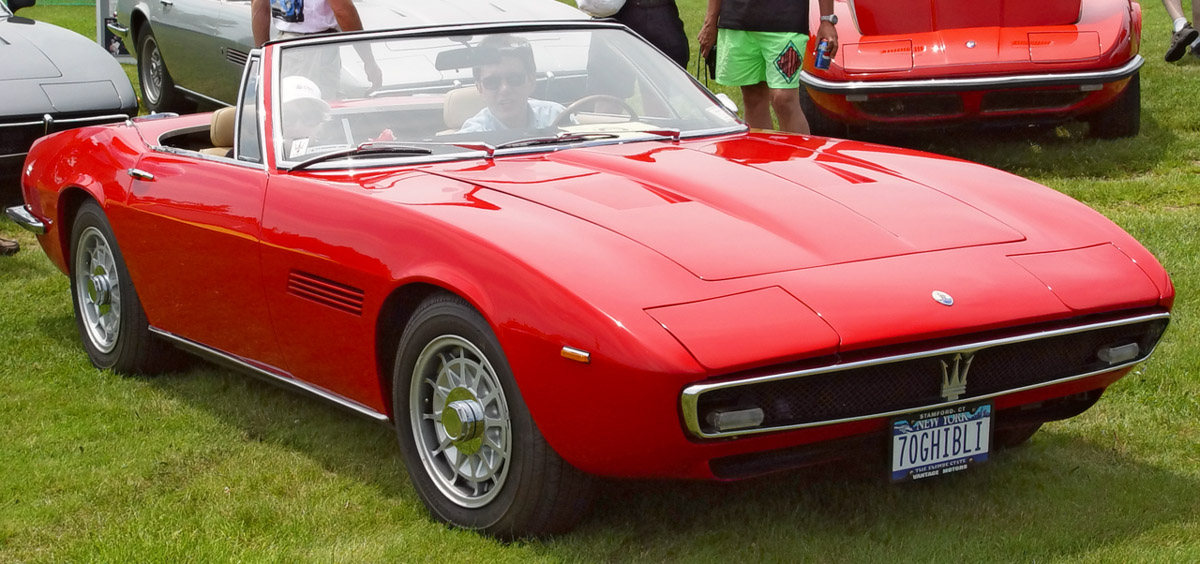
Maserati Ghibli

The Maserati Ghibli is a Gran Turismo car produced by Italian manufacturer Maserati in two generations: first from 1966–73, and again as the Maserati Ghibli II from 1992–97.
The original Maserati Ghibli is a two-door, two-seater GT released by Maserati in 1967. The V8-powered Ghibli debuted at the 1966 Turin Motor Show and proved to be the most popular Maserati vehicle since the automaker withdrew from racing in the 1950s, outselling its two biggest rivals, the Ferrari Daytona and the Lamborghini Miura. So well regarded was the Ghibli Sports Car International named it number nine on its list of Top Sports Cars of the 1960s.
The Ghibli's steel body, renowned for its low, shark-shaped nose, was designed by Giorgetto Giugiaro. Giugiaro, who today heads his own company ItalDesign, worked at coachbuilder Ghia when he designed the Ghibli.
The car was powered by a front-placed quad-cam 330 hp (250 kW) V8 engine. It had a 0-60 mph acceleration time of 6.8 seconds, had a top speed of 154 mph (248 km/h) and could be operated by either a five-speed manual or three-speed automatic transmission. Even by the standards of its time and class, the car consumed copious volumes of fuel, but Maserati fitted the car with two 50 L (13.2 US gal; 11.0 imp gal) fuel tanks,[1] which could be filled via flaps on either side of the roof pillars. The car also featured pop-up headlamps, leather sport seats and alloy wheels.
Maserati Ghibli Spider.


The convertible Ghibli Spyder went into production in 1969. The Spyders were relatively rare, and were outnumbered by the coupés by almost ten to one. The slightly more powerful Ghibli SS (335 hp) was released in 1970. The Ghibli went out of production in 1973 and found a successor the following year with the Bertone-designed Khamsin.
In all, 1149 Coupes, 125 Spyders and 25 Spyder SS models were produced.
Model Engine Displacement Power Fuel system
Ghibli V8 dohc 4719 cc 340 PS (250 kW; 335 hp) 4 pcs Weber 38DCNL carburetor
Ghibli SS V8 dohc 4930 cc 355 PS (261 kW; 350 hp) 4 pcs Weber 38DCNL carburetor

Porsche 356

The Porsche 356 was the company's first production automobile. It was a lightweight and nimble handling rear-engine rear-wheel-drive 2 door sports car available in hardtop coupe and open configurations. Design innovations continued during the years of manufacture, contributing to its motorsports success and popularity. Production started in 1948 at Gmünd, Austria where approximately 50 cars were built. In 1950 the factory relocated to Zuffenhausen, Germany and general production of the 356 continued until April 1965, well after the replacement model 911 made its autumn 1963 debut. It is estimated approximately half of the total production of 76,000 356s still survive.
Prior to World War II Porsche designed and built three Type 64 cars for a 1939 Berlin to Rome race that was cancelled. In 1948 the mid-engine, tubular chassis 356 prototype called "No. 1" was completed. This led to some debate as to the "first" Porsche automobile, but the 356 is considered by Porsche to be its first production model.[1][2]
The 356 was created by Ferdinand "Ferry" Porsche (son of Dr. Ing. Ferdinand Porsche, founder of the company). Like its cousin, the Volkswagen Beetle (which Ferdinand Porsche Senior had designed), the 356 was a four-cylinder, air-cooled, rear-engine, rear-wheel-drive car utilizing unitized pan and body construction. While the 356's body was an original design by Porsche employee Erwin Komenda, its mechanicals (including engine, suspension and chassis) were derived from the Volkswagen. The first 356 was road certified in Austria on June 8, 1948, and used many Volkswagen parts for manufacturing economy. Quickly though, Porsche re-engineered and refined the car with a focus on performance. By the late '50s much fewer parts were shared between Volkswagen and Porsche. The early 356 automobile bodies produced at Gmünd were handcrafted in aluminum, but when production moved to Zuffenhausen, Germany in 1950, models produced there were steel-bodied.
Little noticed at its inception, the first 356s sold primarily in Austria and Germany. It took Porsche two years, starting with the first prototype in 1948, to manufacture the first 50 automobiles. By the early 1950s the 356 had gained some renown among enthusiasts on both sides of the Atlantic for its aerodynamics, handling, and excellent build quality. It was common for owners to race the car as well as drive it on the street. Increasing success with its racing and road cars brought Porsche orders for over 10,000 units in 1964, and by the time 356 production ended in 1965 approximately 76,000 had been produced.
The basic design of the 356 remained the same throughout its lifespan, with evolutionary, functional improvements rather than annual superficial styling changes. Nevertheless a variety of models in both coupe and convertible forms were produced from 1948 through 1965.
Cabriolet models (convertibles) were offered from the start, and in the early 1950s sometimes comprised over 50% of total production. One of the most desirable collector models is the 356 "Speedster", introduced in late 1954 after Max Hoffman, the sole US importer of Porsches, advised the company that a lower-cost, somewhat spartan open-top version could sell well in the American market. With its low, raked windscreen (which could be removed for weekend racing), bucket seats and minimal folding top, the Speedster was an instant hit, especially in Southern California. Production of the Speedster peaked at 1,171 cars in 1957 and then started to decline. It was replaced in late 1958 by the "Convertible D" model. It featured a taller, more practical windshield, [allowing improved headroom with the top erected], roll-up glass side-windows and more comfortable seats. The following year the 356B "Roadster" convertible replaced the D model but the sports car market's love affair with top-down motoring was fading; soft-top 356 model sales declined significantly in the early 60s. Today these early four-cylinder models are highly coveted by collectors and enthusiasts worldwide.
To distinguish among the major revisions of the model, 356's are generally classified into a few major groups. 356 coupes and "cabriolets" (soft-top) built through 1954 are readily identifiable by their split (1948 to 1952) or bent (centre-creased, 1953 to 1954) windscreens. In 1955, with numerous small but significant changes, the 356A was introduced. Its internal factory designation, "Type 1," gave rise to its nickname "T1" among enthusiasts. In early 1957 a second revision of the 356A was produced, known as Type 2 (or T2). In late 1959 more significant styling and technical refinements gave rise to the 356B (a T5 body type).
The mid 1962 356B model was changed to the T6 body type (twin engine lid grilles, an external fuel filler in the right front wing/fender and larger windows). A unique "Karmann Hardtop" or "Notchback" 356B model was produced in 1961 and 1962. The 1961 production run was essentially a cabriolet body with the optional steel cabriolet hardtop welded in place. The 1962 line (T6 production) was a very different design in that the new T6 notchback coupe body did not start life as a cabriolet, but with its own production design—In essence, part cabriolet rear end design, part T6 coupe windshield frame, unique hard top. Both years of these unique cars have taken the name “Karmann Notchback”.[4]
The last revision of the 356 was the 356C introduced for the 1964 model year. It featured disc brakes all round, as well as an option for the most powerful pushrod engine Porsche had ever produced, the 95 hp (71 kW) "SC." 356 production peaked at 14,151 cars in 1964, the year that its successor, the new 911, was introduced to the US market (it was introduced slightly earlier in Europe). The company continued to sell the 356C in North America through 1965 as demand for the model remained quite strong in the early days of the heavier and more 'civilized' 911. The last ten 356's (cabriolets) were assembled for the Dutch police force in March 1966 as 1965 models.[5]
The 356's four-cylinder pushrod engine was later re-introduced in Porsche's "entry-level" 912 model, offered between 1965 and 1969 as response to customer complaints that the new 911 (at nearly twice the price of the 356) was too expensive. Although in some ways the 912 did reprise the 356's specifications, it would not be accurate to say the 912 was successor to the 356; when the decision was made to replace the 356, the 911 was the only car intended to carry the Porsche name forward. Rather the 912 was an afterthought intended to supply the lower-priced end of the market, which the expensive, complex but faster and heavier 911 could not do.

Body Design

The car was built of a unibody construction which has made restoration difficult for cars which were kept in rust prone climates.

Engine

Like the other most famous of Dr. Porsche's designs, the Volkswagen Beetle, the Porsche 356 had a rear mounted air cooled pushrod OHV flat-4 engine

Legacy

The 356 has always been popular with the motor press. In 2004, Sports Car International ranked the 356C tenth on their list of Top Sports Cars of the 1960s. Today, the Porsche 356 is a highly regarded collector car. The Porsche 356 Carrera (with its special DOHC racing engine), Super 90 and Speedster models are today among the most desirable 356 models. Few 356 Carreras were produced and these often bring well over $250,000 at auction. A fully restored 356 Carrera Speedster (of which only about 140 were ever made) will sell for around $300,000 at auction.
The original selling price of a late 1950s Porsche was around US$4,000, which was also the price of a new Cadillac; today they regularly bring between US$20,000 to well over US$100,000 at auction.
Thousands of owners worldwide maintain the 356 tradition, preserving their cars and driving them regularly. The US-based 356 Registry is the largest American club.[citation needed]


According to Autozeitung magazine, a new generation of Porsche 356 will be produced in 2013.
Related Posts Plugin for WordPress, Blogger...