Showing posts with label 70's. Show all posts

Video:BMW 3.0 CSi


one of the most beautiful BMW's ever built gets a little video tribute from its manufacturer.BMW 3.0 CSi replaced the 2800 CS.It was equipped with a straight six engine making 200 HP at 5.500 rpm.For 1971 a top speed of 136 Mph was a remarkable performance coming from a production model.Only 8.359 were ever made by Karman for BMW.Watch the video to see some of the history of this great machine.

BMW M1 (E21)

The BMW M1 (E26) is a sports car that was produced by German automaker BMW from 1978 to 1981.
In the late 1970s, Italian manufacturer Lamborghini entered into an agreement with BMW to build a production racing car in sufficient quantity for homologation.[1][2] The result was sold to the public, from 1978 to 1981, as the BMW M1. It was the only mid-engined BMW to be mass produced. It employed a twin-cam M88/1 3.5 L 6-cylinder petrol engine with Kugelfischer mechanical fuel injection. A version of this motor was later used in the South African version of the BMW 745i, of which 209 examples were built between 1984 and 1986, as well as the E24 BMW M6/M635CSi and E28 BMW M5. The engine had six separate throttle butterflies, four valves per cylinder and produced 277 PS (204 kW; 273 hp) in the street version, giving a top speed of 260 km/h (160 mph). Turbocharged racing versions were capable of producing around 850 hp (634 kW).The M1 coupe was hand-built between 1978 and 1981 under the Motorsport division of BMW as a homologation special for sports car racing. The body was designed by Giugiaro, taking inspiration from the 1972 BMW Turbo show car. Originally, BMW commissioned Lamborghini to work out the details of the car's chassis, assemble prototypes and manufacture the vehicles, but Lamborghini's financial position meant that BMW reassumed control over the project in April 1978, after seven prototypes were built. Only 456 production M1s were built, making it one of BMW's rarest models. The spirit of the M1 lived on in the M635Csi and the first-generation M5, which shared the same (though slightly modified) engine.
The M1 had various successes in motorsports. In 2004, Sports Car International named the car number ten on the list of Top Sports Cars of the 1970s.
The M1 is not related to BMW's 1-series compact executive car which started production in MY 2004. Nor is the M1 related to the BMW 1 Series M Coupe which started production in MY 2010.
In 1979 the head BMW Motorsport, Jochen Neerpasch, devised a one-make championship using racing modified M1s. The series was created to aid BMW in building enough M1s to enter the Group 4 classification in the World Championship for Makes. The new series, known as the Procar BMW M1 Championship, served as a support series for Formula One, and included many current Formula One drivers in identical cars.
The series ran for two years, with Niki Lauda winning the 1979 season, and Nelson Piquet the 1980 season. After BMW met the standards for Group 4, the Procars were used by various teams in the World Championship as well as other national series.

2008 Homage Concept

In April 2008, BMW unveiled the M1 Homage Concept to commemorate the 30th anniversary of the M1. The concept vehicle uses a mid-engine layout and borrows styling cues from both the original M1 and the Turbo show car.[4]


The BMW Homage concept was released at the event Concorso d’Eleganza Villa d'Este 2008. The design was created by Giorgio Giugiaro who got his idea from the BMW Turbo concept which was designed by Paul Bracq. The BMW Turbo boasted many technical and advance innovations from BMW.[5] The front of the car differs the most than the other parts of the car. The front sports double head lights are not the pop up light that are on the original M1, but the usual trademark of the kidney grills made it onto the design of the car. The Hommage also incorporated the double badge in the back of the car as the original M1. There are no photos of the interior of the car or the car in action. The specifications of the car have not been released to the public. BMW has not confirmed if these will be released.

Mercedes-Benz C111

The C111 was a series of experimental automobiles produced by Mercedes-Benz in the 1960s and 1970s. The company was experimenting with new engine technologies, including Wankel engines, Diesel engines, and turbochargers, and used the basic C111 platform as a testbed. Other experimental features included gullwing doors and a luxurious interior with leather trim and air conditioning.
The first version of the C111 was completed in 1969. It used a fiberglass body shell and had a three-rotor direct fuel injected Wankel engine (code named M950F) mounted in the middle. The next C111 appeared in 1970. It used a four-rotor engine producing 370 hp (275 kW). The car could reportedly hit 290 km/h (180 mph).
The company decided not to adopt the Wankel engine and turned to Diesel experiments for the third C111. With its 230 horsepower (170 kW)@ 4,400-4,600 5-speed manual straight-5 turbo-Diesel, the C111 broke nine diesel and gas speed records. With more aerodynamic bodywork that gave it an air drag coefficient of an incredible .191, the C111 eventually hit 200 mph (322 km/h) at Nardò in 1978, and averaged 14.7mpg@ 316 km/h (195.4 mph) over a 12 hour cruise. A later 500 hp (372 kW) 4.8 L twin KKK-turbocharged V8 version set another record, with an average lap-speed of 403.78 km/h (250.958 mph). It was achieved by Dr. Hans Leibold in 1 minute, 56.67 seconds on May 5, 1979.


Mercedes-Benz introduced the C112 at the Frankfurt Motor Show in 1991 as a production sports car. It used a 6.0 L V12 engine mounted in the middle. But after accepting 700 deposits, the company decided not to proceed with production.

Audi 100 Coupe S


Audi 100 (C1, 1968–1976)

The origins of the first Audi 100 have become legendary in Germany. The 100s was the first ever model to have side mounted headlights. When Volkswagen purchased Auto Union from Mercedes Benz in 1965, they seem to have been motivated by a desperate shortage of production capacity for their ’Beetle’ model which at that time was selling faster than the cars could be produced. The then nearly new Auto Union plant at Ingolstadt, built under Mercedes ownership and control, was quickly adapted for Beetle assembly: Volkswagen boss Heinrich Nordhoff, mindful of the poor sales record of the DKW F102, and at a time when the new Audi F103 had yet to prove itself in the market place, gave instructions that no further new Auto Union (including Audi) models should be developed.
However, it was not just the Ingolstadt manufacturing facility that Volkswagen acquired from Mercedes when they purchased the Auto Union business. Among the employees inherited from the Mercedes era was engineer Ludwig Kraus. Kraus did not share Nordhoff’s apparent conviction that demand for the Beetle would remain insatiable forever, and it was Kraus who developed the Audi 100, in direct contravention of instructions from Volkswagen management, and in secret. The first Nordhoff knew of the project was when he was presented with a production ready prototype. It is to Nordhoff’s credit that he changed his mind and gave the car the green light. The Audi 100 would be a commercial success, but it would also be the first of a series of front engined water cooled Audi based designs from the Volkswagen group that would, starting with the first Passat in 1973, enable the group to survive and flourish once the European and US markets began to lose their appetites for rear engined air cooled models.
The Audi 100 was shown to the press on 26 November 1968. Its name originally denoting a power output of 100 PS (74 kW; 99 hp), the Audi 100 was the company's largest car since the revivial of the Audi brand by Volkswagen in 1965. The C1 platform spawned several variants: the Audi 100 two- and four-door saloons, and the Audi 100 Coupé S, a stylish fastback coupé, which bore a remarkable resemblance to the Aston Martin DBS released a year earlier, especially at the rear end, including details such as the louvres behind the rear side windows and shape of the rear light clusters.
Audi followed up the introduction of the four-door saloon in November 1968 with a two-door saloon in October 1969 and the 100 Coupé S in autumn 1970. The cars' four-cylinder engines originally came in base (100, 80 PS (59 kW; 79 hp)), 100 S (1.8 litre, 90 PS (66 kW; 89 hp)) and 100 LS (1.8 litre, 100 PS (74 kW; 99 hp)) guise, while the Coupé was driven by a bored-out 1.9 litre developing 115 PS (85 kW; 113 hp). From April 1970 the 100 LS could be ordered with a 3-speed automatic transmission sourced from Volkswagen.
The Audi 100 enjoyed a level of commercial success for which the company had not planned. Despite running the Ingolstadt production line at full capacity, supply fell short of demand to such an extent that during the summer of 1970 an additional production line for Audi 100s was set up in Volkswagen's own Wolfsburg plant, which made it the first water-cooled car to be produced in Germany's (and by some criteria the world's) largest car plant.[3]
Starting with model year 1972 the 80 and 90 PS versions were replaced by a new regular-petrol-variant of the 1.8 litre engine developing 85 PS (84 hp/63 kW); at the same time, the 100 GL was introduced that featured the 1.9 liter engine formerly used in the Coupé S only.
In March 1971 the 500,000th Audi was produced. By now the Audi 100 had become the most commercially successful model in the company's history, so it is unsurprising that the car in question was an Audi 100 produced at the Ingolstadt plant.[4]
In September 1973 the 100 received a minor facelift with a somewhat smaller grille and reshuffled taillight lens patterns. The rear torsion bar was replaced by coil springs.
For model year 1975 the base 100 was re-christened the 100 L and received a 1.6 litre four cylinder engine (coming out of the Audi 80).

Ferrari P series

The Ferrari P series were prototype sports cars in the 1960s and early 1970s.
Although Enzo Ferrari resisted the move even with Cooper dominating F1, Ferrari began producing mid-engined racing cars in 1960 with the Ferrari Dino-V6-engine Formula Two 156, which would be turned into the Formula One-winner of 1961.
Sports car racers followed in 1963. Although these cars shared their names (based on engine displacement) with road models, they were almost entirely dissimilar. The first Ferrari mid-engine in a road car did not arrive until the 1967 Dino, and it was 1971 before a Ferrari 12-cylinder engine was placed behind a road-going driver in the 365 GT4 BB.

250 P

The 250 P was a Prototype racer produced in 1963, winning the 12 Hours of Sebring, 1000 km Nürburgring and the 24 Hours of Le Mans in that year. It was an open cockpit mid-engined design with a single-cam 3.0 L 250 Testa Rossa V12 engine and was almost entirely unrelated to the other 250 cars.
The 275 P and 330 P were evolutions of the 250 P with 3.3 L and 4.0 L engines, respectively. These raced during 1963 and 1964.

330 P2

Ferrari 330 P2
An entirely new car, the 330 P2, followed in 1965. It featured a lower and lighter chassis and more aerodynamic body, paired with a 410 hp (305 kW) version of the 330 V12. It was first used by Luigi Chinetti's North American Racing Team (NART) in the Daytona race that year. Some of NART's P2 cars also used the 4.4 L engine and thus were named 365 P2. The P2 was not a great success for Ferrari, however, so it was replaced by the P3 for 1966.

330 P3

The 1966 330 P3 introduced fuel injection to the Ferrari stable. It also used a P3 (Type 593) transmission that was prone to failure and was replaced by a ZF transmission when P3 0844 and 0848 were converted to 412P's, another Ferrari first that would only last one season when the ZF's were replaced by 603R P4 transmissions in all the 412P's.
There are no longer any Ferrari P3's existent as original P3 0846 was converted to a P 3/4 and P3's 0844 and 0848 were converted to 412P's by Ferrari.

412P

412P 0844 at the 2007 Goodwood Festival of Speed.
The Ferrari 412P was a "customer version" of the famous 330 P3 race car, built for independent teams like NART (0844), Scuderia Filipinetti (0848), Francorchamps (0850), and Maranello Concessionaires (0854). These cars had carburetor engines instead of the factory Lucas fuel injection. Surviving 412P cars are worth approximately $8 million[clarification needed]at auction.[citation needed] (at Silverstone Classic 2011, 0844's suggested value (by the mechanic working on it) was quoted at UK£12m (US$18m)
There are only 2 cars that were originally built as 412P's: 0850 and 0854. P3 chassis. P3 Typo Motors except for Carburetors in place of FI. P4 suspension but P3 wheelbase 2412mm vs. 2400mm (P4 and P 3/4 0846) 0844 and 0848 were originally P3 Factory Racecars but when Ferrari sold them to customers they removed the Lucas Mechanical Fuel Injection and replaced it with Weber carburetors which reduced their output, something Ferrari wanted to do so that they would win points but not beat the factory cars which were then P 3/4 0846 (See Above), P4 0856, P4 0858, and P4 0860.
The P3's and 412P had the same 4 liter block which is different from the P4 4 liter block and all had P3 not P4 chassis. P 3/4 0846 is unique having, after modification by Ferrari for the 1967 race season, a P3 chassis with a P4 engine.
The 412P and related 330 P3/4 and P4 models weren't eligible for the International Championship of Makes in 1968 as their engines were too large for the new 3 litre Group 6 Prototype category and too few examples had been built to allow homologation for the 5 litre Group 4 Sports Car category which required production of at least 50 units.[2] Ferrari did not contest the championship for a year in protest.
Four 412 Ps were built:
  • 0844 was a converted P3 and is currently in the UK owned by Harry Leventis
  • 0848 was a converted P3 and is currently in Switzerland
  • 0850 is currently owned by an American
  • 0854 is currently owned by James Glickenhaus, who also commissioned and owns the Ferrari P4/5.

    512 S and 512 M

    Ferrari 512 S driven by Nino Vaccarella at the 1970 1000 km Nurburgring
    These were not designated with P as they were not built for the 3000cc Prototype category, but with S as 5000cc Sports cars, of which at least 25 had to be built. Porsche had made that investment in early 1969 with the new Porsche 917. Ferrari answered with the Ferrari 512 which was introduced for 1970, and later modified as 512 M.

    P4/5

    Styling Model of Ferrari P 4/5 by Pininfarina at The Paris Auto Show
    In 2005, James Glickenhaus commissioned Pininfarina to rebody an Enzo as a special one-off custom car.[9] It is inspired by the early P racers, and especially Glickenhaus' own resurrected P3/4.[10][11]
    In May 2010 Glickenhaus announced that P 4/5 Competizione a new car based on P 4/5's designs but built to FIA GT2 Standards would be built and Raced at the 2011 24 Hours of Nurburgring by Scuderia Cameron Glickenhaus in an Experimental Class under the Direction of Paolo Garella Former Head of Special Projects at Pininfarina.


    At The 2011 24 Hours of Nurburgring P 4/5 Competizione finished 2 in class and received a special Constructor's Trophy. After The 24 Hours of Nurburgring P 4/5 Competizione was displayed in The National Auto Museum of Italy in Torino for a month.

Jensen Interceptor

A little known car that was absolutely brilliant.The Jensen Interceptor was a sporting GT-class car hand-built in the United Kingdom by Jensen Motors between 1966 and 1976. The Interceptor name had been used previously by Jensen for an earlier car made between 1950 and 1957. The car broke with Jensen tradition by having a steel bodyshell instead of glass-reinforced plastic and by having the body designed by an outside firm, Carrozzeria Touring of Italy, rather than the in-house staff. The early bodies were Italian-built, by Vignale, before production by Jensen themselves began – with subtle body modifications – in West Bromwich.
The engine was a Chrysler V8 initially of 6276 cc (383 c.i.) with optional manual (Mark I, only 22 built) or TorqueFlite automatic transmissions driving the rear wheels through a limited slip differential in a conventional Salisbury rear axle. The engine grew to 7212 cc (440 c.i.) in late 1971 with 4-bbl carburation. The SP (Six-Pack) model of 1971–73 offered 3x2-bbl carburation; only 232 were built and had the distinction of being the most powerful car ever to have been made by Jensen (390 hp (290 kW)).
The Interceptor took its styling cues from the Brasinca Uirapuru, [2] with a distinctive large, curving wrap-around rear window that doubled as a tailgate. The original specification included electric windows, reclining front seats, a wood rimmed steering wheel, radio with twin speakers, reversing lights and an electric clock. Power steering was included as standard from September 1968.
The Mark II was announced in October 1969, revised frontal styling and vented disc brakes. The Mark III of 1971 had revised seats, fully-cast alloy wheels plus some other improvements. The Mark III was divided to G-, H-, J-series and 'S4-series', depending on the production years. The 'S4-series' version of Interceptor III was the most luxurious Jensen built.
The Interceptor was briefly re-introduced in the 1980s as the Series 4 (S4), as a low-volume 'specialist' motor car in much the same way Bristol continue to market and manufacture their cars. Though the body remained essentially the same, a newer, so called 'cleaner', engine was used and the interior slightly re-designed with the addition of 'sports' front seats as opposed to the armchair style of the earlier models.
It wasn't to be, however. The then owner sold up in 1988 to an engineering company believed to be in a stronger position to manufacture the car which lasted until 1993, and they did commence development work on a series 5 (S5) Interceptor until once again receivers were called in.


Variants

A convertible with powered soft top was introduced in 1974 mainly intended for the American market but also sold in Europe. 267 convertibles were made.[3]
Rarer still is the Coupé version with just 60 made,[3] derived from the convertible and introduced in 1975, just a year before the company's demise. It could be said though this version detracted from the rakish, stylish looks of the GT.


Main article: Jensen FF

Jensen were one of the first manufacturers to equip a production car with four-wheel drive, in the shape of the 1967 Jensen FF (Ferguson Formula). At the time it was hailed as a remarkable development, coming also with anti-lock brakes and traction control. The car is four inches (100 mm) longer than the Interceptor, although it looks very similar, with a tell-tale addition of extra side vents ahead of the doors on the front flanks (resulting in two vents per side rather than one). Press from the time quote "drag-strip" performance when describing the car. In total 320 FFs were produced; 195 Mark I, 110 Mark II and 15 Mark III. [4]

The Jensen Interceptor R

There were plans, in 2007, for a Jensen specialist based at Cropredy Bridge to rebuild original Interceptors using modern components.
In May 2010, Jensen International Automotive was set up, with the financial backing and know-how of Carphone Warehouse founder and chairman Charles Dunstone who joined its board of directors. A small number of Jensen Interceptor Ss, which had started production under a previous company, are being completed by Jensen International Automotive (JIA), in parallel with JIA's own production of the new Jensen Interceptor R; deliveries of the latter have started (beginning of 2011) at the Oxfordshire-based manufacturer and restorer. Tony Banham is JIA's Managing Director.

Maserati Merak

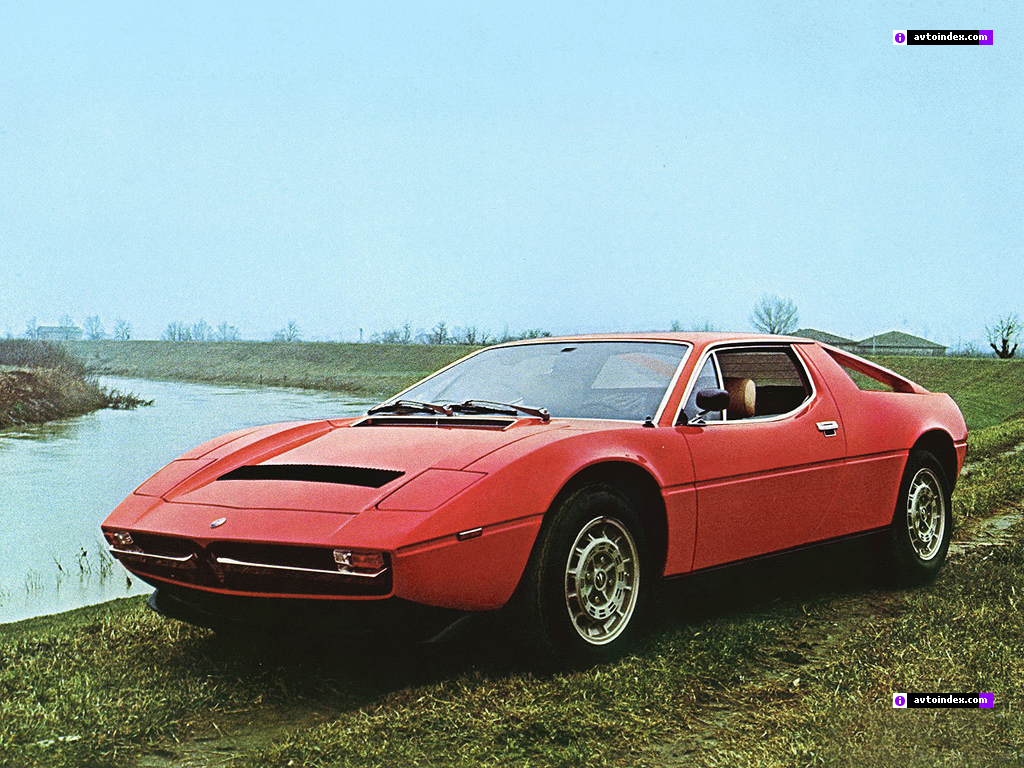
The Maserati Merak was an Italian sport car introduced in 1972, essentially a junior version of the Maserati Bora. It substituted an all new Maserati designed quad-cam V-6 motor (also shared with the Citroen SM) for the Bora's larger V-8, resulting not only in a lower cost, but room for a small backseat and better handling due to lower weight and a better front/rear weight distribution.
Aesthetically, the Merak differed from the otherwise very similar Bora mainly in sporting open flying buttresses instead of the Bora's fully glassed rear, and the use of the Citroen SM dashboard on models produced before 1976.
The Merak went out of production in 1982.

Citroën era Merak

The first Merak was designed during the Citroën ownership of Maserati (1968–1975). It featured a 3.0 L Maserati V6 (190 hp) engine, also used in the Citroën SM.
The mid-engine Merak used the Bora bodyshell, but with the extra space offered by the smaller engine used to carve out a second row of seats, suitable for children or very small adults.
As for the Bora, certain Citroën hydraulic systems were used in the Merak; brakes, clutch, headlight pods. The Citroën SM's dramatic dashboard was also used in early Meraks (1972 to 1975).

GEPI era Merak

In 1976 Maserati introduced the more powerful and lighter Merak SS. Production of the SS stopped in 1982. Its engine produced 15% more power, raising horsepower to 220 hp (164 kW) and weight was reduced by 152 kg to 1,400 kg, resulting in a top speed of 152 mph (245 km/h). Late Merak SS were bestowed with the interior and dash of the Maserati Bora. The US-spec version of the Merak SS also saw a return to traditional hydraulics, eliminating the last of the Citroen high pressure system.


DeTomaso era Merak

In 1977 DeTomaso purchased Maserati, and the Bora was discontinued after a production run of less than 600 cars. In 1977 DeTomaso introduced the Merak 2000, with a smaller powerplant. The Merak 2000 was built mainly for the Italian market, where a newly introduced tax law penalized cars with an engine capacity of more than 2000 cc. The Merak 2000 featured a 2.0 L V6 with 170 hp (127 kW). No Merak 2000 were imported to the United States.

Todays market

On today's market the Maserati Merak does not enjoy the same value as the V-8 Bora. Pricing on average is half the value of a Bora in similar condition. This is partly due to the cars' smaller V-6 powerplant. The Merak is also more common than the Bora, with about 1,900 manufactured over the 1972 to 1982 period.

Featured on television

On April 12, 2005, the Merak was featured in a Top Gear segment against its main competitors, namely the Ferrari Dino and Lamborghini Urraco. In the end, all three cars turned out to be unreliable and did not complete the challenges.
I have gratitude to Wikipedia for the help on this article !

Maserati Ghibli

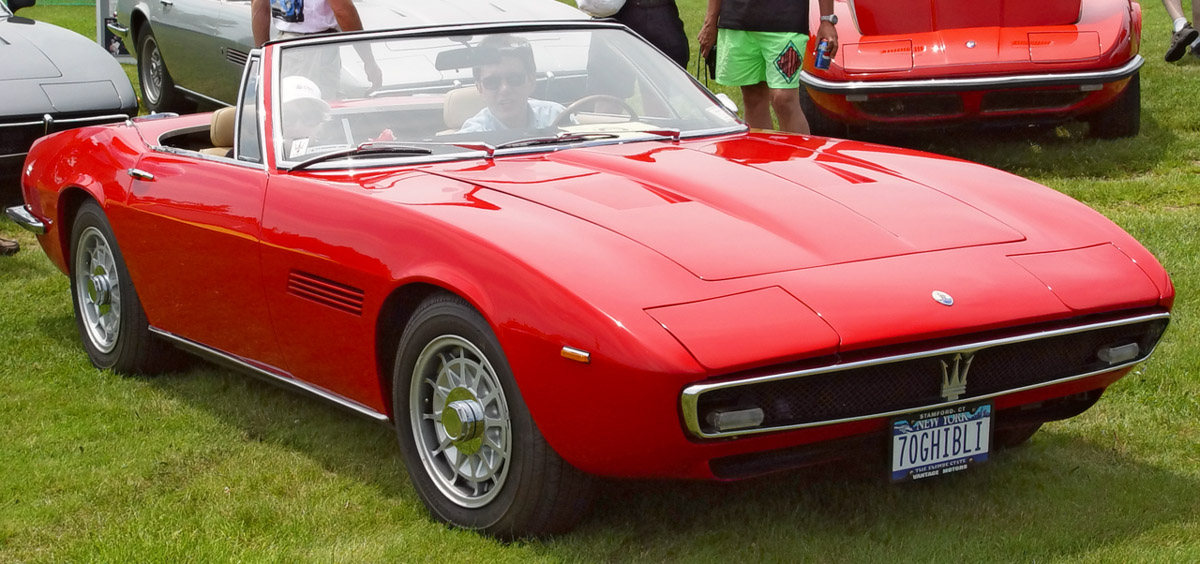
The Maserati Ghibli is a Gran Turismo car produced by Italian manufacturer Maserati in two generations: first from 1966–73, and again as the Maserati Ghibli II from 1992–97.
The original Maserati Ghibli is a two-door, two-seater GT released by Maserati in 1967. The V8-powered Ghibli debuted at the 1966 Turin Motor Show and proved to be the most popular Maserati vehicle since the automaker withdrew from racing in the 1950s, outselling its two biggest rivals, the Ferrari Daytona and the Lamborghini Miura. So well regarded was the Ghibli Sports Car International named it number nine on its list of Top Sports Cars of the 1960s.
The Ghibli's steel body, renowned for its low, shark-shaped nose, was designed by Giorgetto Giugiaro. Giugiaro, who today heads his own company ItalDesign, worked at coachbuilder Ghia when he designed the Ghibli.
The car was powered by a front-placed quad-cam 330 hp (250 kW) V8 engine. It had a 0-60 mph acceleration time of 6.8 seconds, had a top speed of 154 mph (248 km/h) and could be operated by either a five-speed manual or three-speed automatic transmission. Even by the standards of its time and class, the car consumed copious volumes of fuel, but Maserati fitted the car with two 50 L (13.2 US gal; 11.0 imp gal) fuel tanks,[1] which could be filled via flaps on either side of the roof pillars. The car also featured pop-up headlamps, leather sport seats and alloy wheels.
Maserati Ghibli Spider.


The convertible Ghibli Spyder went into production in 1969. The Spyders were relatively rare, and were outnumbered by the coupés by almost ten to one. The slightly more powerful Ghibli SS (335 hp) was released in 1970. The Ghibli went out of production in 1973 and found a successor the following year with the Bertone-designed Khamsin.
In all, 1149 Coupes, 125 Spyders and 25 Spyder SS models were produced.
Model Engine Displacement Power Fuel system
Ghibli V8 dohc 4719 cc 340 PS (250 kW; 335 hp) 4 pcs Weber 38DCNL carburetor
Ghibli SS V8 dohc 4930 cc 355 PS (261 kW; 350 hp) 4 pcs Weber 38DCNL carburetor

Lamborghini Countach

The Lamborghini Countach was a mid-engined sports car produced by Italian automaker Lamborghini from 1974 to 1990. Its design both pioneered and popularized the wedge-shaped, sharply angled look popular in many high performance sports cars. The "cabin-forward" design concept, which pushes the passenger compartment forward in order to accommodate a larger engine, was also popularized by the Countach.
In 2004, American car magazine Sports Car International named this car number three on the list of Top Sports Cars of the 1970s, and it was listed as number ten on their list of Top Sports Cars of the 1980s.
The Countach was styled by Marcello Gandini of the Bertone design studio, the same designer and studio that designed the Miura. Gandini was then a young, inexperienced designer—not very experienced in the practical, ergonomic aspects of automobile design, but at the same time unhindered by them. He produced a quite striking design. The Countach shape was wide and low (42.1 inches), but not very long (only 163 inches). Its angular and wedge-shaped body was made almost entirely of flat, trapezoidal panels.
The doors, a Countach trademark, were scissor doors: hinged at the front with horizontal hinges, so that the doors lifted up and tilted forwards. The main reason is the car's tubular spaceframe chassis results in very high and wide door sills. It was also partly for style, and partly because the width of the car made conventional doors impossible to use in an even slightly confined space. Care needed to be taken, though, in opening the doors with a low roof overhead. The car's poor rear visibility and wide sills led to drivers adopting a method of reversing the car for parking by opening the door, sitting on the sill, and reversing while looking over the back of the car from outside.
The pure style of the prototype was progressively enhanced or cluttered (depending on one's point of view) by the evolution of the car to improve its performance, handling, tractability, and ability to meet mandated requirements. This began with the first production model, which included several vents which were found to be necessary to cool the engine adequately. These included the iconic NACA duct on the door and rear fender of each side of the car. The car design changes ended with a large engine vent directly behind the driver, reducing the rear view. Later additions, including fender flares, spoilers, carburetor covers, and bumpers, progressively changed the aesthetic values of the car.
The Countach's styling and visual impression caused it to become an icon of great design to almost everyone except automotive engineers. The superior performance characteristics of later Lamborghini models (such as the Diablo, or the Murciélago) appealed to performance car drivers and engineers, but they never had the originality or outrageousness that gave the Countach its distinction. The different impressions left by the various Lamborghini models have generated numerous debates and disagreements over what constitutes 'classic' or 'great' automotive design (elegant looks and style, vs. technical and engineering superiority).
The rear wheels were driven by a traditional Lamborghini V12 engine mounted longitudinally with a mid-engined configuration. This contrasted with the Miura, on which the centrally mounted engine had been installed transversely. [2] For better weight distribution, the engine is pointed 'backwards'; the output shaft is at the front, and the gearbox is in front of the engine, the driveshaft running back through the engine's sump to a differential at the rear. Although originally planned as a 5 liter powerplant, the first production cars used the Lamborghini Miura's 4 liter engine. Later advances increased the displacement to 5 liters and then (in the "Quattrovalvole" model) 5.2 L with four valves per cylinder.


All Lamborghini Countaches were equipped with six Weber carburetors until the arrival of the 5000QV model, at which time the car became available in America, and used Bosch K-Jetronic fuel injection. The European models, however, continued to use the carburetors (producing more power than Fuel Injected cars) until the arrival of the Lamborghini Diablo, which replaced the legendary Countach.The Countach used a skin of aircraft-grade aluminium over a tubular space frame, as in a racing car. This is expensive to build but is immensely strong and very light (in spite of its size, the car weighs approximately 1,400 kg (3,100 lb). The underbody tray was fiberglass.Named to honor the company's twenty-fifth anniversary, in 1988, the 25th Anniversary Countach was mechanically very similar to the 5000QV but sported much changed styling. The rear 'air boxes' were restyled and enlarged, while the vents behind them were changed so that they ran front to back instead of side to side. In addition, a new air dam and side skirting, both with air intakes, were fitted, and the taillights were restyled to be narrower, with body-colored panels replacing the upper and lower parts of the previous large taillights. The styling changes were unpopular with many, particularly since the intakes had strakes in them that appeared to mimic those on the Ferrari Testarossa, but they improved the engine's cooling, a problem the Countach had always struggled with. It also featured 345/35R15 tires; the widest tires available on a production car at the time. The Anniversary was produced through 1990 when it was replaced by the Lamborghini Diablo.
Info courtesy to Wikipedia.

Alfa Romeo Montreal


The Alfa Romeo Montreal is a 2+2 coupé automobile produced by the Italian manufacturer Alfa Romeo from 1970 to 1977.
The first production car,[4] Tipo 10564, was shown at the 1970 Geneva Motor Show and was quite different from the original, using a 2593 cc 90° dry-sump lubricated V8 engine with SPICA (Società Pompe Iniezione Cassani & Affini) fuel injection that produced around 200 PS (147 kW; 197 hp), coupled to a five-speed ZF gearbox and a limited-slip differential. This engine was derived from the 2-litre V8 used in the 33 Stradale and in the Tipo 33 sports prototype racer.[5] The chassis and running gear of the production Montreal were taken from the Giulia GTV coupé and comprised double wishbone suspension with coil springs and dampers at the front and a live axle with limited slip differential at the rear.[5]
Since the concept car was already unofficially known as The Montreal, Alfa Romeo kept the model name in production.[3]
Stylistically, the most eye catching feature is the car's front end with four headlamps partly covered by unusual "grilles", that retract when the lights are switched on. Another stylistic element is the NACA duct on the bonnet. The duct is actually blocked off since its purpose is not to draw air into the engine, but to optically hide the power bulge. The slats behind the doors contain the cabin vents, but apart from that only serve cosmetic purposes.
Production was split between the Alfa Romeo plant in Arese and Carrozzeria Bertone's plants in Caselle and Grugliasco outside Turin.[4] Alfa Romeo produced the chassis sans engine or mechanicals and sent it to Caselle where Bertone fitted the body. After body fitment, the car was sent to Grugliasco to be degreased, partly zinc coated, manually spray painted and have the interior fitted. Finally, the car was returned to Arese to have the engine and mechanicals installed.[3] It is worth noting that because of this production method, there is not necessarily any correspondence between chassis number, engine number and production date.
The Montreal remained generally unchanged until it was discontinued in 1977. By then, production had long ceased already as Alfa were struggling to sell their remaining stock. Total number built was 3917;[2] none of them were sold in Montreal, Quebec since Alfa did not develop a North American version to meet the US/Canadian emission control requirements[citation needed]. A Montreal can be seen in the 1974 movie The Marseille Contract where Michael Caine drives a metallic dark brown example.

Cadillac Eldorado


The Eldorado model was part of the Cadillac line from 1953 to 2002. The Cadillac Eldorado was the longest running American personal luxury car as it was the only one sold after the 1999 model year. Its main competitors included the Lincoln Mark Series and the lower-priced Buick Riviera.[citation needed]

Although cars bearing the name varied considerably in bodystyle and mechanical layout during this long period, the Eldorado models were always near the top of the Cadillac line. Nevertheless, and except for the Eldorado Brougham models of 1957–1960, the most expensive models were always the opulent, long wheel-based Series 75 sedans and limousines, not the Eldorado.The name "Eldorado"

The name was proposed for a special show car built in 1952 to mark Cadillac's Golden Anniversary; it was the result of in-house competition won by Mary-Ann Marini (née Zukosky ), a secretary in the company's merchandising department. Another source, Palm Springs Life magazine, attributes the name to a resort destination in California's Coachella Valley that was a favorite of General Motors executives. However, the El Dorado Country Club in Indian Wells, California was not founded until 1957 - five years after Cadillac's naming competition. In any case, the name was adopted by the company for a new, limited-edition convertible that was added to the line in 1953.

The name Eldorado was derived from the Spanish words "el dorado", which is translated "the gilded one" or "the golden one" in English; the name was originally given to the legendary chief or "cacique" of a South American Indian tribe. Legend has it that his followers would sprinkle his body with gold dust on ceremonial occasions and he would wash it off again by diving into a lake. The name more frequently refers to a legendary city of fabulous riches, somewhere in South America, that inspired many European expeditions, including one to the Orinoco by England's Sir Walter Raleigh.The 1953 Eldorado was a special-bodied, low-production convertible (532 units in total). It was the production version of the 1952 El Dorado "Golden Anniversary" concept car, and borrowed bumper bullets (aka dagmars) from the 1951 GM Le Sabre show car.[1] Available in four unique colors (Aztec Red, Alpine White, Azure Blue and Artisan Ochre — the latter is a yellow hue, although it was shown erroneously as black in the color folder issued on this rare model). Convertible tops were available in either black or white Orlon. There was no special badging on the car, other than the "Eldorado" nameplate, in "gold", in the center of the dash. A hard tonneau cover, flush with the rear deck, hid the top in the open car version. Although it was based on the regular Series 62 convertible and shared its engine, it was nearly twice as expensive at US$7,750. This car was 221 inches (5,600 mm) long and 79 inches (2,000 mm) wide.

This first Eldorado had a wraparound windshield and a cut-down beltline, the latter signifying a dip in the sheetmetal at the bottom of the side windows. These two touches were especially beloved by General Motors Styling Chief Harley Earl and subsequently were widely copied by other marques. In fact, throughout 1950s, Eldorado was General Motors' styling leader, and since GM led the industry, where the Eldorado went, everyone else would tend to follow.

In 1954, Eldorado lost its unique sheet metal, sharing its basic body shell with standard Cadillacs. Distinguished now mainly by trim pieces, this allowed GM to lower the price and see a substantial increase in sales.For 1955, the Eldorado's body gained its own rear end styling with high, slender, pointed tailfins. These contrasted with the rather thick, bulbous fins which were common at the time and were an example of Eldorado once again pointing the way forward.

For 1956, a two-door hardtop coupe version appeared, called the Eldorado Seville.1957 saw the Eldorado (in both Biarritz convertible and Seville hardtop bodystyles) with a revised rear-end design featuring a low, downswept fenderline capped by a pointed, in-board fin. The rear fenders were commonly referred to as "chipmunk cheeks". This concept was used for two years, but did not spawn any imitators.
Cadillac Eldorado Brougham

1957 was chiefly notable for the introduction of one of GM's most memorable designs, the Eldorado Brougham. This four-door hardtop with rear-hinged rear doors was an ultra-luxury car that cost an astonishing $13,074 — twice the price of any other 1957 Eldorado and more than the Rolls-Royce Silver Cloud of the same year. It featured a stainless steel roof, air suspension, the first memory power seats, automatic starting for the engine and every other comfort and convenience feature available at GM at the time, even small bottles of perfume. There were serious difficulties with the air suspension. Some owners found it cheaper to have the system removed and replaced with conventional coil springs.
1959–1966:A different Eldorado Brougham was sold for 1959 and 1960. These cars were not quite so extravagantly styled but were very unusual pieces in themselves. Priced at $13,075, they cost $1 more, each, than their older siblings. The design was 100% Cadillac but the company contracted out the assembly to Pininfarina of Italy, with whom the division has had a long-running relationship, and these Eldorados were essentially hand-built in Italy. Discreet, narrow taillights - were integrated into modest tailfins, and a squared-off rear roof line allowed the Brougham to contrast sharply to the "rocketship" taillights, flamboyant fins, and rounded roof lines of the standard 1959 Cadillacs. However, the Brougham's styling cues would prove to indicate where Cadillac styling would head in the early-mid 1960s. Build quality was not nearly to the standard of the Detroit hand-built 1957–1958 models, and the 1959–1960 Broughams did not sell as well as their forebears. However, collector interest and values remain high.

The last Eldorado Seville was built in 1960. After that, the Eldorado convertible became essentially a more luxuriously trimmed version of the Cadillac Series 62 convertible (using trim pieces reserved only for the Fleetwood Sixty Special).

An Eldorado convertible would remain in the Cadillac line through 1966, but its differences from the rest of the line were generally modest. In 1964, probably the most distinctive year during this period, the main visual cue indicating an Eldorado was simply the lack of fender skirts.The Eldorado was radically redesigned in 1967. Intended for the burgeoning personal luxury car market, it was a "personal" Cadillac sharing the E-body with the Oldsmobile Toronado and Buick Riviera, which had been introduced the previous year. Cadillac adopted the Toronado's Unified Powerplant Package and front-wheel drive. (Contrary to popular belief, the similar Buick Riviera did not use the front-wheel drive setup until 1979.) The Eldorado used a standard Cadillac 429 V8 with a modified Turbo-Hydramatic automatic transmission (THM425, based on the Turbo-Hydramatic 400) with the torque converter mounted next to the planetary gearbox, driving it through a metal chain.

Despite sharing underpinnings with the Toronado, the Eldorado's crisp styling, initiated by GM styling chief Bill Mitchell, was distinctive and unique, appearing more angular than the rounded Toronado. Performance was 0–60 mph (0–96 km/h) in less than nine seconds and a top speed of 120 mph (192 km/h). Roadability and handling were highly praised by contemporary reviews, and its sales, 17,930 units,[5] helped give Cadillac its best year ever.[6] Disc brakes were optional in 1967 and became standard in 1968. The new Eldorado was a great departure from the previous generation, which had become little more than a dressed-up version of Cadillac's Series 62. Sales were excellent despite high list prices.

In 1968, the Eldorado gained slight exterior changes to comply with new federal safety and emissions legislation, and as with the rest of the Cadillac lineup, a new 472 cu in (7.7 l) V8 rated at 375 hp (280 kW) (SAE gross). In 1969 it lost its hidden headlamps and picked up as options a halo vinyl roof and later in the model year a power sunroof option. For the 1970 model year, the Eldorado introduced the new 500 cu in (8.2 l) V8 engine, the largest-ever production V8, rated SAE gross 400 hp (298 kW) and 550 ft·lbf (746 N·m) in 1970, that would be an Eldorado exclusive until it became standard on all full size Cadillacs in the 1975 model year.When GM's full-size cars were redesigned for 1971, the Eldorado regained both a convertible model and its fender skirts. The 126.3-inch (3,210 mm) wheelbase version of the Eldorado would run through 1978, receiving facelifts in 1973 and 1975. As before, the Eldorado and Toronado shared the front-wheel drive E-body chassis, while the Riviera (which would temporarily switch to the "B" platform for 1977) remained rear-wheel drive.

Although the door glass on all Eldorados remained frameless, the hardtop rear quarter windows vanished, replaced by a fixed "opera window" in the widened "C" pillar. This was likely done to conform to threatened Federal rollover safety standards that were scheduled to take effect by the mid-1970s.

The Cadillac Eldorado was chosen as the pace car for the Indianapolis 500 Mile Race in 1973. All in all, Cadillac produced 566 of these special pace car convertibles. 33 were used at the track during the race week and the remaining 513 cars were distributed to the U.S. Cadillac dealers (one for each dealership), which were then sold to the general public.

A redesigned instrument cluster was phased in during the 1974 model year (known as the 'space age' instrument panel from Cadillac literature), also shared with Calais, DeVilles and Fleetwoods.

For 1977, the Eldorado received a new grille with a finer crosshatch pattern. The convertible was canceled (although Custom Coach of Lima, Ohio took a few brand-new 1977 and 1978 Eldorados into their coachbuilder facilities and converted into coach convertibles using salvaged parts from 1971-76 Eldorados; Cadillac did not produce convertibles after 1976). The 8.2L V8 of 1970-76 gave way to a new 7L V8 with 180 bhp (134 kW). Minor changes followed in 1978.

This generation of Eldorados produced between 1971 and 1978 were sometimes customized as seen in films like Dolemite, Superfly, Highwaymen (film), The Mack, Willie Dynamite, (the customized Eldorado seen in Willie Dynamite is similar to the one seen in Magnum Force) and even the James Bond film Live and Let Die. An Eldorado was also used in Rob Zombie's second film, The Devil's Rejects as the car that the character Charlie drove. Customizers such as Les Dunham Coachworks have modified brand-new Eldorados with headlight covers (commonly known as Superfly headlights), grille caps, a 1941 goddess hood ornament, lake pipes, and thick-padded vinyl tops, usually with circular porthole windows.
For 1979, a new, trimmer Eldorado was introduced, and for the first time the car shared its chassis with the Buick Riviera as well as the Toronado. Smaller 350 and 368 in³ (5.7 and 6.0 L) V8's replaced the 500 and 425 in³ (8.2 and 7.0 L) of the preceding model, giving better fuel efficiency. For 1979, it was offered only with the Oldsmobile 350 as standard, with the diesel 350 available as an option.
1980 Cadillac Eldorado

In 1980, the gas 350 was replaced with the Cadillac 368 except in California, where the Olds 350 was retained for that year. In both the 1980 Seville and Eldorado (which shared their frames), the 368s in 1980 came with DEFI, whereas for the larger RWD Cadillacs, the 368 only came with a 4-barrel Quadrjet carburetor. Independent rear suspension was adopted, helping retain rear-seat and trunk room in the smaller body. The most notable styling touch was an extreme notchback roofline, making the rear window almost vertical. The Eldorado Biarritz model resurrected the stainless-steel roof concept from the first Brougham. Although downsized, these Eldorados were still substantial-sized cars with good room and power. Contrary to the current body design of the time, the Eldorado continued to feature frameless door glass, and the rear quarter windows re-appeared as they did before 1971, without a thick "B" pillar. However, these cars were not true hardtops, as the rear quarter windows were fixed and could not be rolled down. Most people probably didn't even notice, since air conditioning was de rigueur for all the cars, and the coupe featured "hospital zone" quietness with the windows closed.

For 1981, Cadillac began offering the V8-6-4 variable displacement variant of the 368 engine, which was designed to deactivate some cylinders when full power was not needed, helping meet GM's obligations under the government fuel economy ("CAFE") standards. Unfortunately, it did not work as planned, and sometimes did not work at all. It was a reduced bore version of the 1968 model-year 472, sharing that engine's stroke and also that of the model-year 1977–1979 425. The engine itself was extremely rugged and durable, but its complex electronics were the source of customer complaints.

Another problem with the 1981 model year was an unexplained balancing problem that affected the vehicle's overall handling. GM corrected this issue by installing a large, heavy steel plate under the driver's seat, a fact made popular by 1995's film Casino. The film's leading man Robert De Niro survives a bomb explosion, where the explosive had been attached to his 1981 Eldorado's undercarriage, on the driver's side, with that steel plate effectively shielding his driver seat from the blast beneath; the steel plate is credited with saving his life. The film, including the Eldorado explosion incident, is based upon Frank Rosenthal's life story.

Another problematic engine was introduced for 1982. The 4.1 L HT-4100 was an in-house design that mated cast-iron heads to an aluminum block. HT-4100s failed in large numbers and many were replaced under warranty.[citation needed]

Nevertheless, the Eldorado's reputation was not permanently hurt, and sales rose to unprecedented heights, nearly 100,000 units by 1984, an astonishing volume for one of the most expensive models available.[citation needed]

In 1984, Cadillac also introduced a convertible version of Eldorado Biarritz. It was 200 pounds (91 kg) heavier, but featured the same interior as other Biarritz versions. The model year of 1985 was the last year for the ASC, Inc., aftermarket conversion Eldorado convertible. Because of its limited edition (around 3000 total), the convertible models are now highly sought after by numerous collectors.

1984 was also the first year electronic "digital" instrumentation was an available option. In addition to the digital electronic climate control that was standard on all Eldorados, the standard analog speedometer and fuel gauges could be replaced with a digital display showing speed in a single, precise, and instant number and a fuel gauge that would read the number of gallons of fuel remaining in the gas tank and another gauge showing approximately how many miles can be driven on it.

Prior to the 'official' 1984 and 1985 Eldorado convertibles marketed by Cadillac, some 1979-83 Eldorados were made into coach convertibles by independent coachbuilders e.g. American Sunroof Corporation, Custom Coach (Lima, Ohio - this coachbuilder turned a few 1977 and 1978 Eldorados into convertibles), Hess & Eisenhardt. The same coachbuilders also converted the Oldsmobile Toronado and Buick Riviera into a ragtop.

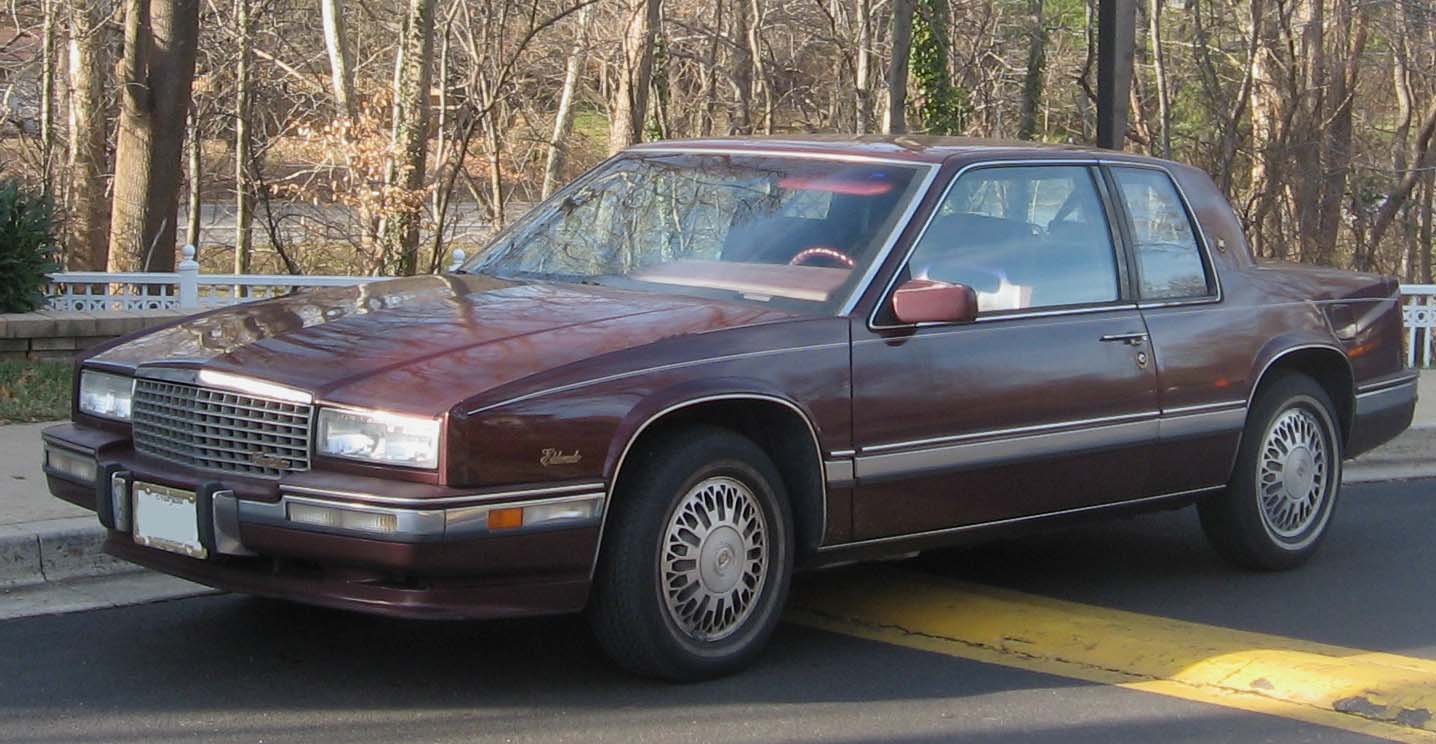
The very limited edition Commemorative Edition was produced in 1985. These are identified by special emblems on the trunk lid and sail panels as well as gold color door lock knobs and keys.For 1986, yet another downsizing occurred, and it was fairly extreme. The Eldorado lost about 16" in length, and some 350 pounds in weight. The convertible was discontinued. Just like in previous generations, the Eldorado shared its chassis with the Oldsmobile Toronado and Buick Riviera, as well as Eldorado's four-door companion, the Cadillac Seville. However, the coupes from Buick and Oldsmobile both utilized Buick's 3.8 liter V6 engine, while Cadillac continued to use their exclusive 4.1 liter V8. The $24,251 Eldorado was now the same size that GM's own compact cars had been only a few years earlier, and considerably smaller than Lincoln's competing Mark VII. Its styling seemed stubby, and in a final unfortunate flourish, for the first time the Eldorado abandoned its "hardtop" heritage and featured framed door glass. News reports later indicated that GM had been led astray by a consultant's prediction that gasoline would be at $3 per gallon in the U.S. by 1986, and that small luxury cars would be in demand. In fact, gasoline prices were less than half that. With a sales drop of 60%, seldom has any model experienced a more precipitous fall. Production was only about a fifth of what it had been just two years earlier.

Aside from a longer, 5 year/50,000 mile warranty, Eldorado received very few changes for 1987. A price drop, to $23,740, did not raise sales any, as only 17,775 were made this year (21,342 for 1986). The standard suspension, with new taller 75 series (previously 70) tires and hydro-elastic engine mounts, was slightly retuned for a softer ride, while the optional ($155) Touring Suspension, with deflected-disc strut valves and 15" alloy wheels, remained for those desiring a firmer ride. As part of a federal requirement to discourage "chop-shop" thieves, major body panels were etched with the VIN. Also new, a combination cashmere cloth with leather upholstery, and locking inertia seat belt reels for rear seat passengers, which allowed for child-seat installation in the outboard seating positions in back. The formal cabriolet roof was added this year. Available for $495 on the base Eldorado, it featured a padded covering over the rear half of the roof, and turned the rear side glass into smaller opera windows. One of Eldorado's most expensive singluar options was the Motorola cellular telephone mounted inside the locking center arm rest. Priced at $2,850, it had been reworked this year for easier operation, and featured a hidden microphone mounted between the sun visors for hands-free operation. Additionally, the telephone featured a clever radio mute control: activated when the telephone and radio were in use at the same time, it automatically decreased the rear speaker's audio volume, and over-rode the front music speakers to be used for the hands-free telephone. On an interesting note, the square marker lamp, located on the bumper extension molding just behind the rear wheel well on 1986 and '87 Eldorado models, would suddenly re-appear on the 1990 & '91 Seville (base models only) and Eldorado Touring Coupe.

1988 was met with an extensive restyle, and sales nearly doubled from the previous year, up to 33,210. While the wheelbase, doors, roof, and glass remained relatively unchanged, new body panels gave the 1988 model a more identifiable "Eldorado" appearance. Now available in just 17 exterior colors (previously 19), the new Eldorado was 3" longer than last year. Underneath the restyled hood was Cadillac's new 155 horsepower 4.5 liter V8. A comprehensive anti-lock braking system, developed by Teves, was newly available. Longer front fenders held "bladed" tips, and a new grill above the revamped front bumper. In back, new three-sided tail lamps - reminiscent of the 1987 Deville - appeared along with a new bumper and trunk lid. Bladed 14" aluminum wheels remained standard, while an optional 15" snowflake-pattern alloy wheel was included with the Touring Suspension option. The interior held wider front seat headrests and swing-away door pull handles (replacing the former door pull straps). New upholstery patterns, along with shoulder belts for outboard rear-seat passengers, appeared for both base and Biarritz models, with the latter bringing back the tufted-button design - last seen in the 1985 Eldorado Biarritz. A new vinyl roof option, covering the full roof top, featured a band of body color above the side door and windows - similar to the style used until 1978. This replaced the "cabriolet roof" option, which covered the rear half of the roof, introduced just a year earlier. With the Biarritz option package, the padded vinyl roof covered just the rear quarter of the roof top, behind the rear side windows. Biarritz also included slender vertical opera lamps, as in 1986 and '87, but now added a spear molding (similar to the style used on the 1976 - 1985 Eldorado Biarritz) that ran from the base of the roof top, continuing horizontally along the door, and down to the front fender tip. The standard power antenna was moved from the front passenger fender to the rear passenger fender. Pricing went up this year - to $24,891. This 1988 restyle would be the last, until the model was replaced by an all-new Eldorado for 1992.
1986–1991 Cadillac Eldorado

With such big changes for Eldorado just a year earlier, 1989 saw little that was new. The optional automatic rearview mirror went from a electrically-operated mechanical tilting mechanism to the new electrochromic style, using a clear fluid filled between the mirror and a thin sheet of glass, which tints upon activation. A new exterior color, White Diamond, brought the color choices up to 18. Gone were the 14" wheels, as the previously-optional 15" "snowflake" style aluminum wheel, introduced last year, was made standard for the base Eldorado. A compact disc player, available only with the Delco Bose Gold Series music system, was a new option this year, as was reversible floor mats, and gold-plated ornamentation ("Cadillac" grille and trunk scripts, sail panel ornaments, deck lid engine plaque, trunk lock cover, tail lamp emblems, and available wire wheel cover wreath and crest). New standard items include an express-down module for the driver's window, electronic oil-life indicator, a more powerful Delco Freedom II battery, a revised factory warranty, and GM's PASS (Passive Automotive Security System) KEY theft-deterrent system, which activated the fuel system based upon a coded pellet within the ignition key. Previously optional items that were now added as standard equipment included a cassette player with graphic equalizer, remote fuel filler door release, and a front license plate mounting. In an effort to use up existing warehouse stock, the brushed chrome lower bodyside accent molding, optional through last year, was added as standard equipment for 1989 (revamped moldings would appear in 1990). New high-gloss Birdseye Maple trim (replacing the satin-finished American Walnut used from 1986–1988) on the instrument panel and console was standard on Eldorado Biarritz, and available (for $245) on the base Eldorado. The optional full cabriolet roof, which re-created the dashing look of a convertible top, was offered this year in limited colors. Pricing rose again, now at $26,738. Production slipped slightly, down to 27,807 (including 7,174 Biarritz models). The dip in sales was partly due to competition from GM's own Buick Riviera, which grew 11" this year in a dramatic restyle, and had a production increase from 8,625 units in 1988 to 21,189 in 1989.

Aside from the new-for-1990 Touring Coupe model (see entry below) introduced later in the model year, it was a year of enhancement for Eldorado. A driver's side airbag was introduced as standard equipment, but as a result, the telescoping steering column was discontinued (although the tilt feature remained). Cruise control buttons were mounted on the center of the previous steering wheel, but with the advent of the air bag (mounted on a smaller diameter steering wheel), they were now moved to the turn signal stalk. A new multi-point fuel injection replaced the throttle-body style from last year, and horsepower jumped from 155 to 180, although the new system required the use of premium fuel. A new cast aluminum wheel design (not available with the Touring Suspension package) was optional for those customers who desired something different than the standard "snowflake" alloy wheel on the base Eldorado. Seating received numerous enhancements, including new molded trim panels, additional lateral and lumbar support, French seams, and revised front headrests. Full leather upholstery (formerly leather and cloth) was now standard on the Biarritz model, but the base model lost the seat-back map pockets. The cellular telephone disappeared from the option list, and the vinyl center armrest was revamped. The electronic climate control received an update in the form of three automatic and two manual settings. The optional leather upholstery package on the base model now included a power passenger seat recliner. Last year's "Eldorado Option Package" (which included new-style carpeted floor mats, body-color door edge guards, illuminated driver and passenger visor vanity mirrors, luggage compartment mat, and the illuminated entry system) was now standard. Additionally, previously optional items that were added as standard equipment this year included the rear window defogger with heated outside mirrors, and bodyside accent striping. New options for 1990 included a central-unlocking feature (from the outside door locks using the key) added to the automatic door locks. A revised deck-lid engine plaque now mentioned the port fuel injection, and the deck-lid itself held a chromed handle above the license plate opening. Also, the rear safety reflectors moved from the bumper onto the panel below the decklid this year. A new charcoal-colored vinyl strip accented the chrome bumper and bodyside moldings this year, while the front bumper guards changed from body-color to charcoal. In the front suspension, the stabilizer shaft was revised for ride and handling, while the tire jack located in the trunk had a new carpeted storage container. Price for 1990 was $28,885, with the Biarritz model an additional $3,180. Production dropped to 20,874 units, about 1/3 of which were the Biarritz model. An additional 1,507 Eldorado Touring Coupe models were made.

1991, the last year for this body style, was also the first year for Cadillac's new 4.9 liter V-8 engine with port fuel injection, teamed up with GM's 4T60-E electronically-controlled 4-speed transmission. Cadillac set apart the GM transmission from other corporate models it was shared with by the Cadillac-exclusive viscous converter clutch, which provided even smoother shifting under hard acceleration. Engine controls were monitored by the GMP4 Powertrain Control Module (PCM), an on-board 64-kilobyte computer. A new exhaust set-up with a wider catalytic converter reduced restriction by 38% from last year, while the 0-60 mph speed went from 9 seconds in 1990 to 8.2 for '91. Revised engine mounts prevented engine noise and vibration from affecting the cabin, while new the Computer Command Ride (CCR) system, optional on most other Cadillac models, was standard on Eldorado. CCR would automatically adapt the suspension mode with regard to vehicle speed for better handling and ride comfort. A $309 electrically-heated windshield was new to the option list this year, as was the available ($480 on base Eldorado, no charge on Biarritz or Touring Coupe) "Security Package" which now included remote keyless entry along with automatic door locks with central unlocking, and the theft-deterrent system. The Bosch II anti-lock braking system, previously a $925 option, was made standard this year, as well as a more powerful 140-amp alternator. A revised windshield washer system rounded out the changes for 1991. Base price was $31,245, almost $2,400 up from 1990, but the jump was not nearly as dramatic when considering the new powertrain and sophisticated suspension system, and that anti-lock brakes were now standard equipment, as well as other previously optional items that were now available at no-charge. In an effort to exhaust parts inventory - and to make Eldorado appear to be a better value in its last year of current style production, several optional items were available at no-charge on the base Eldorado, including choice of full vinyl roof covering or full-cabriolet (convertible-look) roof (an otherwise $1,095 option), leather upholstery with power passenger recliner, and the Delco-Bose sound system - with choice of CD or cassette. Additionally, both the $2,050 Touring Coupe and the $3,180 Biarritz packages included the power moon roof and Delco-BOSE stereo at no additional charge. This would be the last year for the Eldorado Biarritz. Production dropped to just 16,212 (including 2,249 Touring Coupe models), the lowest output seen since 1966.
[edit] 1990–1991 Eldorado Touring Coupe

Although a touring suspension option had been available on Eldorado since 1980, there was an Eldorado Touring Coupe model introduced in mid-1982, and continued through 1985. In 1990, the Eldorado Touring Coupe (ETC), the 2-door version of the Seville Touring Sedan (STS), re-appeared. The car had a special handling and suspension package, quicker steering than the standard Eldorado, and a higher final drive ratio of 3.33:1 in contrast to the base model's 2.97:1. Badging was restricted to ETC badges on both C-pillars, a Cadillac crest on the grille along with the Cadillac script logo and a special "Cadillac Motor Car Company" badge on the trunk, which it shared with the STS. Available in Sable Black, Cotillion White, Medium Slate Gray Metallic, Black Sapphire Metallic (Dark Blue), and Crimson (Bright Red), all with a special beechwood interior. An additional color, Polo Green Metallic, was added for '91. The driver's outside rearview mirror held glass with a blue-tint to reduce glare from following vehicles. The model also featured body-colored door handles, wider side rocker panels, an additional marker lamp behind the rear wheel well, and dual rectangular exhausts. The international-theme tail lights, which were Touring Coupe specific, featured a distinct split-style with "amber above red" lenses.

Eldorado Touring Coupe production for 1990 was 1,507, with an additional 2,249 in 1991.For 1992, Cadillac introduced a new Eldorado, only slightly bigger than its predecessor. Window glass was once again frameless, and shortly after introduction Cadillac's new Northstar V8 became available in both 270 and 295 hp (220 kW) variants, replacing the 200 hp (150 kW) 4.9 L. Sales were up, though never again at record heights.

The Eldorado continued for the rest of the decade with incremental changes and tapering sales. A passenger side airbag was added as standard equipment in 1993. Fresh exterior styling - in the form of updated bumpers front and rear, side cladding, and a new grille - arrived for '95. 1996 featured a slightly revamped interior with a new upholstery sew style, larger analog gauge cluster, relocated climate control system, and updated stereo faces. In the wake of declining sales, circulating reports that the Eldorado would get a redesign for 1999 — similar to that which its Seville platform mate underwent for 1998 — would prove false as the car soldiered on largely unchanged into the new millennium, although it did get some upgrades from the 1999 Seville sister.

The car was also sold under the badge Cadillac ETC (Eldorado Touring Coupe) and ESC (Eldorado Sport Coupe).[7]
2002 Cadillac Eldorado ETC

Having lost its only remaining 2-door platform mate, the Buick Riviera, after the 1999 model year, rumors of the Eldorado's imminent demise began to circulate. GM showed a lowered, customized Eldorado-based concept at the 2000 North American International Auto Show, which was called EldoRODo, to little media or public interest.

Not long after, GM announced that the Eldorado's 50th model year, 2002, would be its last. To mark the end of the historic name, a limited production run 1,596 of cars in red or white - the colors available on the original 1953 convertible - were produced in three batches of 532, signifying the Eldorado's first year of production. These last cars had exhausts that were specially tuned to imitate the note of their illustrious forerunners from a half-century earlier, and a dash-mounted plaque indicating each car's sequence in production. The last Eldorado was delivered to the Cadillac Museum, in honor of Don Massey of Don Massey Cadillac - one of the largest Cadillac dealers in the United States. The second-to-last production Eldorado was sold to Nicola Bulgari, the Italian jeweler and avid automotive aficionado. The car will reside with his collection in Rome, Italy. Production ended on April 22, 2002,[8] with the Lansing Craft Centre retooled to build the Chevrolet SSR.
Related Posts Plugin for WordPress, Blogger...