


Showing posts with label American cars. Show all posts
Showing posts with label American cars. Show all posts
Cord 810/812 Roadster
30's,
american,
American cars,
Auburn Aotomobile,
beautiful car,
classic car,
Cord,
Cord 810/812 Roadster,
God bless AMERICA,
North America,
top 100
Cord was the brand name of a United States automobile, manufactured by the Auburn Automobile Company from 1929 through 1932 and again from 1936 to 1937.
 The Cord Corporation was founded and run by Errett Lobban Cord as a holding company for his many transportation interests, including the Auburn Automobile Company. Cord was noted for its innovative technology and streamlined designs. It is said that Mr. Cord had a philosophy to build truly different, innovative cars, believing they would also sell well and turn a profit. This did not always work well in practice.


Comments
0

Ford GT40
2000's,
60's,
american,
American car,
American cars,
beautiful car,
classic car,
Ford GT40,
God bless AMERICA,
Henry Ford,
muscle car,
muscle cars,
North America,
race car,
sports car

It was built to win long-distance sports car races against Ferrari (who won at Le Mans six times in a row from 1960 to 1965). Chassis # P-1075, which won in 1968 and 1969, is the first car in Le Mans history to win the race more than once with the same chassis, and only one of two cars to have won with the same chassis.) using a Ford engine originally 4.7- liter, enlarged to 4.9-liter (also known as a 5.0) with special alloy Gurney-Weslake cylinder head.
The car was named the GT (for Grand Touring) with the 40 representing its overall height of 40 inches (1.02 m, measured at the windshield) as required by the rules. Large displacement Ford V8 engines (4.2 liter, 4.7 liter and 7 liter) were used, compared with the Ferrari V12 which displaced 3.0 liter or 4.0 liter.
Early cars were simply named "Ford GT". The name "GT40" was the name of Ford's project to prepare the cars for the international endurance racing circuit, and the quest to win the 24 Hours of Le Mans. The first 12 "prototype" vehicles carried serial numbers GT-101 through GT-112. The "production" began and the subsequent cars, the MkI, MkII, and MkIIIs,( with the exception of the MkIV, which were numbered J1-J10)were numbered GT40P/1000 through GT40P/1145, were officially "GT40s". The name of Ford's project, and the serial numbers dispel the story that "GT40" was "only a nickname."
The contemporary Ford GT is a modern homage to the GT40.
History
Henry Ford II had wanted a Ford at Le Mans since the early 1960s.
To this end Ford began negotiation with Lotus, Lola, and Cooper. Cooper had no experience in GT or prototype and its performances in Formula One were declining.
Lotus was already a Ford partner for their Indy 500 project. Ford executives already doubted the ability of Lotus to handle this new project. Colin Chapman probably had similar views as he asked a high price for his contribution and insisted that the car (which became the Lotus Europa) should be named a Lotus-Ford, an attitude that can be viewed as polite refusal.
The Lola proposal was chosen, since Lola had used a Ford V8 engine in their mid-engined Lola Mk 6 (also known as Lola GT). It was one of the most advanced racing cars of the time, and made a noted performance in Le Mans 1963, even though the car did not finish, due to low gearing and so revving out on the mulsanne straight. However, Eric Broadley, Lola Cars' owner and chief designer, agreed on a short-term personal contribution to the project without involving Lola Cars.
The agreement with Broadley included a one-year collaboration between Ford and Broadley, and the sale of the two Lola Mk 6 chassis built to Ford. To form the development team, Ford also hired the ex-Aston Martin team manager John Wyer. Ford Motor Co. engineer Roy Lunn was sent to England; he had designed the mid-engined Mustang I concept car powered by a 1.7 liter V4. Despite the small engine of the Mustang I, Lunn was the only Dearborn engineer to have some experience with a mid-engined car.
Overseen by Harley Copp, the team of Broadley, Lunn and Wyer began working on the new car at the Lola Factory in Bromley. At the end of 1963 the team moved to Slough, near Heathrow airport. Ford then established Ford Advanced Vehicles Ltd, a new subsidiary under the direction of Wyer, to manage the project.
The first chassis built by Abbey Panels of Coventry was delivered on March 16, 1963. The first "Ford GT" the GT/101 was unveiled in England on April 1 and soon after exhibited in New York.
It was powered by the 4.2 L Fairlane engine with a Colotti transaxle, the same power plant was used by the Lola GT and the single-seater Lotus 29 that came in a highly controversial second at the Indy 500 in 1963. (A DOHC head design was used in later years at Indy. It won in 1965 in the Lotus 38.)
The Ford GT40 was first raced in May 1964 at the Nürburgring 1000 km race where it retired with suspension failure after holding second place early in the event. Three weeks later at the 24 Hours of Le Mans, all three entries retired although the Ginther/Gregory car led the field from the second lap until its first pitstop. After a season-long series of dismal results under John Wyer in 1964, the program was handed over to Carroll Shelby after the 1964 Nassau race. The cars were sent directly to Shelby, still bearing the dirt and damage from the Nassau race. Carroll Shelby was noted for complaining that the cars were poorly maintained when he received them, but later information revealed the cars were packed up as soon as the race was over, and FAV never had a chance to clean, and organize the cars to be transported to Shelby.
Shelby's first victory came on their maiden race with the Ford program, with Ken Miles and Lloyd Ruby taking a Shelby American-entered GT40 to victory in the Daytona 2000 in February of 1965. The rest of the season, however, was a disaster.

Miles' death occurred at the wheel of the Ford "J-car", an iteration of the GT40 that included several unique features. These included an aluminum honeycomb chassis construction and a "breadvan" body design that experimented with "kammback" aerodynamic theories. Unfortunately, the fatal Miles accident was attributed at least partly to the unproven aerodynamics of the J-car design, as well as the experimental chassis strength. The team embarked on a complete redesign of the car, which became known as the Mk IV. The Mk IV, a newer design with a Mk II engine but a different chassis and a different body, won the following year (when four Mark IVs, three Mark IIs and three Mark Is raced). The high speeds achieved in that race caused a rule change, which already came in effect in 1968: the prototypes were limited to the capacity of to 3.0 liter, the same as in Formula One. This took out the V12-powered Ferrari 330P as well as the Chaparral and the Mk. IV. If at least 50 cars had been built, sportscars like the GT40 and the Lola T70 were allowed, with a maximum of 5.0 L. John Wyer's revised 4.7 liter (Bored to 4.9 liter, and o-rings cut and installed between the deck and head to prevent head gasket failure, a common problem found with the 4.7 engine.) Mk I. It won the 24 hours of Le Mans race in 1968 against the fragile smaller prototypes. This result, added to four other round wins for the GT40, gave Ford victory in the 1968 International Championship for Makes. The GT40's intended 3.0 L replacement, the Ford P68, and Mirage cars proved a dismal failure. In 1969, facing more experienced prototypes and the new yet still unreliable 4.5 L flat-12 powered Porsche 917s, the winners Ickx/Oliver managed to beat the remaining 3.0 liter Porsche 908 by just a few seconds with the already outdated GT40 (in the very car that had won in 1968 - the legendary GT40P/1075). Apart from brake wear in the Porsche and the decision not to change pads so close to the race end, the winning combination was relaxed driving by both GT40 drivers and heroic efforts at the right time by (at that time Le Mans' rookie) Jacky Ickx, who won Le Mans five times more in later years. In 1970, the revised Porsche 917 dominated, and the GT40 had become obsolete.At the 1995 Detroit Auto Show, the Ford GT90 concept was shown and at the 2002 show, a new GT40 Concept was unveiled by Ford.
While similar in appearance to the original cars, it was bigger, wider, and three inches taller than the original 40 inches (1.02 m). Three production prototype cars were shown in 2003 as part of Ford's centenary, and delivery of the production Ford GT began in the fall of 2004. The Ford GT was assembled in the Ford Wixom plant and painted by Saleen, Incorporated at their Saleen Special Vehicles plant in Troy, Michigan, USA.

A British company, Safir Engineering, who made continuation GT40s in the 1980s owned the GT40 trademark at that time, and when they completed production, they sold the excess parts, tooling, design, and trademark to a small American company called Safir GT40 Spares based in Ohio. Safir GT40 Spares licensed the use of the GT40 trademark to Ford for the initial 2002 show car, but when Ford decided to make the production vehicle, negotiations between the two failed, and as a result the new Ford GT does not wear the badge GT40. It is rumored[by whom?] that Safir GT40 Spares asked $40 million dollars for the rights, but this has never been verified. The partners at Safir GT40 Spares state they have correspondence from Ford declining Safir's $8 million offer. Later models or prototypes have also been called the Ford GT but have had different numbering on them such as the Ford GT90 or the Ford GT70. The GT40 name is currently licensed for use by the Pathfinder Motorsports GT40/R Competition, which is built by Hi-Tech in South Africa, which also builds street version models of the GT40.
Plymouth Superbird
70's,
american,
American cars,
classic american car,
Mopar,
muscle car,
NASCAR,
Plymouth,
Plymouth Superbird

The short-lived Plymouth Road Runner Superbird was a highly modified version of the Plymouth Road Runner with well known graphics and horn. It was the factory's follow up stock car racing design for the 1970 season to the Dodge Charger Daytona of 1969, and incorporated many engineering changes and modifications (both minor and major) garnered from the Daytona's season in competition on the track. The car's primary rival was the Ford Torino Talladega, which in itself was a direct response to the Mopar aero car. It has also been speculated[who?] one major motivating factors in the production of the car was to lure Richard Petty back to Plymouth. Both of the Mopar aero cars famously featured a protruding, aerodynamic nosecone, a high-mounted rear wing and, in the case of the Superbird, the same horn which mimicked the Road Runner cartoon character.
Developed specifically for NASCAR racing, the Superbird, a modified Road Runner, was Plymouth's follow-on design to the Charger Daytona fielded by sister company Dodge in the previous season. The Charger 500 version that began the 1969 season was the first American car to be designed aerodynamically using a wind tunnel and computer analysis, and later was modified into the Daytona version with nose and tail. The Superbird's smoothed-out body and nosecone were further refined from that of the Daytona, and the street version's retractable headlights added nineteen inches to the Road Runner's original length. The rear wing, was mounted on tall vertical struts that put it into less disturbed air thus increasing the efficiency of the downdraft that it placed upon the car's rear axle. For nearly thirty years the mathematic formula used to determine the exact height of the enormous wing was thought to be a highly guarded Chrysler secret. However, in the 1990's a retired Chrysler project engineer admitted publicly that the height was determined in much simpler fashion: It was designed to provide clearance for the trunklid to open freely. The rear-facing fender scoops were incorporated in an effort to ventilate trapped air from the wheel wells in order to facilitate brake cooling.

"Superbird" decals were placed on the outside edges of the spoiler vertical struts featuring a picture of the Road Runner cartoon character holding a racing helmet. A smaller version of the decal appears on the driver side headlight door. Superbirds had three engine options: the 426 Hemi V8 engine, the 440 Super Commando with a single 4-barrel carburetor, or the 440 Super Commando Six Barrel with three two-barrel carburetors. Only 135 models were fitted with the 426 Hemi. As the 440 was less expensive to produce, the "Street" version of the 426 Hemi engine used in competition was homologated by producing the minimum number required.
On the street, the nose cone and wing were very distinctive, but the aerodynamic improvements hardly made a difference there or on the drag strip. In fact, the 1970 Road Runner was actually quicker in the quarter mile and standard acceleration tests due to the increased weight of the Superbird's nose and wing. Only at speeds in excess of 90 mph (140 km/h) did the modifications show any benefit.

The Superbird and the Dodge Charger Daytona were each built for one model year only (1970 and 1969 respectively).
AC Cobra
60's,
AC,
AC Shelby Cobra,
american,
American car,
American cars,
american market,
classic american car,
God bless AMERICA,
muscle car,
race car

The AC Cobra, also known colloquially as the Shelby Cobra in North America, is an Anglo-American sports car that was produced during the 1960s.
Like many British specialist manufacturers, AC Cars had been using the smooth, refined Bristol straight-6 engine in its small-volume production, including its AC Ace 2-seater roadster. This had a hand-built body with a steel tube frame, and aluminium body panels that were made using English wheeling machines. The engine was a pre-World War II design of BMW which by the 1960s was considered dated. Bristol decided in 1961 to cease production of its engine and instead to use Chrysler 331 cid (5.4 L) V8 engines. Although untrue, it is commonly believed that AC was left without a future source of power and that American ex-racing driver Carroll Shelby saved the company from bankruptcy. AC started using the 2.6 litre Ford Zephyr engine in its cars. In September 1961, Shelby airmailed AC a letter asking them if they would build him a car modified to accept a V8 engine. AC agreed, provided a suitable engine could be found. He first went to Chevrolet to see if they would provide him with engines, but not wanting to add competition to the Corvette they said no. Ford however, wanted a car that could compete with the Corvette and they happened to have a brand new thin-wall small-block engine which could be used in this endeavor. It was Ford's 260 in³ HiPo (4.2 L) engine – a new lightweight, thin-wall cast small-block V8 tuned for high performance. Ford provided Shelby with two 260ci engines. In January 1962 mechanics at AC Cars in Thames Ditton, Surrey fitted the prototype chassis CSX0001 with a 260ci Ford V8; the 221ci was never sent. However, early engineering drawings were titled "AC Ace 3.6". After testing and modification, the engine and transmission were removed and the chassis was air-freighted to Shelby in Los Angeles on 2 February 1962.[4] His team fitted it with an engine and transmission in less than eight hours at Dean Moon's shop in Santa Fe Springs, California, and began road-testing.
Chassis numbering:
AC's system was as follows: The Ace chassis numbers read AEX... "A" being the car series and "X" being for export with left hand drive. Later with the introduction of the Bristol engine the chassis numbers ran "BEX..." When switching to the Ford 2.6 engine the Ace chassis numbers ran "RS..." for Ruddspeed as Ken Rudd may have been influential in the choice of engine. The first Cobra chassis was left hand drive and given the next letter in the alphabet,i.e. C. Therefore the numbers ran CSX2... for all the export Cobras. Otherwise, the prefix was "CS2...". The four following numbers ran from 2000 sequentially. When the MKIII Cobra was built the identification ran from CSX3000 (for left hand drive export). There were other numbers used such as "COB...." and "COX...".

The first 75 Cobra Mark I (including the prototype) were fitted with the 260 engine (4.2 L). The remaining 51 Mark I model were fitted with a larger version of the Windsor Ford engine, the 289 in³ (4.7 L) V8. In late 1962 Alan Turner, AC's chief engineer completed a major design change of the car's front end and was able to fit it with rack and pinion steering while still using transverse leaf spring suspension. The new car entered production in early 1963 and was designated Mark II. The steering rack was borrowed from the MGB while the new steering column came from the VW Beetle. About 528 Mark II Cobras were produced to the summer of 1965 (the last US-bound Mark II was produced in November 1964).
By 1963 the leaf-spring Cobra was losing its supremacy in racing. Shelby tried fitting a larger Ford FE engine of 390 cubic inches (6.4 L). Ken Miles drove and raced the FE-powered Mark II and pronounced the car was virtually undrivable, naming it "The Turd". A new chassis was developed and designated Mark III.
The new car was designed in cooperation with Ford in Detroit. A new chassis was built using 4 in (102 mm) main chassis tubes (up from 3 in (76 mm)) and coil spring suspension all around. The new car also had wide fenders and a larger radiator opening. It was powered by the "side oiler" Ford 427 engine (7.0 L) rated at 425 bhp (317 kW), which provided a top speed of 164 mph (262 km/h) in the standard model and 485 bhp (362 kW) with a top speed of 185 mph (298 km/h) in the competition model. Cobra Mark III production began on the 1st of January 1965; two prototypes had been sent to the United States in October 1964. Cars were sent to the US as unpainted rolling chassis, and they were finished in Shelby's workshop. Although an impressive automobile, the car was a financial failure and did not sell well. In fact to save cost, most AC Cobra 427s were actually fitted with Ford's 428 cubic inches (7.01 L) engine, a long stroke, smaller bore, lower cost engine, intended for road use rather than racing. It seems that a total of 300 Mark III cars were sent to Shelby in the USA during the years 1965 and 1966, including the competition version. 27 small block narrow fender versions, which were referred to as the AC 289, were sold in Europe. Unfortunately, The MK III missed homologation for the 1965 racing season and was not raced by the Shelby team. However, it was raced successfully by many privateers and went on to win races all the way into the 70s. The remaining 31 unsold examples were detuned and fitted with wind screens for street use. Called S/C for semi-competition, an original example can currently sell for 1.5 million USD, making it one of the most valuable Cobra variants.

The Cobra was perhaps too successful as a performance car and reputedly contributed to the implementation of national speed limits in the United Kingdom. An AC Cobra Coupe was calculated to have done 186 mph (299 km/h) on the M1 motorway in 1964, driven by Jack Sears and Peter Bolton during shakedown tests prior to that year's Le Mans 24h race.[6] However, government officials have cited the increasing accident death rate in the early 1960s as the principal motivation, with the exploits of the AC Cars team merely highlighting the risk.
Although successful in racing, the AC Cobra was a financial failure, which led Ford and Carroll Shelby to discontinue importing cars from England in 1967. AC Cars kept producing the coil spring AC Roadster with narrow fenders, a small block Ford 289 and called the car the AC 289. It was built and sold in Europe until late 1969. AC also produced the AC 428 until 1973. The AC Frua was built on a stretched Cobra 427 MK III coil spring chassis using a very angular handsome steel body designed and built by Pietro Frua. With the demise of the 428 and succeeding 3000ME, AC shut their doors in 1984 and sold the AC name to a Scottish company. The company's tooling, and eventually the right to use the name, were licensed by Autokraft, a Cobra parts reseller and replica car manufacturer owned by Brian A. Angliss.
Autokraft era
Autokraft manufactured an AC 289 continuation car from 1982 as the Autokraft Mk IV, basically a Mk III with a 5.0 L (302 cu in) Ford V8 and Borg Warner T5 Transmission. The Mk IV also received an independent suspension. Shortly thereafter, Carroll Shelby filed suit against AC Cars and Brian A. Angliss, in U.S. District Court in Los Angeles. The ensuing settlement resulted in Shelby and AC Cars/Angliss releasing a joint press release whereby AC/Angliss acknowledged that Carroll Shelby was (and is) the manufacturer of record of all the 1960s AC Cobra automobiles in the United States and that Shelby himself is the sole person allowed to call his car a Cobra. Nonetheless, production of the Mk IV continued, from 1987 as a joint venture with Ford as the AC Mk IV with a 250 hp (186 kW) at 4,200 rpm, 4,942 cc Ford V8 which provided a top speed of 215 km/h (134 mph) and 0–100 km/h in 5.2 seconds. At the 1990 Geneva Salon the Lightweight version was presented: weight was down to 1,070 kg (2,400 lb) (compared to 1,190 kg or 2,600 lb) and power was up to 370 hp (276 kW) at 5,750 rpm thanks to alloy heads, a Holley Performance Products four-barrel carburettor, and no catalytic converter.[7] While the Lightweight did not meet US federal regulations, the Mk IV did, and 480 cars of all versions were built until 1996.SUPER SNAKE:
Shelby Motors built twenty two 427 competition roadsters. In 1965, one was selected and converted into a special model called the 427 "Cobra to End All Cobras." The first one of these (number CSX3015) was originally part of a European promotional tour before its conversion. This conversion called for making the original racing model street legal with mufflers, a windshield and bumpers amongst other modifications. But some things were not modified, including the racing rear end, brakes and headers. The most notable modification is the addition of Twin Paxton Superchargers. This gave the car a claimed 800 brake horsepower (600 kW) and 800 lb·ft (1,085 N·m) of torque at 3000 rpm. Officially 0–60 mph (0–97 km/h) was achieved in 4.5 seconds.[citation needed]

Shelby's original model, CSX3015, was kept by Carroll Shelby himself over the years as a personal car, sometimes entering it into local races like the Turismos Visitadores Cannonball-Run race in Nevada, where he was "waking [up] whole towns, blowing out windows, throwing belts and catching fire a couple of times, but finishing."[9] The CSX3015 was auctioned on 22 January 2007, at the Barrett-Jackson Collector Car Event in Scottsdale, Arizona, for $5 million plus commission (£2.8 million).
1969 Dodge Coronet R/T and Super Bee

The Coronet and similar Plymouth Belvedere received complete redesigns in 1968, as did the Dodge Charger, which shared the B-body platform. There was a mild facelift in 1970. Trim levels initially included the base Coronet, Coronet Deluxe, Coronet 440, Coronet 500 and Coronet R/T. The Coronet Super Bee was introduced in early 1968 as a companion to the Plymouth Road Runner. In keeping with Dodge's position as a step above Plymouth, the Super Bee shared the Charger's Rallye instrument cluster and the Coronet 440's rear finish panel.
As in 1967, the 440ci RB V8 was only available in the Coronet R/T in 1968. The 426ci Hemi V8 was supposed to be limited to the R/T and Super Bee, but two 1968 Coronet 440s are known to have been built with this engine.
In mid-1969, the A12 package was introduced on the Super Bee. It included a 390 hp (291 kW) version of the 440 with three 2bbl Holley carburetors on an aluminum intake manifold, a black fiberglass lift-off hood secured with metal pins, heavy-duty suspension and 15" steel wheels with no hubcaps or wheel covers. The hood had an integrated forward-facing scoop which sealed to the air cleaner assembly and bore a decal on each side with the words "SIX PACK" in red letters, "Six Pack" being the name used for the 6-bbl induction setup when installed on a Dodge (Plymouth went with "440 6bbl" on the A12 Road Runners). The A12 Super Bee could be had with most Super Bee options, with the exception of air conditioning and tire-wheel packages. The A12 option was a 1969-only package, but the 440 6bbl returned in 1970 as an optional engine on both the Super Bee and the Coronet R/T.
The base Coronet and Deluxe were available as 2-door coupes, 4-door sedans or station wagons. The base Coronet was dropped in 1969, leaving the Deluxe as the lowest trim level through 1970.
The Coronet 440 convertible was dropped for 1968, but a 2-door coupe was added along with the 2-door hardtop, 4-door sedan and station wagon. This would remain the lineup through 1970.

The Coronet R/T 2-door hardtop and convertible continued through 1970.
The Super Bee was only available as a 2-door coupe or 2-door hardtop. Chrysler did display a convertible with Super Bee stripes at car shows in 1968, but never offered it as a production model. Some enthusiasts have created "phantom" Super Bee convertibles by adding the appropriate trim and stripes to Coronet 500 convertibles.

A “six-pack” (three two-barrel carburetors) version of the 440 engine was added to the list mid-year. This engine was between the standard engine and the Hemi as a $463 option. The 1969 model year gave customers several engines to choose from, the base 383 hp (high performance), 440 six pack, and the 426 Hemi V8. The 440 Magnum (4bbl) was not available as an option, it was reserved for the Coronet R/T.
In 1970, the Super Bee was given a different front end look that consisted of a dual ovaled grill that was referred to as “bumble bee wings”, this new look turned off many buyers. Despite the new looks, the engines, as well as the “ramcharger” hood (that carried over from 1969 model), sales plummeted for the 1970 model. In 1970, Dodge also produced four Super Bee convertibles; the whereabouts of the four cars are unknown.
1969 AMC SC/Rambler
60's,
Amc Rambler,
american,
American car,
American cars,
american market,
big engine,
classic car,
God bless AMERICA,
muscle car,
muscle cars,
North America

As a true compact-sized car on a 106 in (2,692 mm) wheelbase, the Rambler station wagon had no domestic competitors, and it offered interior space advantage compared to imported models with its 66 cubic feet (1,869 L) of cargo space.[30] Available only in 440 trim, the wagons came with a roll down rear window with drop-down tailgate, as well as a roof rack.
In part to commemorate the impending passing of the Rambler name, American Motors added the Rogue-based SC/Rambler to the line (detailed separately).
A total production for the 1969 model year was 96,029.[23] The last U.S.-made Rambler was assembled in Kenosha, Wisconsin, on June 30, making the production total of 4,204,925 units.[31]

Ford Thunderbolt
As the muscle car market took shape, Ford introduced a Ford Fairlane Thunderbolt for drag racing for 1964, heavily modified to incorporate Fords 427 CID (7.0 L) V8 race engine with two four-barrel carburetors on a high-riser manifold, ram-air through the openings left by deleting the inboard headlights, equal-length headers, trunk-mounted battery, fiberglass hood, doors, fenders and front bumper, acrylic glass windows, and other lightweight options including deleted rear-door window winders, carpeting, radio, sealant, sun visors, armrests, jack, lug wrench, heater, soundproofing, and passenger side windshield wiper. The cars wore Fairlane 500 trim, and were only offered with the 2-door sedan body. This special model, of which 111 to 127 total were made (sources disagree),[who?] delivered 657 hp (490 kW) at 7,500 rpm [3]and was known as the Thunderbolt.
 Racing in NHRA Super Stock class on 7-inch (180 mm)-wide tires, the Thunderbolt was based on the mid-level Fairlane 500 two-door pillared sedan, and in 1964 set elapsed time and top speed records at 11.6 seconds and 124 mph (200 km/h), .[4] took the Super Stock title, and won the Manufacturer's Cup; it is probably the quickest and fastest production drag racer ever produced. The car as delivered was in fact slightly too light to meet NHRA's 3200 lb (1451 kg) minimum weight unless it was raced with a full tank of gasoline, which would bring it to 3203 lb (1453 kg). NHRA rules then[clarification needed] required a metal front bumper, so the cars began to be supplied with an aluminum bumper and previous purchasers were supplied with one.


 Finally,[clarification needed] the NHRA changed the rules to require 500 models of a car to be manufactured for Super Stock competition, and Ford, which had been losing $1500 to $2000 on each Thunderbolt sold at the sticker price of $3900, gave up. The first 11 Thunderbolts were painted maroon (known as Vintage Burgundy in Ford literature), the rest white; 99 had manual transmissions. Many are still raced. About 50 similar Mercury Cyclones were also produced by Ford in 1964, destined to be modified to represent Ford in A/FX competition, which they dominated as well.


Pontiac Firebird
american,
American car,
American cars,
american market,
God bless AMERICA,
massive engines,
muscle car,
muscle cars,
North America,
Pontiac,
Pontiac Firebird,
Pontiac TransAm,
pony car,
pony cars,
V8
The Pontiac Firebird was built by the Pontiac division of General Motors between 1967 and 2002. The Firebird was introduced the same year as the automaker's platform-sharing model, the Chevrolet Camaro. This coincided with the release of the 1968 Mercury Cougar, which shared its platform with another pony car, the Ford Mustang.
The vehicles were powered by various four-cylinder, six-cylinder, and V8 engines of different GM divisions. While primarily Pontiac-powered until 1977, Firebirds were built with several different engines from nearly every GM division until 1982 when GM began to discontinue engines it felt were unneeded and either spread successful designs from individual divisions among all divisions or use new engines of corporate architecture.
FIRST GENERATION:
 The first generation Firebirds had a characteristic Coke bottle styling. Unlike its cousin, the Chevrolet Camaro, its bumpers were integrated into the design of the front end and its rear "slit" taillights were inspired by the Pontiac GTO. Both a two-door hardtop and a convertible were offered through the 1969 model year. Originally the car was a "consolation prize" for Pontiac, who had initially wished to produce a two-seat sports car of its own design, based on the original Banshee concept car. However, GM feared such a vehicle would directly compete with Chevrolet's Corvette, and the decision was made to give Pontiac a piece of the pony car market by having them share the F-body platform with Chevrolet.
The base model Firebird came equipped with the OHC inline-6 and a single-barrel carburetor. The next model, the Sprint, had a four-barrel carburetor, developing 215 hp (160 kW). Most buyers opted for one of the V8 engines: the 326 CID (5.3 L) with a two-barrel carburetor producing 250 hp (186 kW); the "H.O." (High Output) engine of the same displacement, but with a four-barrel carburetor and producing 285 hp (213 kW); or the 400 CID (6.6 L) from the GTO with 325 hp (242 kW). A "Ram Air" option was also available in 1968, providing functional hood scoops, higher flow heads with stronger valve springs, and a different camshaft. Power for the Ram Air package was the same as the conventional 400 H.O., but the engine peaked at a higher RPM.
SECOND GENERATION:
The second generation debut for the 1970 model year was delayed until February 26, 1970, because of tooling and engineering problems; thus, its popular designation as a 1970½ model, while leftover 1969s were listed in early Pontiac literature without a model-year identification.[5]
Trims
There were two Ram Air 400 cu in (6.6 L) engines for 1970: the 335 hp (250 kW) Ram Air III (366 hp (273 kW) in GTO) and the 345 hp (257 kW) Ram Air IV (370 hp (280 kW) in GTO) that were carried over from 1969. The difference between the GTO and Firebird engines was the secondary carburetor linkage which prevented the rear barrels from opening. Bending the linkage to allow full carburator operation resulted in identical engines.
 A distinctive, slant-nose facelift occurred in 1977, redone somewhat in 1979. From 1977 to 1981, the Firebird used four square headlamps, while the Camaro continued to retain the two round headlights that had previously been shared by both Second Generation designs. Curb weights rose dramatically in the 1973 model year due to the implementation of 5 mph (8.0 km/h) telescoping bumpers and various other crash and safety related structural enhancements; SD455 Trans Ams weighed in at 3,850 lb (1,750 kg).
The 455 engine available in the second generation Firebird Trans Am was arguably the last high-performance engine of the original muscle car generation. The 455 cu in (7.5 L) engine first made its appearance in 1971 as the 455-HO. In 1973 and 1974, a special version of the 455, called the SD-455, was offered. The SD-455 consisted of a strengthened cylinder block that included 4-bolt main bearings and added material in various locations for improved strength. Original plans called for a forged crankshaft, although actual production SD455s received nodular iron crankshafts with minor enhancements. Forged rods and forged aluminum pistons were specified, as were unique high flow cylinder heads. A 1967 GTO Ram Air camshaft with 301/313 degrees of advertised duration, 0.407 inch net valve lift, and 76 degrees of valve overlap was specified for actual production engines in lieu of the significantly more aggressive Ram Air IV style cam that had originally been planned for the engine (initially rated at 310 hp (230 kW) with that cam), but proved incapable of meeting the tightening emissions standards of the era. This cam, combined with a low compression ratio of 8.4 (advertised) and 7.9:1 actual resulted in 290 SAE net horsepower. Production test cars yielded 1/4 mile times in the 14.5 second/98 MPH range in showroom tune – results consistent for a car with a curb weight of 3,850 pounds and the rated 290 SAE net horsepower figure some sources suggest was "under-rated," High Performance Pontiac magazine dyno-tested an SD and gave it 371 SAE net rating. During a 1972 strike, the Firebird (and the sister F-body Camaro) were nearly dropped.[7] Pontiac offered the 455 for a few more years, but tightening restrictions on vehicle emissions guaranteed its demise. Thus, the 1976 Trans Am was the last of the "Big Cube Birds," with only 7,100 units produced with the 455 engine.
 Beginning in 1978, Pontiac engineers reversed years of declining power by raising the compression ratio in the Pontiac 400 through the installation of different cylinder heads with smaller combustion chambers (1977 pontiac 400 engines also had the 350 heads bolted to the 400 blocks, these heads were known as the 6x-4 heads)(taken from the Pontiac 350). This increased power by 10% for a total of 220 during the 1978–79 model years. The 400/403 options remained available until 1979, when the 400 CID engines were only available in the 4-speed transmission Trans Ams and Formulas (the engines had actually been stockpiled from 1978, when PMD had cut production of the engine). 1979 marked the 10th Anniversary of the Trans Am, and a special anniversary package was made available: silver paint with a silver leather interior. The 10th Anniversary cars also featured a special Firebird hood decal, which extended off of the hood and onto the front fenders. In 1979 Pontiac sold 116,535 Trans Ams which still holds the record to this day. In 1980, due to ever-increasing emissions restrictions, Pontiac dropped all of its large displacement engines.
 1980 therefore saw the biggest engine changes for the Trans Am. The 301, offered in 1979 as a credit option, was now the standard engine. Options included a turbocharged 301 or the Chevrolet 305 small block.
In the final year of the Second Generation Firebirds (1981), Trans Am still used the same engines as it had in the previous model year, with the only change being the addition of a new electronic carburetion system.
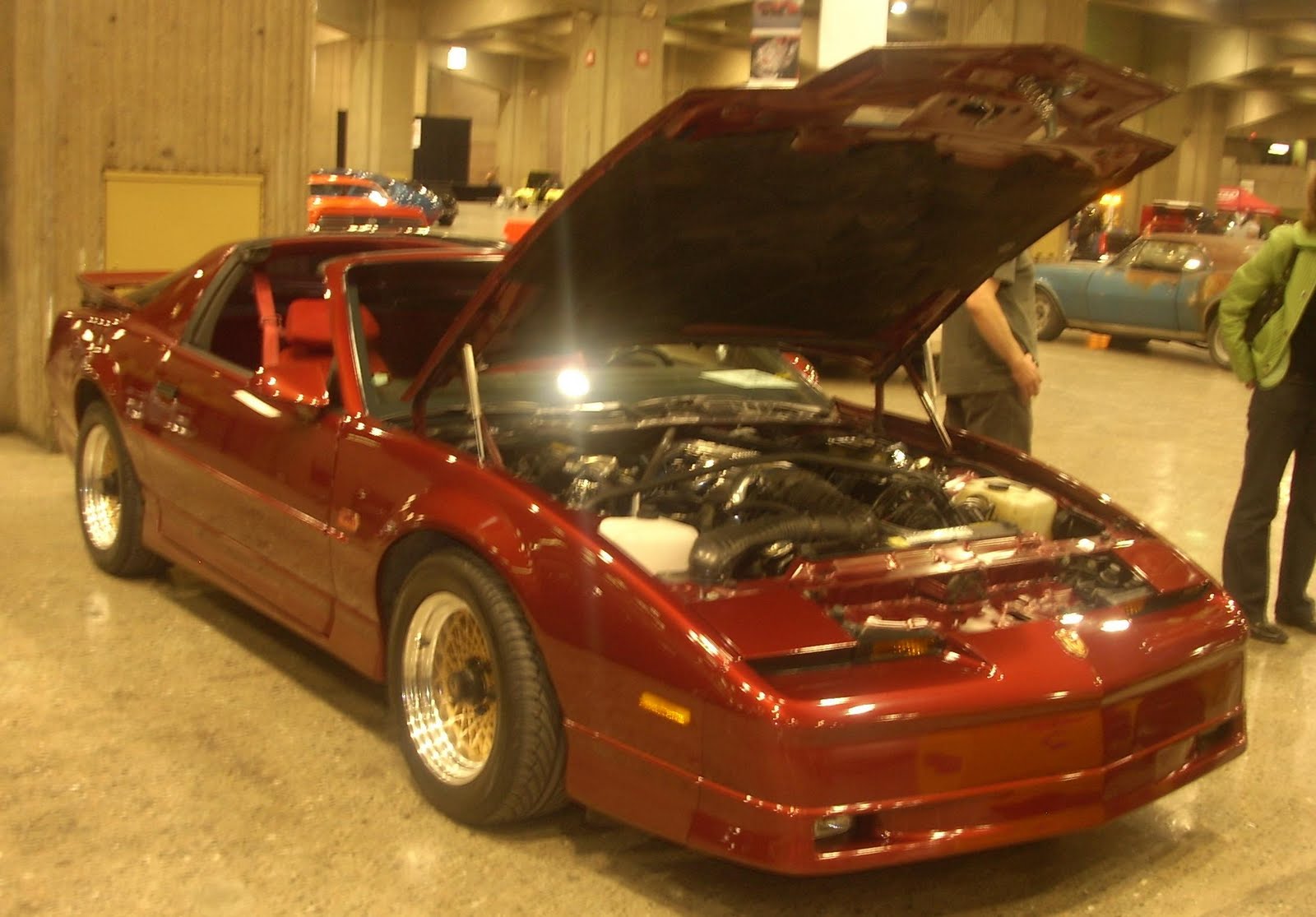
THIRD GENERATION:
The availability and cost of gasoline (two fuel crises had occurred by this time) meant the weight and the fuel consumption of the 3rd generation had to be considered in the design. In F-body development, both the third generation Firebird and Camaro were proposed as possible front wheel drive platforms, but the idea was scrapped. The state of the art of computerized engine management was in its infancy, and as long as saving fuel was the primary objective, it was not possible to have high horsepower and torque numbers. They did manage to cut enough weight from the design so that acceleration performance would be better than the 1981 models. They also succeeded in the fuel consumption department, offering a 4-cylinder Firebird that would provide 34 miles per gallon.[8] GM executives decided that engineering effort would best be spent on aerodynamics and chassis development. They created a modern platform, so that when engine technology advanced, they would have a well balanced package with acceleration, braking, handling, and aerodynamics. For the time being, they would have world class aerodynamics and handling, and excellent fuel economy. (Little did they know that by 1989 the fastest American car on the market would be a Firebird.[9])
 The Firebird and Camaro were completely redesigned for the 1982 model year, with the windshield slope set at 62 degrees, (about 3 degrees steeper than anything GM had ever tried before), and for the first time, a large, glass-dominated hatchback that required no metal structure to support it. Two concealed pop-up headlights, a first on the F-Body cars, were the primary characteristic that distinguished the 3rd Gen Firebird from its both its Camaro sibling and its prior form; (a styling characteristic carried into the 4th Gen's design). In addition to being about 500 lbs (227 kg) lighter than the previous 2nd Gen design, the 3rd Generation Firebird was the most aerodynamic product GM had ever released. Wind tunnels were used to form the new F-Body platform's shape, and Pontiac took full advantage of it. The aerodynamic developments extended to the finned aluminum wheels with smooth hubcaps and a functional rear spoiler.

 FOURTH GENERATION:The fourth-generation F-body continued the aerodynamic formula initiated by the previous generation, but saw declining sales. As before, the Camaro kept the exposed headlights and the Firebird its pop-up units, with some minor changes. The overall styling of the Firebird more strongly reflected the "Banshee IV" concept car than the 1991 "face lift" received by the Third Generation model.
 From 1993 until 1995 (1995 non-California cars), Firebirds received a 3.4 L V6 with 160 hp (120 kW), or the 5.7 L 275 hp (205 kW) LT1 V8. The 1993 Firehawk (only available in Formula trim for 1993–1997) received the SLP package with a functional hood scoop and other performance enhancements that increased power to 300 hp (220 kW). Only 201 were built for 1993, with the same engine as in the 1993 Corvettes. The LT1 in the Formula and Trans Am was very similar to the one in the Corvette C4, except with 2-bolt mains and a more restrictive intake/exhaust system. The 1993 model year V6 models had angular cable driven throttle body units that later changed in 1994 to multi-port fuel injection.
 The 1995 models were the same as those of previous years, but traction control (ASR: Acceleration Slip Regulation) was now available. The steering wheel was also changed. It was borrowed from the Grand Prix. An optional performance package included polyurethane bushings, suspension upgrades, as well as a freer intake/exhaust similar to that on the Chevrolet Corvette, supplying 315 hp, but this package was seldom ordered. The 'Transmission Perform' button was available only in the 1994 and 1995 Formula and Trans Am. This option was stopped for the 1996 and later models, but the connections are still there for 1996 and 1997 Formula and Trans Am.
The mid-1995 and later models had a 200 hp 3.8 L V6 as the base engine, and the power rating of the LT1 had been raised to 285, due to a new dual catalytic converter exhaust system that was optional in previous years.
 The all-aluminum 5.7 L V8 engine was sourced from the Corvette C5, and produced 305 hp (227 kW) at 5,200 rpm; 335 ft·lbf (454 N·m) at 4,000 rpm, (310 after 2000) or 320 hp (325 after 2000) in the WS-6 "Ram Air" version. In 2001 and 2002, models equipped with a V8 received the high-flow LS6 intake manifold and a high-performance clutch. A Firehawk model, produced by SLP and sold through Pontiac dealerships, had 330 hp (335 after 2000, 345 in late 2002 models equipped with the optional Blackwing intake. The V6-equipped Firebirds were rated at 205 hp (153 kW)[citation needed].
FIREBIRD TRANS AM:
 The Trans Am was a specialty package for the Firebird, typically upgrading handling, suspension, and horsepower, as well as minor appearance modifications such as exclusive hoods, spoilers, fog lights and wheels. In using the name Trans Am, a registered trademark, GM agreed to pay $5 per car sold to the SCCA.[10] Four distinct generations were produced between 1969 and 2002. These cars were built on the F-body platform, which was also shared by the Chevrolet Camaro.
The second generation was available from 1970 to 1981 and was featured in the 1977 movie Smokey and the Bandit, the 1978 movie Hooper and the 1980 movie Smokey and the Bandit II. The third generation, available from 1982 to 1992, was featured in the 1983 movie Smokey and the Bandit Part 3 and the 1984 movie Alphabet City. KITT, the automotive star, and its evil counterpart KARR, of the popular 1980s TV series Knight Rider, was a modified third generation Trans Am. The fourth generation Trans Am, available from model years 1993 to 2002, offered between 275 bhp (205 kW) and 325 bhp (242 kW).

During the 1995, 1996, and 1997 NHRA seasons, 14-time Funny Car champion John Force used a Firebird body to replace the obsolete Oldsmobile Cutlass and Chevrolet Lumina body he had used since 1988. He used it for three seasons, winning the championship in all three years. The Firebird body also replaced the Oldsmobile Cutlass in the Pro Stock class in 1995, forcing drivers Warren Johnson, Jerry Eckman, and Mark Pawuk to replace their body styles for the 1996 year, none of them would win with the first year of the Firebird body, but Pro Stock driver Jim Yates, a second year driver, using the Firebird body, would.
The vehicles were powered by various four-cylinder, six-cylinder, and V8 engines of different GM divisions. While primarily Pontiac-powered until 1977, Firebirds were built with several different engines from nearly every GM division until 1982 when GM began to discontinue engines it felt were unneeded and either spread successful designs from individual divisions among all divisions or use new engines of corporate architecture.
FIRST GENERATION:

The base model Firebird came equipped with the OHC inline-6 and a single-barrel carburetor. The next model, the Sprint, had a four-barrel carburetor, developing 215 hp (160 kW). Most buyers opted for one of the V8 engines: the 326 CID (5.3 L) with a two-barrel carburetor producing 250 hp (186 kW); the "H.O." (High Output) engine of the same displacement, but with a four-barrel carburetor and producing 285 hp (213 kW); or the 400 CID (6.6 L) from the GTO with 325 hp (242 kW). A "Ram Air" option was also available in 1968, providing functional hood scoops, higher flow heads with stronger valve springs, and a different camshaft. Power for the Ram Air package was the same as the conventional 400 H.O., but the engine peaked at a higher RPM.
 Engines

| 1967 | 230 cu in (3.8 L) Pontiac OHC I6 | 326 cu in (5.3 L) Pontiac V8 | 326 cu in (5.3 L) Pontiac H.O. V8 | 400 cu in (6.6 L) Pontiac V8 | 400 cu in (6.6 L) Pontiac Ram Air V8 | |
| 1968 | 250 cu in (4.1 L) Pontiac OHC I6 | 350 cu in (5.7 L) Pontiac V8 | 350 cu in (5.7 L)Pontiac H.O. V8 | 400 cu in (6.6 L) Pontiac V8 | 400 cu in (6.6 L) Pontiac H.O. V8 | 400 cu in (6.6 L) Pontiac Ram Air II V8 (mid-year release) |
| 1969 | 250 cu in (4.1 L) Pontiac OHC I6 | 350 cu in (5.7 L) Pontiac V8 | 350 cu in (5.7 L) Pontiac H.O. V8 | 400 cu in (6.6 L) Pontiac V8 | 400 cu in (6.6 L) Pontiac H.O. Ram Air III V8 | 400 cu in (6.6 L) Pontiac Ram Air IV V8 |
The second generation debut for the 1970 model year was delayed until February 26, 1970, because of tooling and engineering problems; thus, its popular designation as a 1970½ model, while leftover 1969s were listed in early Pontiac literature without a model-year identification.[5]
Trims
- Firebird
- Firebird Esprit
- Firebird Formula
- Firebird Trans-Am
- Firebird Trans-Am WS6
- Firebird Skybird
- Firebird Redbird
- Firebird Yellowbird
- Special Edition (popular 'Bandit')
- Gold Special Edition
- Macho Trans-Am (made by one of the Pontiac dealers)
- 1976 50th (Pontiac) Anniversary Edition
- 1979 10th (Trans Am) Anniversary Edition
- 1980 Pace Car Indy 500 Edition (turbo Trans Am)
- 1981 NASCAR Edition (turbo Trans Am).[6]
There were two Ram Air 400 cu in (6.6 L) engines for 1970: the 335 hp (250 kW) Ram Air III (366 hp (273 kW) in GTO) and the 345 hp (257 kW) Ram Air IV (370 hp (280 kW) in GTO) that were carried over from 1969. The difference between the GTO and Firebird engines was the secondary carburetor linkage which prevented the rear barrels from opening. Bending the linkage to allow full carburator operation resulted in identical engines.
 A distinctive, slant-nose facelift occurred in 1977, redone somewhat in 1979. From 1977 to 1981, the Firebird used four square headlamps, while the Camaro continued to retain the two round headlights that had previously been shared by both Second Generation designs. Curb weights rose dramatically in the 1973 model year due to the implementation of 5 mph (8.0 km/h) telescoping bumpers and various other crash and safety related structural enhancements; SD455 Trans Ams weighed in at 3,850 lb (1,750 kg).
The 455 engine available in the second generation Firebird Trans Am was arguably the last high-performance engine of the original muscle car generation. The 455 cu in (7.5 L) engine first made its appearance in 1971 as the 455-HO. In 1973 and 1974, a special version of the 455, called the SD-455, was offered. The SD-455 consisted of a strengthened cylinder block that included 4-bolt main bearings and added material in various locations for improved strength. Original plans called for a forged crankshaft, although actual production SD455s received nodular iron crankshafts with minor enhancements. Forged rods and forged aluminum pistons were specified, as were unique high flow cylinder heads. A 1967 GTO Ram Air camshaft with 301/313 degrees of advertised duration, 0.407 inch net valve lift, and 76 degrees of valve overlap was specified for actual production engines in lieu of the significantly more aggressive Ram Air IV style cam that had originally been planned for the engine (initially rated at 310 hp (230 kW) with that cam), but proved incapable of meeting the tightening emissions standards of the era. This cam, combined with a low compression ratio of 8.4 (advertised) and 7.9:1 actual resulted in 290 SAE net horsepower. Production test cars yielded 1/4 mile times in the 14.5 second/98 MPH range in showroom tune – results consistent for a car with a curb weight of 3,850 pounds and the rated 290 SAE net horsepower figure some sources suggest was "under-rated," High Performance Pontiac magazine dyno-tested an SD and gave it 371 SAE net rating. During a 1972 strike, the Firebird (and the sister F-body Camaro) were nearly dropped.[7] Pontiac offered the 455 for a few more years, but tightening restrictions on vehicle emissions guaranteed its demise. Thus, the 1976 Trans Am was the last of the "Big Cube Birds," with only 7,100 units produced with the 455 engine.


In the final year of the Second Generation Firebirds (1981), Trans Am still used the same engines as it had in the previous model year, with the only change being the addition of a new electronic carburetion system.
THIRD GENERATION:
The availability and cost of gasoline (two fuel crises had occurred by this time) meant the weight and the fuel consumption of the 3rd generation had to be considered in the design. In F-body development, both the third generation Firebird and Camaro were proposed as possible front wheel drive platforms, but the idea was scrapped. The state of the art of computerized engine management was in its infancy, and as long as saving fuel was the primary objective, it was not possible to have high horsepower and torque numbers. They did manage to cut enough weight from the design so that acceleration performance would be better than the 1981 models. They also succeeded in the fuel consumption department, offering a 4-cylinder Firebird that would provide 34 miles per gallon.[8] GM executives decided that engineering effort would best be spent on aerodynamics and chassis development. They created a modern platform, so that when engine technology advanced, they would have a well balanced package with acceleration, braking, handling, and aerodynamics. For the time being, they would have world class aerodynamics and handling, and excellent fuel economy. (Little did they know that by 1989 the fastest American car on the market would be a Firebird.[9])


1993

[edit] 1994
The 1994 model year marked the 25th anniversary of the Trans Am, and another Anniversary Edition was released, painted white with a single blue stripe down the center of the vehicle that was reminiscent of the 1970 Trans Am. It was also the debut of the 4L60e 4 speed electronically controlled automatic transmission in the F-body, which took the place of the non-electronic 700R4.[edit] 1995
 The 1995 models were the same as those of previous years, but traction control (ASR: Acceleration Slip Regulation) was now available. The steering wheel was also changed. It was borrowed from the Grand Prix. An optional performance package included polyurethane bushings, suspension upgrades, as well as a freer intake/exhaust similar to that on the Chevrolet Corvette, supplying 315 hp, but this package was seldom ordered. The 'Transmission Perform' button was available only in the 1994 and 1995 Formula and Trans Am. This option was stopped for the 1996 and later models, but the connections are still there for 1996 and 1997 Formula and Trans Am.
The mid-1995 and later models had a 200 hp 3.8 L V6 as the base engine, and the power rating of the LT1 had been raised to 285, due to a new dual catalytic converter exhaust system that was optional in previous years.
[edit] 1997
The 1997 Firehawk LT4 model, made by SLP Performance Parts and sold through Pontiac dealerships, had 330 hp (243 kW) and 340 ft·lbf (459 Nm) of torque.[edit] 1998
In 1998, the Firebird received a "face lift" dominated by a new front fascia (now with four pop-up headlights) as well as other modifications, the most significant of which was the introduction of the latest Corvette small block V8 engine, the LS1. Initially, the color "Bright Purple Metallic" had been available, however it was discontinued due to poor sales. The color was replaced with "Navy Blue Metallic," but not before a total of 12 Trans Am models with the WS6 Ram Air package (10 coupés and two convertibles) made it out of the factory dressed in "Bright Purple Metallic."[1][edit] 1998–2002
For 1998–2002 Pontiac used the same heavy duty brakes, steering ratios, fuel pumps and shocks (non-WS6) on both V6 and V8 models.
[edit] Engines
| 1993 | 3.4 L (207.5 cu in) L32 V6 | 5.7 L (347.8 cu in) LT1 V8 (iron block, aluminum heads) | |
| 1994 | 3.4 L (207.5 cu in) L32 V6 | 5.7 L (347.8 cu in) LT1 V8 (iron block, aluminum heads) | |
| 1995 | 3.4 L (207.5 cu in) L32 V6 | 3.8 L (231.9 cu in) L36 V6 | 5.7 L (347.8 cu in) LT1 V8 (iron block, aluminum heads) |
| 1996 | 3.8 L (231.9 cu in) L36 V6 | 5.7 L (347.8 cu in) LT1 V8 (iron block, aluminum heads) | |
| 1997 | 3.8 L (231.9 cu in) L36 V6 | 5.7 L (347.8 cu in) LT1 V8 (iron block, aluminum heads) | 5.7 L (347.8 cu in) LT4 V8 (iron block, aluminum heads) in Firehawk by SLP |
| 1998 | 3.8 L (231.9 cu in) L36 V6 | 5.7 L (347.8 cu in) LS1 V8 (aluminum block and heads) | |
| 1999 | 3.8 L (231.9 cu in) L36 V6 | 5.7 L (347.8 cu in) LS1 V8 (aluminum block and heads) | |
| 2000 | 3.8 L (231.9 cu in) L36 V6 | 5.7 L (347.8 cu in) LS1 V8 (aluminum block and heads) | |
| 2001 | 3.8 L (231.9 cu in) L36 V6 | 5.7 L (347.8 cu in) LS1 V8 (aluminum block and heads) | |
| 2002 | 3.8 L (231.9 cu in) L36 V6 | 5.7 L (347.8 cu in) LS1 V8 (aluminum block and heads) |

The second generation was available from 1970 to 1981 and was featured in the 1977 movie Smokey and the Bandit, the 1978 movie Hooper and the 1980 movie Smokey and the Bandit II. The third generation, available from 1982 to 1992, was featured in the 1983 movie Smokey and the Bandit Part 3 and the 1984 movie Alphabet City. KITT, the automotive star, and its evil counterpart KARR, of the popular 1980s TV series Knight Rider, was a modified third generation Trans Am. The fourth generation Trans Am, available from model years 1993 to 2002, offered between 275 bhp (205 kW) and 325 bhp (242 kW).

Racing
Firebirds were used in the Trans-Am series in the 1960s and 1970s. When the Pontiac Trans Am came out, there was controversy over the model's inability to compete in the Trans-Am because the smallest available engine was too large for use in the series at 400 cubic inches (6.6 liters). The name also caused controversy because it was used without permission from the SCCA, who threatened suit. GM settled the dispute by paying US$5 to the SCCA for every car sold. When the Trans-Am was last seen, model year 2002 Firebirds were in use. Firebirds were used in the IROC Series until it folded after the 2006 season.During the 1995, 1996, and 1997 NHRA seasons, 14-time Funny Car champion John Force used a Firebird body to replace the obsolete Oldsmobile Cutlass and Chevrolet Lumina body he had used since 1988. He used it for three seasons, winning the championship in all three years. The Firebird body also replaced the Oldsmobile Cutlass in the Pro Stock class in 1995, forcing drivers Warren Johnson, Jerry Eckman, and Mark Pawuk to replace their body styles for the 1996 year, none of them would win with the first year of the Firebird body, but Pro Stock driver Jim Yates, a second year driver, using the Firebird body, would.
Subscribe to:
Posts (Atom)


