Showing posts with label grand tourer. Show all posts

Aston Martin DB9

he Aston Martin DB9 is a GT sports car launched by Aston Martin in 2004.
The DB9 is the first model to be built at Aston Martin's Gaydon facility in Warwickshire, England. The moniker "DB" stems from the initials of David Brown, the owner of Aston Martin for a significant part of its history. The DB9, which was designed by Ian Callum and finished by his successor, Henrik Fisker, superseded the now-discontinued Aston Martin DB7 (also by Callum) which started production in 1994.
The Aston Martin DB9 comes in two variants; the coupé and 'Volante' convertible, each producing 470 bhp (350 kW; 477 PS) from a 6.0L V12 engine, originally taken from its sister car the V12 Vanquish. In fact, this V12 engine is why Aston Martin did not call the car the DB8, which could suggest that it has only a V8 engine.[1] One report states that Aston Martin believed that this car was such a huge leap from the Jaguar XJ-S based DB7 that it named it DB9 instead of DB8, which they thought would indicate a gradual evolution.[2] The Gaydon facility's production capacity for the DB9 could allow for approximately five thousand units per year, which is roughly the same production volume as other esteemed sports cars, in particular the Ferrari F430 and Porsche 911 Turbo. The DB9, however, is more often compared against other competitors in its segment: the Ian Callum designed Jaguar XKR, the Volkswagen-produced Bentley Continental GT, the ten-cylinder powered BMW M6, and the AMG variants of the Mercedes-Benz SL. Traditionally being a maker of more exclusive automobiles, CEO Dr. Ulrich Bez assures Aston Martin loyalists that production numbers of the DB9 will be slightly higher than previous models; however, Aston Martin will still retain only a small statistical percentage of the high-end sports car market.[3]
The DB9 is the first Aston Martin model to be designed and developed upon Ford's aluminium VH (vertical/horizontal) platform. The body structure is composed of aluminium and composites melded together by mechanically fixed self-piercing rivets and robotic assisted adhesive bonding techniques.[4] The innovative bonded aluminium structure possesses more than double the torsional rigidity of its predecessor's, despite being 25 percent lighter.[4] Aston Martin's engineers designed the quad-cam, 48-valve engine for the V12 Vanquish in collaboration with Ford's Research and Vehicle Technology team (RVT) and were able to reduce its weight by 11.8 kg (26 lb) for use in the DB9.[4]

DB9 Volante

A DB9 Volante.
The Aston Martin DB9 Volante is the convertible version of the DB9 coupe. It is built by hand in limited numbers and has enhanced styling. It is powered by the same 6.0 litre, DOHC 48 valve V12 as the DB9 and is completed with 470 bhp (331 kW) and a top speed of 186 mph (300 km/h).[citation needed] Because it is a convertible it will do 0–60 mph in 4.9 seconds,[6] three-tenths of a second slower than the hard top coupe. The Volante is taller than the hardtop, standing at 51.2 inches (1,300 mm) compared to 50.1 inches (1,270 mm). The transmission options are either the Graziano-sourced six speed manual or the ZF-sourced six speed 'Touchtronic 2' automatic. The DB9 Volante is featured in the television shows Desperate Housewives and Entourage.

DB9 LM

In order to commemorate Aston Martin's victory at the 2007 24 Hours of Le Mans, a special edition of the DB9 was released. Known as the DB9 LM, the car is limited to only 124 examples. All are coupes, and will only be available in a unique color known as Sarthe Silver, named in honour of the Circuit de la Sarthe, where Le Mans is run. The Sports Pack is included, while the brake calipers are painted red and a chromed mesh grill are added.

Facelift

In 2008, Aston Martin decided to do a facelift to the DB9. Changes include a more powerful engine, re-designed interior and some minor exterior modifications. Exterior modifications include a new front grille, re-designed mirrors which look closer to the DBS supercar made by the same company and all-new wheel designs available for the customers to choose from. Customers also can now select clear tail lights for their DB9, much like the ones in the DBS.
Changes have been made to the engine as well which now produces 20 PS (15 kW; 20 hp) more (470 PS) and 600 N·m (440 lb·ft) through an increased compression ratio in the rethought cylinder heads. The Touchtronic gearbox has been modified as well to make faster and smoother changes. This was possible with the use of a new hydraulic control box. The new gearbox is also said to make parking easier than before. New Bilstein suspension was also added to the car which improved ride quality and handling characteristics.
Interior modifications include a re-designed center console which is identical to the one from the DBS supercar and thicker glass to reduce noise in the cabin.
In 2011, Aston Martin will give the DB9 another minor facelift, changing the front fascia, headlights, taillights, door sills, and wheels. The 2011 DB9 also gets Aston Martin’s Adaptive Damping System as standard equipment (previously an option.)

Motorsport

The DBR9 which won its class at the 2007 and 2008 24 Hours of Le Mans.
The DB9 has been adapted for use in sports car racing by Prodrive. Initially the DBR9 was launched prior to the 2005 season, running in the ACO and FIA's GT1 class. It retains the DB9's 6.0 litre V12 engine, but has been extensively modified to decrease its weight as well as to improve performance.[9][10] The DBR9 won in its debut at the 2005 12 Hours of Sebring, and has gone on to take wins in the American Le Mans Series, Le Mans Series, FIA GT Championship, as well as the 24 Hours of Le Mans.[11]
Along with the DBR9, a DBRS9 variant was also developed. This car runs in the GT3 category, mostly used for small national championships as well as the FIA GT3 European Championship. The DBRS9 also uses the standard V12, but is not as highly tuned as the unit in the DBR9. Bodywork modifications are also more subdued.
It weighs 1 tonne (2,200 lb) and does 0 to 60 mph (97 km/h) in 3.4 seconds with a top speed estimated at 200 mph (320 km/h).


Top Gear

On the British automotive show Top Gear the DB9 is thought of highly, notably on the show's "Cool Wall" segment, where the presenters considered it to be "too cool" for the wall and it received its own category, dubbed the "DB9 Sub Zero Fridge" which was in fact a mini-refrigerator with the car's card within it.

Maserati Merak

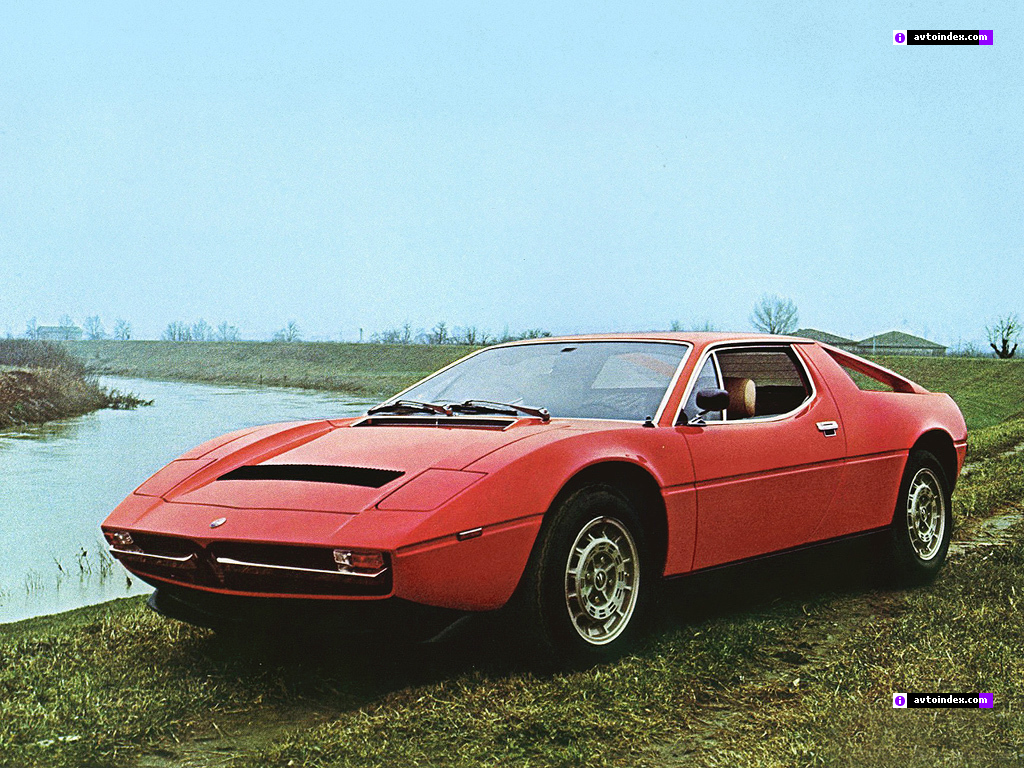
The Maserati Merak was an Italian sport car introduced in 1972, essentially a junior version of the Maserati Bora. It substituted an all new Maserati designed quad-cam V-6 motor (also shared with the Citroen SM) for the Bora's larger V-8, resulting not only in a lower cost, but room for a small backseat and better handling due to lower weight and a better front/rear weight distribution.
Aesthetically, the Merak differed from the otherwise very similar Bora mainly in sporting open flying buttresses instead of the Bora's fully glassed rear, and the use of the Citroen SM dashboard on models produced before 1976.
The Merak went out of production in 1982.

Citroën era Merak

The first Merak was designed during the Citroën ownership of Maserati (1968–1975). It featured a 3.0 L Maserati V6 (190 hp) engine, also used in the Citroën SM.
The mid-engine Merak used the Bora bodyshell, but with the extra space offered by the smaller engine used to carve out a second row of seats, suitable for children or very small adults.
As for the Bora, certain Citroën hydraulic systems were used in the Merak; brakes, clutch, headlight pods. The Citroën SM's dramatic dashboard was also used in early Meraks (1972 to 1975).

GEPI era Merak

In 1976 Maserati introduced the more powerful and lighter Merak SS. Production of the SS stopped in 1982. Its engine produced 15% more power, raising horsepower to 220 hp (164 kW) and weight was reduced by 152 kg to 1,400 kg, resulting in a top speed of 152 mph (245 km/h). Late Merak SS were bestowed with the interior and dash of the Maserati Bora. The US-spec version of the Merak SS also saw a return to traditional hydraulics, eliminating the last of the Citroen high pressure system.


DeTomaso era Merak

In 1977 DeTomaso purchased Maserati, and the Bora was discontinued after a production run of less than 600 cars. In 1977 DeTomaso introduced the Merak 2000, with a smaller powerplant. The Merak 2000 was built mainly for the Italian market, where a newly introduced tax law penalized cars with an engine capacity of more than 2000 cc. The Merak 2000 featured a 2.0 L V6 with 170 hp (127 kW). No Merak 2000 were imported to the United States.

Todays market

On today's market the Maserati Merak does not enjoy the same value as the V-8 Bora. Pricing on average is half the value of a Bora in similar condition. This is partly due to the cars' smaller V-6 powerplant. The Merak is also more common than the Bora, with about 1,900 manufactured over the 1972 to 1982 period.

Featured on television

On April 12, 2005, the Merak was featured in a Top Gear segment against its main competitors, namely the Ferrari Dino and Lamborghini Urraco. In the end, all three cars turned out to be unreliable and did not complete the challenges.
I have gratitude to Wikipedia for the help on this article !

Aston Martin DB7

This is certainly one of the most beautiful cars ever made and totally deserves its place in this top.The Aston Martin DB7 is a grand tourer which was made by Aston Martin from September 1994 to December 2004. The grand tourer was available either as a coupé or a convertible. The prototype was complete by November 1992, and debuted at the Geneva Motor Show in March, 1993. The six-cylinder DB7 was positioned as an "entry-level" model below the hand-built V8 Virage introduced a few years earlier. The DB7 was the highest production Aston Martin model ever, with more than 7,000 built before it was replaced by the DB9. The DB7 was styled by Ian Callum and Keith Helfet.
The DB7, known internally as the NPX project, was made mostly with resources from Jaguar and had the financial backing of the Ford Motor Company, owner of Aston Martin since 1988. The DB7's platform is an evolution of the Jaguar XJS's, though with many changes. The styling started life as the still-born Jaguar F type (XJ41 – coupe / XJ42 – convertible) designed by Keith Helfet. Ford cancelled this car and the general design was grafted onto an XJS platform. The styling received modest changes by Ian Callum so that it looked like an Aston Martin. The first generation Jaguar XK-8 also uses an evolution of the XJ-S/DB7 platform and the cars share a family resemblance, though the Aston Martin was significantly more expensive and exclusive.
The DB7 was engineered in Kidlington, Oxfordshire, by Tom Walkinshaw Racing on behalf of Aston Martin. The production engines continued to be built in Kidlington during the life of the vehicle.
With production of the Virage (soon rechristened "V8" following Vantage styling revisions) continuing at Newport Pagnell, a new factory was acquired at Bloxham, Oxfordshire that had previously been used to produce the Jaguar XJ220, where every DB7 would be built throughout its production run. The DB7 and its relatives were the only Aston Martins produced in Bloxham and the only ones with a steel unit construction inherited from Jaguar (Aston Martin had traditionally used aluminium for the bodies of their cars, and models introduced after the DB7 use aluminium for the chassis as well as for many major body parts).
The convertible Volante version was unveiled at the North American International Auto Show in Detroit in 1996.[1] Both versions have a supercharged straight-6 engine that produced 335 bhp (250 kW; 340 PS) and 361 lb·ft (489 N·m) of torque. In the United States, the Coupé sold for $140,000, and the Volante for $150,000. Works Service provided a special Driving Dynamics package, which greatly enhanced performance and handling for drivers who wanted more than the standard configuration.

V12 Vantage

In 1999, the more powerful DB7 V12 Vantage was introduced at the Geneva Motor Show. Its 6.0 litre, 48-valve, V12 engine produced 420 bhp (313 kW; 426 PS) and 400 ft·lbf (540 N·m) of torque. It has a compression ratio of 10.3:1. It was available with either a TREMEC T-56 six speed manual or a ZF 5HP30 five speed automatic gearbox. Aston Martin claims it has a top speed of either 186 mph (299 km/h) with the manual gearbox or 165 mph (266 km/h) with the automatic gearbox, and will accelerate from 0–60 mph (97 km/h) in 4.9 seconds.[2] It is 4,692 mm long, 1,830 mm (72.0 in) wide, 1,243 mm (48.9 in) high, with a weight of 1.8 tonnes.
After the launch of the Vantage, sales of the supercharged straight-6 engine DB7 quickly dried up, and production was ended in mid-1999.


V12 GT and GTA

In 2002, a new variant was launched, named V12 GT or V12 GTA when equipped with an automatic transmission. It was essentially an improved version of the Vantage, its V12 engine producing 435 bhp (324 kW; 441 PS) and 410 ft·lbf (560 N·m) of torque. Aesthetically, compared to the Vantage it has a mesh front grille, vents in the bonnet (hood), a boot (trunk) spoiler, an aluminium gear lever, optional carbon fibre trim and new wheels. It also has 355 mm (14.0 in) front and 330 mm (13.0 in) rear vented disc brakes made by Brembo. When being tested by Jeremy Clarkson on Top Gear in 2003, he demonstrated the car's ability to pull away in fourth gear and continue until it hit the rev limiter at a speedometer indicated 135mph.
Related Posts Plugin for WordPress, Blogger...