Showing posts with label MG. Show all posts

MG 6 2011


MG6 has five seats in the sports sedan model to describe the nature of the MG brand and bring something different to the amount of the market. MG 6 is the first all new MG sports car since the launch of the MG F.

Guy Jones, director of sales and marketing for MG Motor UK said: This is a milestone for the MG brand and iconic British car industry. MG began the global launch of a completely new model that is designed and developed here in Britain for the global automotive market. Currently we do not build and sell mid-engine MG TF sports car here in Britain, but we can now look forward to expanding the range of MG.
The launch took place at the Motor Show 2009 in Guangzhou, in China and is the beginning of a promising future for the global MG brand. The launch in China, the world automobile market began the deployment of international sales of MG 6, which includes the United Kingdom. Sales in China will begin in January and plans for the UK and other markets will be released in 2010.
He also announced that production of MG 6 The Chinese market will begin a new facility at the forefront Lingang, China, in December 2009. It 'also plans to start production of MG 6 at the factory in Birmingham in the United Kingdom before the end of 2010. The famous MG brand was never a bright future, because it starts expanding global sales of a new range of products.


2010 MG TF


In summer 2009, two new MGS would begin to be part of a successful MG TF LE500, affordable MG TF 135 MG and a brand new single is produced by 85 years 85 years TF MG brand. Jack Safiruddin, Sales & After Sales Operations Manager of MG said. When summer kicked by two of the new car, and our last release £ 2,000 off the price of an MG scrapped in the coming months is a very interesting time for customers to get a new sports car they always wanted.

The highly anticipated MG TF 135 will be launched shortly and is sure to appeal to drivers who want a sports car fun at very competitive prices. A good level of trim and equipment, such as the ICE Clarion, combined with the price, which will broaden its appeal within the budget and bring many more people. TF 135 hit the showrooms soon, offering a fun and charm of a convertible sports car, the loan is very affordable £ 13 511 OTR.
A unique MG TF is launched to mark the 85th anniversary of the MG brand. The MGTF 85th Anniversary will be a great car with excellent driving characteristics. Available in three colors covered with special graphics and a striking new design alloy wheels outside the car looks sensational. The cabin is great for a graphics specialist finishers continue monogrammed threshold and shift knob, plus new leather trim and elegant eggplant a high quality ICE.
Besides the great look, the new TF 85th Anniversary model also has a flat ride and handling that is tuned to make this unique car to drive. Suspension Bilstein, Eibach anti-roll system, lower ride height, a new package of torque and the wheel against the amendment set the wheels of style "Twisted Pepper Rimstock '85th Anniversary Edition gives you a feeling very grown up and handling accurately at high speed. Safiruddin Jack continued, the 85th TF is a car driving is a very real and appropriate to celebrate the anniversary of an iconic brand as MG. The combination of looks and handling to use fans and potential new customers alike.
This car will be launched at £ 15,664 on the road, which, again, after the government abandoned the system of deductions does TF 85th A competitive £ 13,664. With the full load and high MG TF LE500 specified, affordable MG TF 135 MG and handling tight 85th Anniversary, MG now offers a range of cars that give the current owners are looking for something new and potential customers who want just enjoy the British mid-engine, top-down driving sports car, some real choice.

MG T-type

The MG T series included the TA, TB, TC, TD, and TF Midget models, a range of body-on-frame convertible sports car produced in sequence from 1936 through 1955. The last of these models, the TF, was replaced by the MGA.
The MG TA Midget replaced the PB in 1936.[1] It was an evolution of the previous car and was 3 inches (76 mm) wider in its track at 45 inches (1,100 mm) and 7 inches (180 mm) longer in its wheelbase at 94 inches (2,400 mm). The previous advanced overhead-cam inline-four engine was now not in use by any other production car so it was replaced by a more typical MPJG OHV unit from the Wolseley 10 but with twin SU carburettors, modified camshaft and manifolding. The engine displaced just 1292 cc, with a stroke of 102 mm (4.0 in) and a bore of 63.5 mm (2.5 in) and power output was 50 hp (40.3 kW) at 4,500 rpm. The four-speed manual gearbox now had synchromesh on the two top ratios. Like the PB, most were two-seat open cars with a steel body on an ash frame, but it could also be had from 1938 as a Tickford drophead coupé with body by Salmsons of Newport Pagnell or closed "airline" coupé as fitted to the P type, but only one of these is thought to have been made. It was capable of reaching nearly 80 mph (130 km/h) in standard tune with a 0–60 mph time of 23.1 seconds. Unlike the PB, hydraulic brakes were fitted. Just over 3,000 were made and in 1936 it cost £222 on the home market.
When first introduced the model was known as the T Type and only after the advent of the TB did the TA designation come into use.[2]The TA was replaced by the TB Midget in May 1939 with the fitting of a smaller but more modern XPAG engine as fitted to the Morris 10 but in a higher tuned state and like the TA with twin SU carburettors. This 1250 cc I4 unit featured a slightly less-undersquare 66.6 mm (2.6 in) bore and 90 mm (3.5 in) stroke and had a maximum power output of 54 hp (40 kW) at 5200 rpm. Available as either an open 2-seater or more luxurious Tickford drophead coupé, this is the rarest of the T-type cars with only 379 made.The TC Midget was the first postwar MG,[1] launched in 1945. It was quite similar to the pre-war TB, sharing the same pushrod-OHV engine with a slightly higher compression ratio of 7.4:1 giving 54.5 bhp (40.6 kW) at 5200 rpm but using more modern interior elements allowing a wider cockpit. The makers also provided several alternative stages of tuning for "specific purposes".[3] It was exported to the United States, even though only ever built in right-hand drive. The export version had slightly smaller US specification sealed-beam head lights and larger twin rear lights, as well as turn signals and chrome-plated front and rear bumpers. Exactly 10,000 were produced, from September 1945 (chassis number TC0251) to Nov. 1949 (chassis number TC10252), a larger number than any previous MG model. It cost £527 on the home market in 1947.
The 1950 TD Midget combined the TC's drivetrain, a modified hypoid-geared rear axle, the MG Y-type chassis, a familiar T-type style body and independent suspension using coil springs from the MG Y-type saloon. Also new were rack and pinion steering, smaller 15-inch (380 mm) disc type road wheels, a left-hand drive option and standard equipment bumpers and over-riders. The car was also 5 inches (130 mm) wider with a track of 50 inches (1,300 mm).
In 1950 the TD MkII was introduced, produced alongside the standard car, with a more highly tuned engine with 8.0:1 compression ratio giving 57 bhp (43 kW) at 5500 rpm. It also featured twin fuel pumps, revised dampers, and a higher rear-axle ratio
Nearly 30,000 TDs had been produced, including about 1700 Mk II models, when the series ended in 1953 with all but 1656 exported, 23,488 of them to the US alone.[5]
An example tested by The Motor magazine in 1952 had a top speed of 77 mph (124 km/h) and could accelerate from 0–60 mph (97 km/h) in 18.2 seconds. A fuel consumption of 26.7 miles per imperial gallon (10.6 L/100 km; 22.2 mpg-US) was recorded.[4]
In 1998, the rights, intellectual properties and trademarks associated with the production of MG TD is acquired by TD Cars Sdn Bhd in Malaysia to reproduce the TD series as TD2000.
The TF Midget, launched in 1953 ,[1] was a facelifted TD, fitted with the TD Mark II engine, headlights fared into the fenders, a sloping radiator grille, and a new pressurized cooling system along with a simulated external radiator cap.
The 1954 engine, now designated XPEG, was enlarged to 1466 cc by increasing the bore to 72 mm (2.8 in), giving 63 bhp (47 kW) at 5,000 rpm; the car was designated the "TF1500".
Production ended on 4 April 1955 after 9,602 TFs had been manufactured, including two prototypes and 3,400 TF1500s. The TF was superseded by the MGA.


The TF name was reused in 2002 on the mid-engined MG TF sports car.

MG MGA

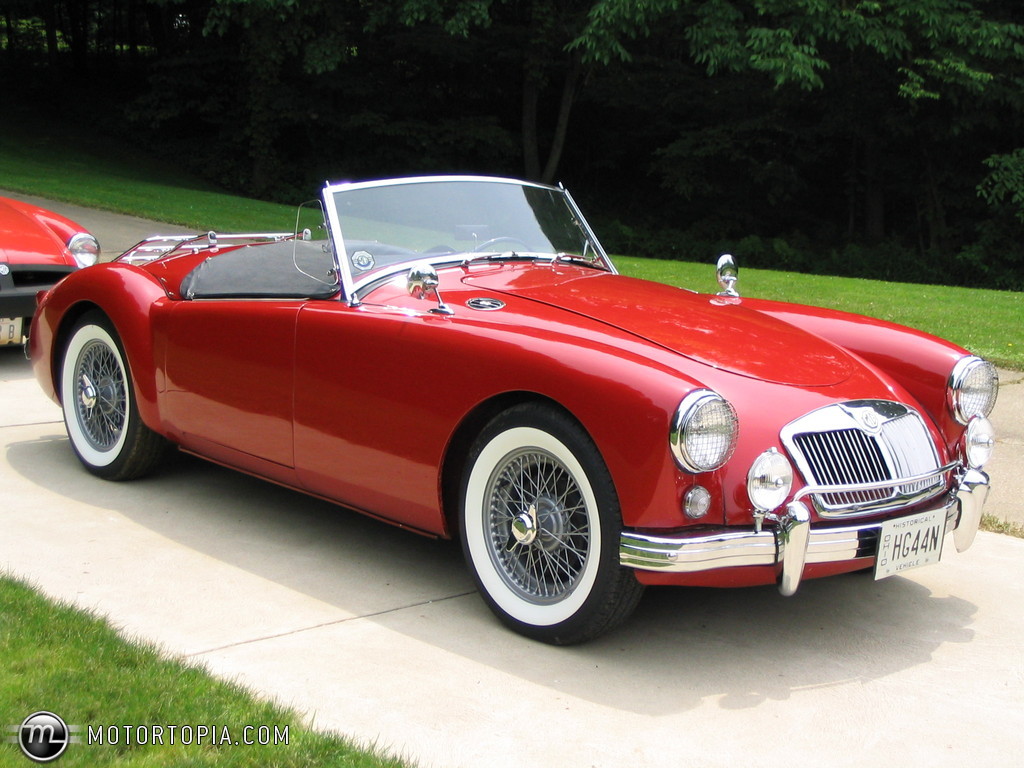
The MGA is a sports car produced by MG division of the British Motor Corporation from 1955 to 1962.
The MGA replaced the older T-type cars and represented a complete styling break from the older vehicles. The car was officially launched at the Frankfurt Motor Show in 1955. A total of 101,081 units were sold through the end of production in July 1962, the vast majority of which were exported. Only 5869 cars were sold on the home market, the highest export percentage of any British car. It was replaced by the MGB.
The MGA design dates back to 1952, when MG designer Syd Enever created a streamlined body for George Philips' TD Le Mans car. The problem with this car was the high seating position of the driver because of the limitations of using the TD chassis. A new chassis was designed with the side members further apart and the floor attached to the bottom rather than the top of the frame sections. A prototype was built and shown to the BMC chairman Leonard Lord. He turned down the idea of producing the new car as he had just signed a deal with Donald Healey to produce Austin-Healey cars two weeks before. Falling sales of the traditional MG models caused a change of heart, and the car, initially to be called the UA-series, was brought back. As it was so different from the older MG models it was called the MGA, the "first of a new line" to quote the contemporary advertising. There was also a new engine available, therefore the car did not have the originally intended XPAG unit but was fitted with the BMC corporate B-Series type allowing a lower bonnet line.
It was a body-on-frame design and used the straight-4 "B series" engine from the MG Magnette saloon driving the rear wheels through a 4-speed gearbox. Suspension was independent with coil springs and wishbones at the front and a rigid axle with semi-elliptic springs at the rear. Steering was by rack and pinion. The car was available with either wire-spoked or steel-disc road wheels.
The 1489 cc engine produced 68 hp (51 kW) at first, but was soon uprated to 72 hp (54 kW). Lockheed hydraulic drum brakes were used on all wheels. A coupé version was also produced, bringing the total production of standard MGAs to 58,750.[2]
An early open car was tested by the British magazine The Motor in 1955 had a top speed of 97.8 mph (157.4 km/h) and could accelerate from 0–60 mph (97 km/h) in 16.0 seconds. A fuel consumption of 26.7 miles per imperial gallon (10.6 L/100 km; 22.2 mpg-US) was recorded. The test car cost £844 including taxes.
A high-performance Twin-Cam model was added for 1958. It used a high compression (9.9:1 later 8.3:1) DOHC aluminium cylinder head version of the B-Series engine producing 108 hp (81 kW; 109 PS) (100 bhp (75 kW; 101 PS) in the low-compression version). Four-wheel disc brakes by Dunlop were fitted, along with Dunlop peg drive knock-off steel wheels similar to wheels used on racing Jaguars, unique to the Twin-Cam.
The temperamental engine was notorious for warranty problems during the course of production, and sales were poor.[citation needed] Ironically, the source of the problem was only discovered after production had ended;[citation needed] many restored Twin-Cams are running more reliably today than they ever did during production.[citation needed] The Twin-Cam was dropped in 1960 after 2,111 had been produced.
An open car was tested by the British The Motor magazine in 1958 and was found to have a top speed of 113 mph (182 km/h), acceleration from 0–60 mph (97 km/h) in 9.1 seconds and a fuel consumption of 27.6 miles per imperial gallon (10.2 L/100 km; 23.0 mpg-US) was recorded. The test car cost £1,283 including taxes of £428.In May 1959 the standard cars also received an updated engine, now at 1588 cc producing 78 bhp (58 kW; 79 PS) . At the front disc brakes were fitted, but drums remained in the rear.
31,501 were produced in less than three years.[2]
Externally the car is very similar to the 1500 with differences including: Amber or white (depending on market) front turn indicators shared with white parking lamps, separate stop/tail and turn lamps in the rear, and 1600 badging on the boot and the cowl.
A number of 1600 De Luxe versions were produced with leftover special wheels and four wheel disc brakes of the departed Twin-Cam, or using complete modified Twincam chassis left redundant by the discontinuance of that model. Seventy roadsters and 12 coupés were built.
A 1600 open car was tested by the British magazine The Motor in 1959. It had a top speed of 96.1 mph (154.7 km/h) and could accelerate from 0–60 mph (97 km/h) in 13.3 seconds. A fuel consumption of 29.7 miles per imperial gallon (9.51 L/100 km; 24.7 mpg-US) was recorded. The test car cost £940 including taxes of £277.The MGA's bodywork was based largely on that of a one-off MG TD specially built by the MG factory at the request of racing privateer George Phillips for the 1951 24 Hours of Le Mans. Later, a new chassis was designed so as to seat the driver lower in the car with even cleaner bodywork resulting in the EX 175 prototype.
The later MG prototype EX 182 was very close to the final production MGA and was the car actually raced at Le Mans in 1955. Three MGA prototypes were entered at Le Mans in 1955. Two of the cars finished the race placing 12th and 17th overall, proving the worth of the new car. The third car crashed with serious injuries to the driver, Dick Jacobs.
The MGA has been raced extensively in the U.S. since its 1955 introduction and with considerable success. In Sports Car Club of America competition the MGA has won numerous regional and national championships. It has also been a favorite choice of those competing in vintage racing. The MGA continues to win races even at the highest levels. Kent Prather has been the most successful American MGA driver to date with G Production wins at the SCCA national championships in 1986, 1990, 1995, 2002, 2003, and 2005. Prather and his MGA accomplished this despite the fact that his MGA was often the oldest vehicle competing among several hundred race cars at the SCCA Runoffs.

Film and television appearances


  • Movie – Blue Hawaii (1961, Elvis Presley & Angela Lansbury) Elvis sings from his open red 1960 MGA 1600 Mk I roadster. The car made numerous appearances in the first half of the picture, often with camera work that seemed suspiciously marketing-like, panning back to the car or putting the car under complimentary soundstage lighting. Elvis so liked the car he bought it for himself, and after changing hands once or twice, he re-acquired the vehicle, which is now at Graceland with his Lincolns, Cadillacs and Stutzes.
  • Movie – Animal House (1978, John Belushi & Tim Matheson) a yellow MGA roadster is driven by antagonist Greg Marmalard (played by James Daughton).
  • Movie – Guess Who's Coming To Dinner (1967, Spencer Tracy, Katharine Hepburn, Sidney Poitier), Spencer Tracy who is having a hard time with the interracial engagement of his daughter with a black doctor (Poitier), backs his Dodge into a black MGA in a drive in, causing the owner, another black man, to become quite irate.
Related Posts Plugin for WordPress, Blogger...