


Showing posts with label Jag. Show all posts
Showing posts with label Jag. Show all posts

Jaguar E-Type
60's,
american,
beautiful car,
British,
british sports car,
classic car,
Jag,
Jaguar E-Type,
North America,
top 100
The Jaguar E-Type (UK) or XK-E (US) is a British automobile, manufactured by Jaguar between 1961 and 1975. Its combination of good looks, high performance, and competitive pricing established the marque as an icon of 1960s motoring. A great success for Jaguar, more than 70,000 E-Types were sold during its lifespan.
 In March 2008, the Jaguar E-Type ranked first in the Daily Telegraph's list of the "100 most beautiful cars" of all time.[2] In 2004, Sports Car International magazine placed the E-Type at number one on their list of Top Sports Cars of the 1960s.
On its release Enzo Ferrari called it "The most beautiful car ever made".[citation needed]
The model was made in three distinct versions which are now generally referred to as "Series 1", "Series 2" and "Series 3". A transitional series between Series 1 and Series 2 is known unofficially as "Series 1½".
 In addition, several limited-edition variants were produced:
 The New York City Museum of Modern Art recognised the significance of the E-Type's design in 1996 by adding a blue roadster to its permanent design collection, one of only six automobiles to receive the distinction.[3]


It is suspected that the first prototype (E1A) was given the code based on: (E): The proposed production name E-Type (1): First Prototype (A): Aluminium construction (Production models used steel bodies)
The car featured a monocoque design, Jaguar's fully independent rear suspension and the well proved "XK" engine.
The car was used solely for factory testings and was never formally released to the public. The car was eventually scrapped by the factory.
 Jaguar's second E-Type concept was E2A which, unlike the E1A, was constructed from a steel chassis with an aluminium body. This car was completed as a race car as it was thought by Jaguar at the time it would provide a better testing ground. E2A used a 3-litre version of the XK engine with a Lucas fuel injection system.
After retiring from the LeMans 24 hr the car was shipped to America to be used for racing by Jaguar privateer Briggs Cunningham. In 1961 the car returned to Jaguar in England to be used as a testing mule. Ownership of E2A passed to Roger Woodley (Jaguar's customer competition car manager) who took possession on the basis the car not be used for racing. E2A had been scheduled to be scrapped. Roger's wife Penny Griffiths owned E2A until 2008 when it was offered for sale at Bonham's Quail Auction. It eventually sold for US$4,957,000

The Jaguar E-Type was very successful in SCCA Production sports car racing with Group44 and Bob Tullius taking the B-Production championship with a Series-3 V12 racer in 1975. A few years later, Gran-Turismo Jaguar from Cleveland Ohio campaigned a 4.2-litre 6-cylinder FHC racer in SCCA production series, and in 1980 won the National Championship in the SCCA C-Production Class, defeating a fully funded factory Nissan Z-car team with Paul Newman.

Overview
The E-Type was initially designed and shown to the public as a grand tourer in two-seater coupé form (FHC or Fixed Head Coupé) and as convertible (OTS or Open Two Seater). The 2+2 version with a lengthened wheelbase was released several years later.On its release Enzo Ferrari called it "The most beautiful car ever made".[citation needed]
The model was made in three distinct versions which are now generally referred to as "Series 1", "Series 2" and "Series 3". A transitional series between Series 1 and Series 2 is known unofficially as "Series 1½".

- The "'Lightweight' E-Type" which was apparently intended as a sort of follow-up to the D-Type. Jaguar planned to produce 18 units but ultimately only a dozen were reportedly built. Of those, one is known to have been destroyed and two others have been converted to coupé form. These are exceedingly rare and sought after by collectors.
- The "Low Drag Coupé" was a one-off technical exercise which was ultimately sold to a Jaguar racing driver. It is presently believed to be part of the private collection of the current Viscount Cowdray.


Concept versions

E1A (1957)
After the company's success at the LeMans 24 hr through the 1950s, Jaguar's defunct racing department was given the brief to use D-Type style construction to build a road-going sports car, replacing the XK150.It is suspected that the first prototype (E1A) was given the code based on: (E): The proposed production name E-Type (1): First Prototype (A): Aluminium construction (Production models used steel bodies)
The car featured a monocoque design, Jaguar's fully independent rear suspension and the well proved "XK" engine.
The car was used solely for factory testings and was never formally released to the public. The car was eventually scrapped by the factory.
E2A (1960)

After retiring from the LeMans 24 hr the car was shipped to America to be used for racing by Jaguar privateer Briggs Cunningham. In 1961 the car returned to Jaguar in England to be used as a testing mule. Ownership of E2A passed to Roger Woodley (Jaguar's customer competition car manager) who took possession on the basis the car not be used for racing. E2A had been scheduled to be scrapped. Roger's wife Penny Griffiths owned E2A until 2008 when it was offered for sale at Bonham's Quail Auction. It eventually sold for US$4,957,000

Motor sport
Bob Jane won the 1963 Australian GT Championship at the wheel of a "lightweight" E-Type.[15]The Jaguar E-Type was very successful in SCCA Production sports car racing with Group44 and Bob Tullius taking the B-Production championship with a Series-3 V12 racer in 1975. A few years later, Gran-Turismo Jaguar from Cleveland Ohio campaigned a 4.2-litre 6-cylinder FHC racer in SCCA production series, and in 1980 won the National Championship in the SCCA C-Production Class, defeating a fully funded factory Nissan Z-car team with Paul Newman.
Jaguar XK150
The Jaguar XK150 is a sports car produced by Jaguar between 1957 and 1961. It replaced the XK140.
 Initially it was available in Fixed Head Coupé (FHC) and Drop Head Coupé (DHC) versions. The Open Two Seater roadster (OTS) was not launched until 1958. Token rear seats were fitted in the coupés.
 Although having a family resemblance to the XK120 and XK140, the XK150 was radically modernized. A one-piece windscreen replaced the split screen, and the wing line no longer dropped as much over the doors. The bonnet was widened, opened down to the wings, and on the roadster the bulkhead was moved back 4 inches (102 mm) to make the bonnet longer. The car was available at various times in Red, Pearl Grey, White, Indigo Blue, Claret, Cotswold Blue, Black, Mist Grey, Sherwood Green, Carmen Red, British racing Green, Cornish grey and Imperial Maroon.
 In the interior, the XK140's walnut dashboard was replaced by one trimmed in leather. On the early Drop Head Coupés, an aluminium centre dash panel with an X pattern engraving was fitted which looked similar to the early 3.8 E-type. It was discontinued after June 1958. Thinner doors gave more interior space.
The standard engine, the same as fitted to the XK140, was the 3.4 litre DOHC Jaguar straight-6 rated at 180 SAE bhp at 5750 rpm but most cars were fitted with the SE engine that had a modified cylinder head with larger exhaust valves rated at 210 SAE bhp at 5500 rpm. Twin 1.75-inch (44 mm) SU HD6 carburettors were fitted.
While the first XK150 were slower than their predecessors, the deficit was corrected in the spring of 1958 with a 3.4-litre "S" engine with three 2-inch (51 mm) SU HD8 carburettors and a straight ported cylinder head giving a claimed 250 SAE bhp.
For 1960, Jaguar bored its 3.4 to 3.8 litres, rating this option at 220 hp (164 kW; 223 PS) in standard tune or 265 hp (198 kW; 269 PS) "S" form. A 3.8 litre 150S could top 135 mph (217 km/h) and sprint from 0–60 mph in around 7.0 seconds, thus restoring whatever verve the XK had been missing.
Four-wheel Dunlop 12 in (305 mm) disc brakes appeared for the first time although it was theoretically possible to order a car with drums. Either wire wheels or disc wheels could be specified. Suspension and chassis were very similar to that on the XK140. Steering was by rack and pinion; power steering was not offered.
Production ended in October 1960,[1] and totaled 2265 Roadsters, 4445 Fixed Head Coupés and 2672 Drop Head Coupés.

History


The standard engine, the same as fitted to the XK140, was the 3.4 litre DOHC Jaguar straight-6 rated at 180 SAE bhp at 5750 rpm but most cars were fitted with the SE engine that had a modified cylinder head with larger exhaust valves rated at 210 SAE bhp at 5500 rpm. Twin 1.75-inch (44 mm) SU HD6 carburettors were fitted.
While the first XK150 were slower than their predecessors, the deficit was corrected in the spring of 1958 with a 3.4-litre "S" engine with three 2-inch (51 mm) SU HD8 carburettors and a straight ported cylinder head giving a claimed 250 SAE bhp.
For 1960, Jaguar bored its 3.4 to 3.8 litres, rating this option at 220 hp (164 kW; 223 PS) in standard tune or 265 hp (198 kW; 269 PS) "S" form. A 3.8 litre 150S could top 135 mph (217 km/h) and sprint from 0–60 mph in around 7.0 seconds, thus restoring whatever verve the XK had been missing.
Four-wheel Dunlop 12 in (305 mm) disc brakes appeared for the first time although it was theoretically possible to order a car with drums. Either wire wheels or disc wheels could be specified. Suspension and chassis were very similar to that on the XK140. Steering was by rack and pinion; power steering was not offered.
Production ended in October 1960,[1] and totaled 2265 Roadsters, 4445 Fixed Head Coupés and 2672 Drop Head Coupés.
Jaguar Mark 2
50's,
american,
american market,
beautiful car,
British,
british cars,
british cop,
classic car,
Jag,
JAGUAR,
Jaguar Mark 2,
North America,
top 100
The Jaguar Mark 2 is a medium sized saloon car built from 1959 to 1967 by the Jaguar company in Coventry, England, as successors to the Jaguar 2.4 and 3.4 models, manufactured between 1957 and 1959. These retrospectively became known as the Jaguar Mark 1 following the release of the Mark 2 in 1959.
 Adhering to Sir William Lyons' maxim of "grace, pace and space", the Mark 2 was a beautiful, fast and capable saloon. It came with a 120 bhp 2.4 L, 210 bhp 3.4 L or 220 bhp 3.8 L Jaguar XK engine.[3] The 3.8 is similar to the unit used in the 3.8 E-Type (called XKE in the USA), having the same block, crank, connecting rods and pistons but different inlet manifold and carburation (two SUs versus three on the E-Type in Europe) and therefore 30 bhp less. The head of the six cylinder engine in the Mark 2 had curved ports compared to the straight ports of the E-Type configuration. For markets other than the US the 3.4 was fitted with twin SU carburettors and the 2.4 with twin Solexes, but three Solexes were used in US spec 3.4s and 3.8s.
The Daimler 2.5 litre engine was fitted to the Daimler 250 derivative of the Mark 2 (In European markets known as the Daimler 2.5-V8 then Daimler V8-250), having first been used in the Daimler SP250 sports car (the SP250 was originally known as the Daimler Dart but "Dart" was a trademark of Dodge and had to be dropped by Daimler under threat of legal action.) The aluminium alloy Daimler engine was lighter than the cast iron block Jaguar sixes, therefore reducing the mass over the front wheels and hence reducing understeer compared to the XK-powered versions under hard cornering. These models were recognisable by the characteristic Daimler wavy fluting incorporated in the chrome grille instead of the Jaguar badge and figurine.
The Mark 2 was discontinued in September 1967 and replaced by the 240 and 340, so named to distinguish them from the old 2.4 and 3.4 which, as noted above, became known as the Mark 1 following the introduction of the Mark 2 in 1959. The Jaguar 240 and 340 were interim models to fill the gap until the introduction of the XJ6 in September 1968. The 340 was discontinued immediately but the 240 continued as a budget priced model until April 1969; its price of £1364 was only £20 more than the first 2.4 in 1956.[2]
 The economies of the new 240 and 340 models came at a cost – the leather upholstery was replaced by "Ambla" leather-like material and slimmer, more economical front and rear bumpers were introduced. Other changes included the replacement of the front fog lamps with circular vents and optional fog lamps for the UK market. The sales price was reduced to compete with the Rover 2000 TC.[4]
The 240's performance was improved over the old 2.4 model by upgrading the 2.4's cylinder head and twin Solex carburettors to the straight port 'E-Type' head and twin SU carburettors. For the first time the 2.4-litre model could exceed 100 mph [2], [5] resulting in a slight sales resurgence.
A 3.8 litre car with the 220 bhp engine was capable of accelerating from 0-60 mph (97 km/h) in 8.5 seconds and could reach a top speed of 125 mph (201 km/h).

 Jaguar Mark 2The Mark 2 gained a reputation as a capable car among criminals and law enforcement alike; the 3.8 Litre model being particularly fast with its 220 bhp (164 kW) engine driving the car from 0-60 mph (97 km/h) in 8.5 seconds and to a top speed of 125 mph (201 km/h) with enough room for five adults.[6][7][8] Popular as getaway cars, they were also employed by the Police to patrol British motorways.
The Mark 2 is also well known as the car driven by fictional TV detective Inspector Morse played by John Thaw, although Morse's car was the least desirable version (with its 2.4 L engine, steel wheels and Everflex vinyl roof). It was often pushed into scenes with engine noises dubbed onto the soundtrack in post-production. In November 2005, the car used in the television series sold for more than £100,000 following a total ground-up rebuild (prior to this, in its recommissioned state in 2002 after coming out of storage, it had made £53,000 at auction – some £45,000 more than an equivalent without the history).[9] In the original novels by Colin Dexter, Morse had driven a Lancia but Thaw insisted on his character driving a British car in the television series.
John Thaw stated in one interview that the Jaguar was "an absolute arse to drive".

The Daimler 2.5 litre engine was fitted to the Daimler 250 derivative of the Mark 2 (In European markets known as the Daimler 2.5-V8 then Daimler V8-250), having first been used in the Daimler SP250 sports car (the SP250 was originally known as the Daimler Dart but "Dart" was a trademark of Dodge and had to be dropped by Daimler under threat of legal action.) The aluminium alloy Daimler engine was lighter than the cast iron block Jaguar sixes, therefore reducing the mass over the front wheels and hence reducing understeer compared to the XK-powered versions under hard cornering. These models were recognisable by the characteristic Daimler wavy fluting incorporated in the chrome grille instead of the Jaguar badge and figurine.
The Mark 2 was discontinued in September 1967 and replaced by the 240 and 340, so named to distinguish them from the old 2.4 and 3.4 which, as noted above, became known as the Mark 1 following the introduction of the Mark 2 in 1959. The Jaguar 240 and 340 were interim models to fill the gap until the introduction of the XJ6 in September 1968. The 340 was discontinued immediately but the 240 continued as a budget priced model until April 1969; its price of £1364 was only £20 more than the first 2.4 in 1956.[2]

The 240's performance was improved over the old 2.4 model by upgrading the 2.4's cylinder head and twin Solex carburettors to the straight port 'E-Type' head and twin SU carburettors. For the first time the 2.4-litre model could exceed 100 mph [2], [5] resulting in a slight sales resurgence.
Performance
A 3.4 litre car with automatic transmission tested by The Motor magazine in 1961 had a top speed of 119.9 mph (193.0 km/h) and could accelerate from 0-60 mph (97 km/h) in 11.9 seconds. A touring fuel consumption of 19.0 miles per imperial gallon (14.9 L/100 km; 15.8 mpg-US) was recorded. The test car cost £1951 including taxes of £614.[1]A 3.8 litre car with the 220 bhp engine was capable of accelerating from 0-60 mph (97 km/h) in 8.5 seconds and could reach a top speed of 125 mph (201 km/h).
Portrayal in media


The Mark 2 is also well known as the car driven by fictional TV detective Inspector Morse played by John Thaw, although Morse's car was the least desirable version (with its 2.4 L engine, steel wheels and Everflex vinyl roof). It was often pushed into scenes with engine noises dubbed onto the soundtrack in post-production. In November 2005, the car used in the television series sold for more than £100,000 following a total ground-up rebuild (prior to this, in its recommissioned state in 2002 after coming out of storage, it had made £53,000 at auction – some £45,000 more than an equivalent without the history).[9] In the original novels by Colin Dexter, Morse had driven a Lancia but Thaw insisted on his character driving a British car in the television series.
John Thaw stated in one interview that the Jaguar was "an absolute arse to drive".
Jaguar XJS
80's,
american,
beautiful car,
British,
british sports car,
classic car,
Jag,
JAGUAR,
Jaguar XJS,
top 100

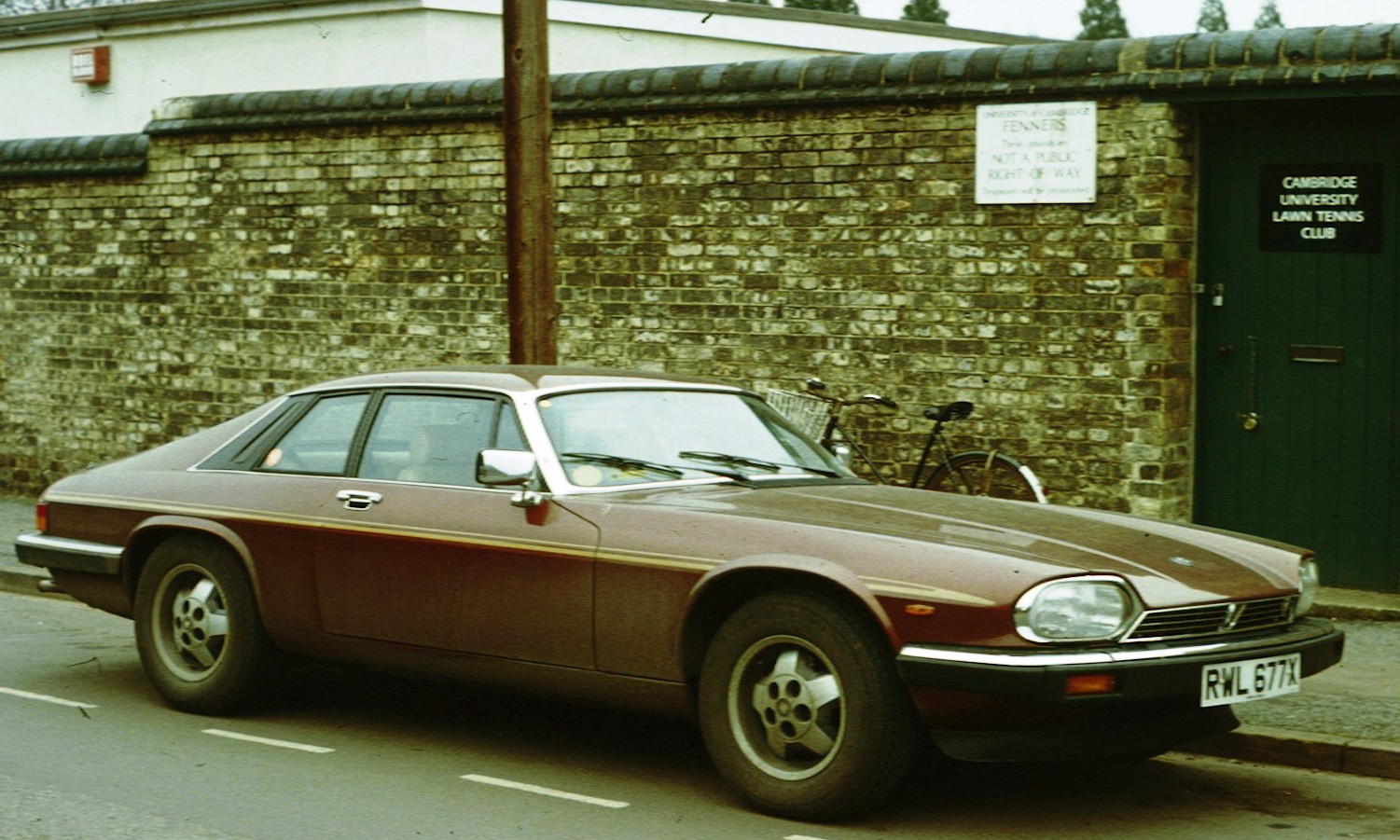
The first XJ-S appeared in 1975 as a 1976 model. Power came from the Jaguar V-12 petrol engine with a choice of a manual or automatic transmission, but the manual was soon dropped. V-12 automobiles were unusual at the time, with notable others coming from Italian luxury sports car makers Lamborghini and Ferrari. The specifications of the XJ-S compared well with both Italian cars; it was able to accelerate to 60 mph (97 km/h) in 7.2 seconds and reach 150 mph (240 km/h). The first series of XJ-S cars had a Borg-Warner Model 12 transmission with a cast iron case and a bolt-on bell-housing. In 1979 GM Turbo-Hydromatic 400 transmissions were fitted. The TH400 transmission was an all aluminium alloy case with an integrated non-detachable bell-housing.
Jaguar's timing was not good; the car was launched in the wake of a fuel crisis, and the market for a 5.3 litre V12 grand tourer was very small. The styling was also the subject of criticism, including the buttresses behind the windows. German authorities feared these would restrict rearward vision, and refused to give the model (along with a similarly adorned contemporary Lancia model) type approval: it was for a time necessary instead for German XJS buyers to obtain type approval for each individual car when registering it.[4] Such fears were ill founded, since in reality the rear visibility was very reasonable, with only the frontmost top edges of the buttresses being visible, when looking rearward.
Jaguar did seize promotional opportunities with the television series The New Avengers and Return of the Saint. The New Avengers featured Mike Gambit (Gareth Hunt) who drove an XJ-S. Return of the Saint saw Simon Templar (played by Ian Ogilvy) driving an early XJ-S with the number plate "ST 1". Miniature versions were made by Corgi and proved popular. A decade and a half before, Jaguar had turned down the producers of the earlier Saint series when approached about the E-type; the producers had instead used a Volvo P1800.
Responding to criticisms that the XJ-S was not a worthy E-type successor, Pininfarina revealed a sporty show car in 1978 based on XJ-S mechanicals and called Jaguar XJSpider.[5] The car never went into production.
6-cylinder version and a convertible
In 1983, a new 3.6 litre engine débuted Jaguar AJ6 engine I6, as well as a new cabriolet version, the XJ-SC. In the XJ-SC, the coupé's rather small rear seats were eliminated making it only a 2-seat car. The XJ-SC was not a full convertible but had a non-removable centre targa-type structure and fixed cant rails above the doors. The rear quarter windows remained as well.Between 1983 and 1987 the 6 cylinder engined cars were only available with a 5-speed manual transmission (Getrag 265), with a 4-speed automatic (ZF 4HP22) offered from 1987 onwards (along with improved fuel injection as used on the XJ40). The earlier, manual models were not imported by Jaguar into the United States, which had to wait until the facelift manual 4 litre XJS coupé and convertible were available; even then they were sold only in low numbers. A limited number of earlier 5-speed AJ6 cars did however enter the US as grey market personal imports.[citation needed]
A V12 XJ-SC emerged in 1985.

1991–1996
The car was re-engineered in 1991 and renamed XJS. All XJSs from this time are referred to as "facelift" models. The rear side windows appeared enlarged (although the body glass aperture was actually the same size as the earlier car), and the buttresses stayed, as designer Geoff Lawson argued that they were part of the car's character. The car got a new 4 litre version of the AJ6. In 1992 a 4 litre convertible was added to the range. The V12's capacity was enlarged to 6 litre in May 1993 (227 kW (304 hp)). At the same time the car benefited from a revision to the rear brakes, they were now fitted with outboard rear disc brakes, instead of the more complicated inboard items on previous models. With the introduction of the 6.0 litre V12, the transmission was also updated to a GM 4L80E with a 4th gear overdrive, whilst the automatic 4 litre models continued with the electronic ZF4HP24E transmission. A 2+2 convertible was also introduced, as was a customised insignia line. At the same time the car received more aerodynamic front and rear bumpers. 1992 thru 1994 were the only years the 6-cylinder with 5-speed manual transmission XJS was exported to the United States. Exact production figures are unknown, though it is likely there are fewer than ten.In April 1994 substantial revisions were made to the 4 litre AJ6 engine which became the 4.0 litre AJ16 with coil on plug ignition being amongst the most noticeable of the changes. In 1995, the final specification changes were made and the car was referred to as the Celebration model to celebrate the 60th year of the Jaguar company. Celebration cars are easily identifiable by the diamond turned wheels, Jaguar embossed seats and distinctive wooden steering wheel. These latest cars are the most desirable of all the later XJSs, especially the convertibles. The 6 litre V12 had all but disappeared by this time and was only available during the last year of production by special order. The car was discontinued in 1996, after 21 years in production. It was replaced by the XK8.
Motorsport
For 1977, the "Group44" racing team had a very successful season in Trans Am with a race car based on the actual production XJ-S chassis and running gear. The team won the series' 1977 drivers' championship cup for Bob Tullius but missed winning the manufacturer's title by two points (only one Jaguar was competing in the Trans-Am series compared to many more Porsche entrants). In 1978, a purpose-built tube-frame "silhouette" style XJS race car was constructed which greatly reduced the weight compared to the full production chassis car campaigned in 1977. This silhouette car had only the production car's roof panel as the sole piece of factory XJS sheetmetal on the car. Group 44 succeeded in again capturing the driver's championship for Bob Tullius and also captured the manufacturer's title as well, by entering Brian Fuerstenau driving the 1977 car at some venues to gain additional manufacturer's point for Jaguar. The silhouette car survived and has surfaced recently in the SVRA historic sports race series. The 1977 factory chassis race car is believed to still be in the hands of Group 44's Bob Tullius.In April 1979 a Jaguar XJS driven by Dave Heinz and Dave Yarborough was entered into Cannonball Baker Sea-To-Shining-Sea Memorial Trophy Dash, widely known simply as the Cannonball Run. They completed the 2,863 miles (4,608 km) from New York to Los Angeles in a record time of 32 hours and 51 minutes, a record that stood for 4 years, until it was beaten by David Diem and Doug Turner in a Ferrari 308. Diem and Turner covered the same distance in 32 hours and 7 minutes on the US Express, an unofficial successor to the Cannonball Run.[9]
In 1984 Tom Walkinshaw captured the Drivers’ title of the European Touring Car Championship with a Group A version of the XJ-S, entered by TWR. During the championship season the TWR team had also won the Spa 24 Hours race with an XJ-S driven by Tom Walkinshaw, Hans Heyer and Win Percy.
In 1985, XJ-S drivers John Goss and Armin Hahne won the James-Hardie 1000 for Group A Touring Cars at Bathurst, New South Wales in Australia. This car was the third of a trio of XJS's entered for the race by TWR. Walkinshaw and Percy finished third in the lead Jag after oil line problems late in the race.
Today the XJS continues to be extensively campaigned in club level motorsport both in the United Kingdom and overseas. Best known of the race series is probably the Jaguar Enthusiasts' Club XJS championship, currently in association with Toyo Tires. Their championship has now been running for over a decade, offering an affordable entry into club motorsport in the UK, and continuing to attract large grids of this unlikely racing car. Cars compete in various states of modification, from barely modified road cars through to full race-specification cars built in homage to the great TWR specials.
Jaguar XJ220

The Jaguar XJ220 is a mid-engined supercar produced by Jaguar in collaboration with Tom Walkinshaw Racing as Jaguar Sport between 1992 and 1994. It held the record for the highest top speed of a production car (350 km/h, 217 mph) (although it was modified from standard to achieve this), until the arrival of the McLaren F1 in 1994. The XJ220 is unrelated to other XJ models, despite sharing the "XJ" prefix.In the early days of the company, certain Jaguar employees had created an informal group they called "The Saturday Club" (so-named because they would meet after-hours and on weekends to work on unofficial pet-projects). In the 1980s, Jaguar's chief engineer Jim Randle, as part of that group, began work on what he saw as competition for cars like the Ferrari F40 and Porsche 959. He envisioned what was essentially an updated XJ13 - a lightweight two-seater with a powerful mid-mounted V12 engine. Randle expanded on the idea by settling on all wheel drive for increased traction and better handling and an integral safety-cage so the car could be safely raced at extremely high speeds. From the outset, the intention was to create a vehicle capable of exceeding 320 km/h (200 mph).The production version of the car was first shown to the public in October 1991 after undergoing significant changes. The most obvious of which was a completely different drivetrain and the elimination of the scissor doors. TWR was charged with producing the car and had several goals/rules: the car would be rear wheel drive instead of all wheel drive; would have a turbocharged V6 engine instead of the big V12; and performance goals of over 200 mph (320 km/h), 0 to 60 mph (97 km/h) in 3.6 seconds, and the lightest weight possible.
The 6.2-litre V12 had been judged too difficult to get past increasingly strict emission regulations, and there were also reportedly some design problems caused by the size of the power plant. It was replaced with a Tom Walkinshaw-developed 3.5-litre V6 based on the engine used in the Austin Metro 6R4 rally car and fitted with twin Garrett T3 turbochargers, generating 542 bhp (404 kW; 550 PS) of maximum power at 7000 rpm and 476 lb·ft (645 N·m) of torque at 4500 rpm. This engine was the first V6 in Jaguar's history, and was the first to use forced induction. In spite of the smaller displacement and half the number of cylinders, the engine produced more power than the V12 would have. However, potential customers judged the exhaust note to be harsh and the lag from the turbos to be an annoyance. Also missing from the production version of the car was the Ferguson all wheel drive – the production car had only rear driven wheels, through a conventional transaxle – and the ABS.
With the promise of four-wheel drive and a 500bhp Jaguar V12 this sounded like a dream come true for enthusiasts and speculators alike. Unfortunately, when production finally began in the early 90s, the boom had gone and Group B (for which the XJ220 was originally conceived) had disappeared. Not only this but Jaguar had made the unpopular decision to drop the 4WD and V12 drivetrain for RWD and turbocharged V6. This led to disgruntled customers, many of whom launched court cases against Jaguar, only to lose, and ultimately unsold 220s.The car entered production in 1992 in a purpose-built factory at Bloxham near Banbury, and the first cars were delivered to customers in July. Original customers included Elton John and the Sultan of Brunei.

In spite of the drama surrounding its creation, a total of 281 cars were made and by 1997, few of these remained available for sale new at £150,000. Nowadays, it remains a sought-after collectible sports car, fetching £100,000+.The XJ220 is not only the fastest but the widest car Jaguar has ever built at nearly 7 feet in width.Racing version

A racing version called the XJ220C was also made. The XJ220C, driven by Win Percy won its first race, a round of the BRDC National Sports GT Challenge at Silverstone. Three works XJ220C's were entered in the 1993 Le Mans 24 Hour race, in the newly created Grand Touring Class. Two of the cars retired but one XJ220, driven by John Nielsen, David Brabham and David Coulthard took the checkered flag to take a class win. This, however, was revoked two weeks later when the XJ220C was disqualified for not running catalytic converters on the cars when the road-going XJ220s did.
An XJ220 would also be used in the Italian GT Championship in the early 1990s, although this car had no factory support.Pininfarina-designed version
During the mid-nineties, the Sultan of Brunei and his brother Prince Jefri secretly bought hundreds of sports cars and had them custom appointed by various companies. One of these is a custom Jaguar XJ220 that has been heavily modified by Pininfarina. Modifications included fixed headlights, replacing the pop-up versions originally installed, and a redesigned double-vane rear wing.Speed record

Jaguar XK

The Jaguar XK series (XK, XK8 and XKR) is a series of grand tourer cars produced by British car maker Jaguar since 1996. The series was introduced at the Geneva Motor Show on 5 March 1996. The first generation of the series, the XK8, replaced of the XJS, and was available as a coupé and convertible. The XK8 was the first 8-cylinder vehicle produced by Jaguar, when the Jaguar AJ-V8 engine was introduced.


Subscribe to:
Posts (Atom)


