The Land Rover Defender (initially called the Land Rover Ninety and Land Rover One Ten) is a British four wheel drive off-road utility vehicle.
The product of continued development of the original Land Rover Series launched in 1948, it uses the basic yet robust underpinnings of a ladder frame chassis and aluminium body and is available in a huge variety of body types from the manufacturer, plus many more specialist versions such as fire engines.
In Britain, Defenders have the image of being used in agricultural and military pursuits, due to their sturdiness. Due to this, they are frequently associated in the public consciousness with the countryside in general, farmers in particular, and also the British Royal Family, who are known to drive them around their country estates.The model was introduced in 1983 as the Land Rover Ninety and the Land Rover One Ten, the numbers representing the wheelbase in inches. The number was spelt out in full in advertising and in handbooks and manuals, and the vehicles also carried badges above the radiator grille which read "Land Rover 90" or "Land Rover 110", with the number rendered numerically. The Ninety and One Ten replaced the earlier Land Rover Series, and at the time of launch, the only other Land Rover model in production was the Range Rover.
In 1989, a third model was brought out by Land Rover to be produced in parallel with the other two: the Land Rover Discovery. To avoid possible confusion, from 1991 the Ninety and the One Ten were renamed the Defender 90 and Defender 110. These carried front badges that say "Defender", with a badge on the rear of the vehicle saying "Defender 90" or "Defender 110". The current model, from 2007, still has the space above the radiator for the badge, but this is simply blank, and they have "Land Rover" spelt out across the leading edge of the bonnet in raised individual letters. At the rear is a new '"Defender" badge with an underlining "swoosh". On these current models there are no badges defining the wheelbase model of the vehicle.
The 127-inch (3,226 mm) wheelbase Land Rover 127 available from 1985 was always marketed with the name rendered numerically. Following the adoption of the Defender name, it became the Defender 130, although the wheelbase remained unchanged.
In the United States and Canada, North American Specification (NAS) Defenders sold between 1993 and 1997 said only "Land Rover" with no "90" or "110" numeric designation.Production of the model now known as the Defender began in 1983 as the Land Rover One Ten, a simple name which reflected the 110 inch (2.794 m) length of the wheelbase. The Land Rover Ninety, with 93 inch (2.362 m) wheelbase, and Land Rover 127, with 127 inch (3.226 m) wheelbase, soon followed.[4]
Outwardly, there is little to distinguish the post-1983 vehicles from the Series III Land Rover. A full-length bonnet, revised grille, plus the fitting of wheel arch extensions to cover wider-track axles are the most noticeable changes. While the engine and other body panels carried over from the Series III, mechanically the Ninety and One Ten showed significant modernisation, including:
Coil springs, offering a more comfortable ride and improved axle articulation
A permanent four-wheel drive system borrowed from the Range Rover, featuring a two-speed transfer gearbox with a lockable centre differential
A modernised interior
A taller one-piece windscreen
In addition, a new series of progressively more powerful and more modern engines were designed for future use.
The One Ten was launched in 1983, and the Ninety followed in 1984. From 1984, wind-up windows were fitted (Series models and very early One Tens had sliding panels), and a 2.5 litre, 68 hp (51 kW) diesel engine was introduced. This was based on the earlier 2.3 litre engine, but had a more modern fuel-injection system as well as increased capacity. A low compression version of the 3.5 litre V8 Range Rover engine was available in conjunction with a 5 speed transmission which transformed performance.[5]

This period saw Land Rover market the utility Land Rover as a private recreational vehicle. Whilst the basic pick-up, Station Wagon and van versions were still working vehicles, the County Station Wagons were sold as multi-purpose family vehicles, featuring improved interior trim and more comfortable seats. This change was reflected in Land Rover starting what had long been common practice in the car industry - detail changes and improvements to the County model from year to year in order to attract new buyers and to encourage existing owners to trade in for a new vehicle. These changes included different exterior styling graphics and colour options, and a steady trickle of new "lifestyle" accessories that would have been unthinkable on a Land Rover a few years ago, such as radio/cassette players, styled wheel options, headlamp wash/wipe systems and new accessories such as surfboard carriers and bike racks. The switch from leaf spring to coil spring suspension was crucial to the new models' success. It offered improved off-road ability and load capacity for traditional commercial users, whilst the improved handling and ride comfort now made the Land Rover attractive to the general public.The biggest change to the Land Rover came in late 1990, when it became the Land Rover Defender, instead of the Land Rover Ninety or One Ten. This was because in 1989 the company had introduced the Discovery model, requiring the original Land Rover to acquire a name.[4] The Discovery also had a new turbodiesel engine. This was also loosely based on the existing 2.5 litre turbo unit, and was built on the same production line, but had a modern alloy cylinder head, improved turbocharging, intercooling and direct injection. It retained the block, crankshaft, main bearings, cambelt system and other ancillaries as the Diesel Turbo. The breather system included an oil separator filter to remove oil from the air in the system, thus finally solving the Diesel Turbo's main weakness of re-breathing its own sump oil. The 200Tdi as the new engine was called produced 111 hp (83 kW) and 195 lb·ft (264 N·m) of torque, which was nearly a 25% improvement on the engine it replaced (although as installed in the Defender the engine was de-tuned slightly from its original Discovery specification (111 horsepower) due to changes associated with the exhaust).[4]
This engine finally allowed the Defender to cruise comfortably at high speeds, as well as tow heavy loads speedily on hills while still being economical. In theory it only replaced the older Diesel Turbo engine in the range, with the other 4-cylinder engines (and the V8 petrol engine) still being available. However, the Tdi's combination of performance and economy meant that it took the vast majority of sales. Exceptions were the British Army and some commercial operators, who continued to buy vehicles with the 2.5 litre naturally aspirated diesel engine (in the Army's case, this was because the Tdi was unable to be fitted with a 24 volt generator). Small numbers of V8-engined Defenders were sold to users in countries with low fuel costs or who required as much power as possible (such as in Defenders used as fire engines or ambulances).
Along with the 200Tdi engine, the 127's name was changed to the Land Rover Defender 130. The wheelbase remained the same; the new figure was simply a tidying up exercise. More importantly, 130s were no longer built from "cut-and-shut" 110s, but had dedicated chassis built from scratch.
1994 saw another development of the Tdi engine, the 300Tdi. Although the 200Tdi had been a big step forward, it had been essentially a reworking of the old turbocharged diesel to accept a direct injection system. In contrast the 300Tdi was virtually new, despite the same capacity, and both the Defender and the Discovery had engines in the same state of tune, 111 bhp (83 kW), 195 ft·lbf (264 N·m).[4]
Throughout the 1990s the vehicle attempted to climb more and more upmarket, while remaining true to its working roots. If ordered without any optional extras, the Defender was a basic working tool. If the owner so wished, any number of options and accessories could transform it into a vehicle that was perfectly acceptable as an everyday method of transport, while still retaining excellent off-road abilities. This was epitomised by limited edition vehicles, such as the SV90 in 1992 with roll-over protection cage, alloy wheels and metallic paint and the 50th Anniversary 90 in 1998 equipped with automatic transmission, air conditioning and Range Rover 4.0 litre V8 engine.
A new variant was the Defender 110 Double Cab, featuring a Station Wagon style seating area, with an open pick up back. Although prototypes had been built in the Series days, it was not until the late 1990s that this popular and adaptable vehicle finally reached production.

Land Rover South Africa offered a unique Defender during the period the group was owned by BMW. Between 1997 and 2000, the Defender 90 and 110 were offered with a BMW petrol engine alongside the normal Tdi engine. The engine was the BMW M52 2800 cc, straight-six, 24-valve engine as found in the BMW 328i, 528i, 728i and the Z3. Power and torque output for this engine was 142 kW (193 hp) @ 5500 rpm and 280 Nm (207 ft-lb) @ 3500 rpm. This option was offered due to a demand for a petrol-driven alternative to the diesel engine after production of the V8 Defender had ended. The vehicles were built at Rosslyn outside Pretoria. Total production for the 2.8i was 632 Defender 90s and 410 Defender 110s. Early models were not speed-restricted, but later models were limited to 160 km/h. The higher speed and power of this unique model has made it into a highly collectable Land Rover, both in South Africa, and abroad in markets such as the UK.Land Rover Defender vehicles have been used extensively by many of the world's military forces, including the US in some limited capacity, following experience with the vehicle during the first Gulf War, where US forces found the British Army's vehicles to be more capable and better suited to operation in urban areas and for air-lifting than the Humvee. The British Army has used Land Rovers since the 1950s, as have many countries in the Commonwealth of Nations. The British Army replaced its Series III fleet with One Tens in 1985, with a smaller fleet of Nineties following in 1986. Both used the 2.5 litre naturally aspirated diesel engine. These older vehicles are reaching the end of their service lives, with many being sold onto the civilian market from the late 1990s.
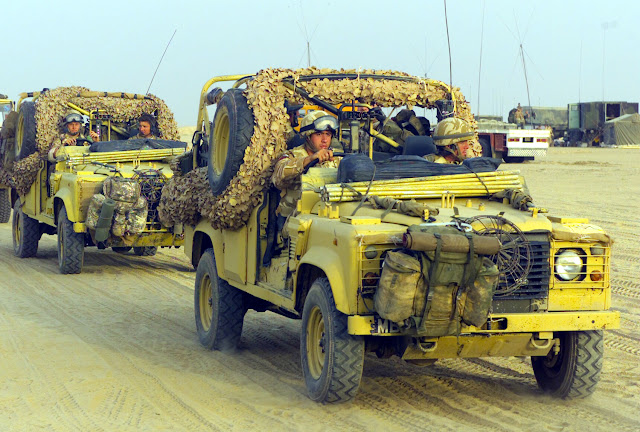
In 1994 Land Rover created the Defender XD (XD= eXtra Duty) to replace and complement these vehicles. Powered by 300Tdi engines, the XD has a much stronger chassis, with fibre webbing around the welded joints in the chassis and around stress points to massively increase load capacity. The XD was available both in Defender 90 and 110 forms and known to the British Army as Land Rover Wolves. Usually 110-inch (2,794 mm) Soft or Hard Tops, they are used for patrol, communications and supply duties. 90XDs are less common, but are generally ordered as Soft Top or Hard Top vehicles for light liaison and communications. Short-wheelbase vehicles lack the load capacity needed by modern armies, and the increased power of heavy-lift helicopters has made the larger 110s easily air-transportable- a historic advantage of the smaller, lighter 90.
Land Rover always offered its "Core" military Defenders with the 300Tdi engine rather than the more powerful but more complicated Td5 engine offered in civilian vehicles. Before the 300Tdi engine was introduced, military Land Rovers were offered with 2.5 litre petrol and diesel engines, as well as the 3.5 litre V8 petrol. Although trials with the Td5 engine proved it to be reliable in battlefield conditions, it was decided that servicing and repairing its electronic control systems should they fail was too complicated and reliant on having diagnostic computers available. Land Rover were also unable to guarantee they could make the Td5 resistant to electro-magnetic interference. The Australian Army also tested the Td5 and found it to be reliable, but was concerned that the extra performance and speed that the engine gave would result in more accidents and vehicle damage on rough tracks when driven by inexperienced drivers, so opted for the older engine as well.The British police have used Land Rovers (including the Defender) in their service for many years, they are supplied with the entire range from Land Rover itself.In 2004 a fleet of 12 Long wheelbase 110 Td5 Land Rovers were produced for the central German Government, varying between 110 Vans, 110 Hi-capacity pick-ups and 110 Station wagons. The German Government did not renew the supply contract after 2006 instead turning to Mercedes for their logistics fleet.
Vehicles produced for the German Government order were produced in metallic grey with white roofs. The electrical installation on these vehicles was a special order and kept "luxury" fittings and fixtures to a bare minimum. Four FFR equipped vehicles were produced to facilitate the VHF radios in service at that time with the German Government and Police authorities. Following the change-over to the Mercedes contract, the German Central Government sold their Td5 fleet.
With 300Tdi production stopping in 2006, Land Rover is currently gearing up production of a military version of the 4-cylinder DuraTorq engine that is also used as a replacement for the Td5 in civilian vehicles.
The British Army's Land Rovers have been the subject of criticism following recent operations in Iraq and Afghanistan. The majority of British Service Land Rovers carry no armour-plating and the composite armoured SNATCH Land Rover (originally designed to withstand small arms fire and hand-launched projectiles as experienced in Northern Ireland) is not immune to the larger roadside bomb and rocket attacks. Some have called for British troops to be equipped with Humvees, or other such vehicles. However, similar criticisms have been levelled at the American vehicle. Other proposals include the South African made RG-31 or similar larger and more heavily armoured trucks or armoured vehicles that provide greater protection.
There have been many rumours about a replacement vehicle type. This is most likely the larger, higher-capacity 4x4 or 6x6 Pinzgauer forward-control vehicle similar to the now disused Land Rover 101 Forward Control, given that the current Land Rover design is also reaching its weight limits due to the increasing amounts of communications and weapons gear used by modern patrol forces.Replacing the Defender with a new model has been in the planning stages for many years. The design is over 25 years old in its current form and, in some ways, directly evolved and updated from the Land-Rover of 1948.
New methods of building the Defender have made the model profitable again (since the 1990s, the hand-built vehicle had been made at a loss), so its replacement has been less of a priority. Total replacement will be needed by 2015, when new regulations regarding crash safety for pedestrians will render the current design obsolete.
At present, the Defender does not meet the safety requirements for the USA, and only small batches of specially modified (and very expensive) vehicles have been sold there in the past. A replacement vehicle will almost certainly be designed to be legal in America.
A press report by Autocar stated that the replacement, being developed within Land Rover as Project Icon, will be launched in 2012.






 CJ-1

 Transmissions
 The Jeep CJ-8 was a long wheel-base version of the CJ-7, introduced in 1981. It featured a 103-inch (2,616 mm) wheelbase and a removable half-cab, creating a small pick-up style box instead of utilizing a separate pickup bed. Only 27,792 were built in the five years of production before being replaced by the similarly sized Comanche.
 CJ-8s used the traditional transfer case and manual front-locking hubs to engage the four-wheel drive. Most had a four- or five-speed manual transmission, but a three-speed automatic transmission was an option.
 A full length steel hardtop CJ-8 was made for the Alaskan Postal Service, using right hand drive and automatic transmissions. Instead of the rear tailgate, the steel hardtop utilized a hinged barn door opening to the back. There were only 230 produced and sold in the U.S. It was also widely sold in Venezuela and Australia as the CJ8 Overlander, with small differences including full length rear windows on the Overlander.[22] Steel hardtops used on these postal Scramblers and Overlanders were known as "World Cab" tops.


